"Man is the monster he fears"
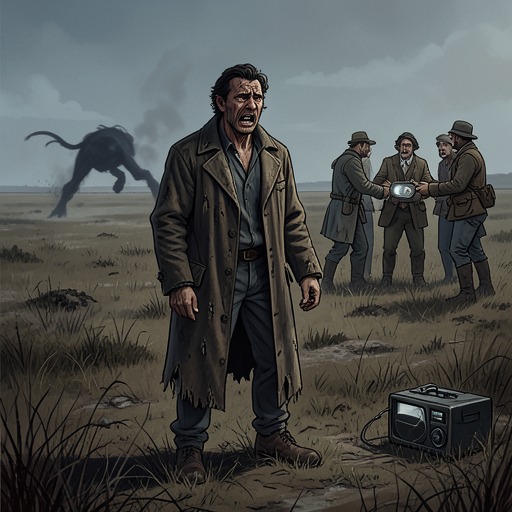
Bird Box“MAN IS THE CREATURE HE FEARS” is the central maxim in Frank’s notebook: the claim that people may create their own ruin by accepting fear as truth. The idea begins as Frank’s private theory about the creatures and the human mind, then reappears in Gary’s arguments inside the house. Its force lies in its ambiguity: it challenges the household’s rules of survival, but Gary’s confidence in it helps lead Don to remove the coverings that keep the creatures outside.
Frank’s theory
Frank’s notebook presents the creatures as a test of human comprehension. Frank argues that the effects of an encounter may differ from person to person according to each individual’s mental capacity, and describes the other housemates as more vulnerable to the rules they have attributed to the creatures. He treats his own supposed resistance as proof of his theory, setting his confidence against the fear that governs the others.
The notebook’s account does not establish that Frank is right. Instead, it records his belief that people have been told they will go mad if they see the creatures and then succumb to that expectation. His conclusion, written as a forceful repeated assertion, is that people bring about their own fear and thereby become the threat they dread. The distinction between an actual danger and a belief that intensifies danger is the theory’s central uncertainty.
Gary and the notebook
Malorie discovers that Gary has Frank’s notebook, although Gary had said that Frank took it with him. The pages are meticulously written, with sentences running left to right, right to left, and down the page; later lines form spiral patterns. This unusual organization makes the notebook’s ideas visible as well as verbal, but Malorie’s discovery also gives the text a concrete consequence: Gary has not merely repeated Frank’s theory. He possesses Frank’s private record and conceals that fact from the household.
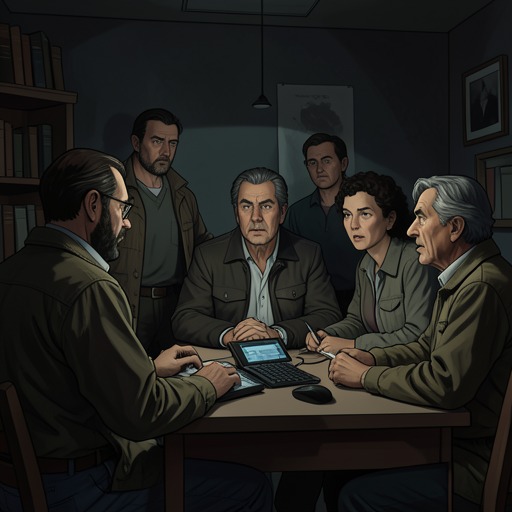
Malorie eventually tells the housemates that she found the notebook in Gary’s briefcase and recalls that Gary had described it as the notebook Frank took away. The disclosure changes the discussion from an abstract disagreement about fear into a question of Gary’s credibility. Tom turns toward Gary, and the room falls silent. When Tom asks what the group should do, Cheryl immediately says Gary has to go; Tom begins a vote. The maxim thus becomes entangled with the community’s practical judgment of the person advocating it.
Testing the idea against danger
The household has reason to be cautious about claims that the creatures cannot enter or harm them. Earlier, when the ground is exposed in the cellar, Tom observes that if the creatures truly wanted to enter the house, they could already have done so. His remark does not resolve what the creatures want or how they act; it underscores that the survivors are reasoning from incomplete evidence. Later, Tom drinks from the well because he is thirsty, not because he wants to be a champion. His choice likewise keeps immediate experience distinct from a grand claim about immunity or courage.
Tom’s uncertainty also appears in discussion of animals and madness. Olympia suggests that animals might be unable to go mad because their brains are too small. Tom considers whether animals lack the capacity to lose their minds, or whether the creatures affect people differently according to their intelligence. He also wonders how they affect people who are already mentally ill. These questions do not support Frank’s certainty; they show the household trying to understand effects that it cannot safely observe directly.
From argument to consequence
During the births, Gary presents two possibilities: either his philosophies are correct, or he is immune. The alternatives make plain what his reasoning cannot settle. His theory might explain why some people respond differently, but his claim of immunity remains a claim, not a confirmed fact. At this moment Malorie asks him to leave her alone, and his speculation offers no relief from the immediate crisis.
Soon afterward, Gary identifies Don as trying to persuade the others with what Gary has taught him. Don removes the coverings, believing that the creatures cannot hurt them. The repeated statements that Don pulled the coverings down connect Gary’s influence to the household’s exposure: Frank’s maxim has moved from notebook, to Gary’s persuasion, to an action that puts the group at risk. The evidence does not prove that Frank’s theory is true or that fear alone explains the creatures’ effects. It does show the danger of treating a speculative interpretation as established protection.
Significance
The maxim matters because it turns fear into both a subject of debate and a force that can alter behavior. The survivors’ precautions may be based on incomplete knowledge, but abandoning them on the strength of Gary’s argument is no less uncertain. The notebook’s claim that people make their own fear therefore carries an irony: in trying to reject fear, Gary and Don act on an unverified belief about safety, with consequences for everyone in the house.
The story keeps the question unresolved rather than confirming either side of the argument. Frank’s writing insists that expectation helps produce madness; the household’s need for coverings reflects the possibility that the danger is real. Between those positions, the maxim functions less as a settled explanation than as a warning about certainty: fear may distort judgment, but confidence in an appealing theory can distort it too.