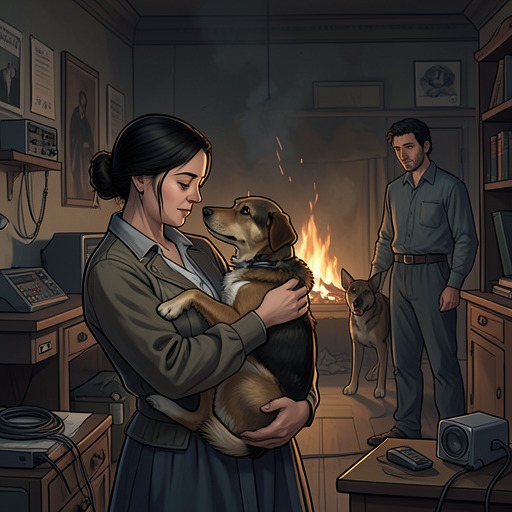
Animal madness after exposure
Bird BoxAnimal madness after exposure is an uncertain but consequential part of the creatures’ threat: animals may be companions, potential guides, or warnings, yet their responses to the crisis cannot be predicted. The contrast between Victor’s place in the survivors’ household and his later loss of control, followed by the birds’ attack on the river, makes animal behavior another source of danger in a world where sight is already unsafe.
Animals in a World Under Blindfolds
The survivors’ dependence on animals begins with ordinary companionship. When Malorie first enters the living room, a border collie approaches her and waits at her feet to be petted. Jules identifies him as Victor, six years old, and says he has had the dog since he was a puppy. Malorie pets him and thinks that Shannon would have liked him. The encounter gives Victor a familiar place in the household: he is not initially a threat but a living connection to the people and routines Malorie has lost.
Animals also figure in plans for travel beyond the protected house. Tom proposes that the survivors wear protective helmets over their blindfolds, carry butcher knives, and let dogs lead them. His plan includes a contingency: if a dog goes mad, they are to release its leash and defend themselves if it attacks. The proposal treats a dog both as a possible guide and as a risk that may have to be managed. It is a plan made under uncertainty, not proof that animals can safely navigate the world.
Victor’s Change
The possibility raised in Tom’s plan becomes immediate when Victor encounters something in the cellar. Malorie wonders what he saw, but the text does not identify the stimulus or establish precisely what animals perceive. It expressly leaves unanswered how animals are affected. What follows is nevertheless clear: Victor produces a growl Malorie has never heard from him, and he cannot stop. She remembers Jules’s deep attachment to the dog and recognizes Victor as her last link to the housemates.
As Victor continues to lose control, Malorie keeps her distance and listens from the carpeted stairs. She hears him move violently, soil himself, and snap at empty air. The episode strips away the security implied by his familiar presence in the living room: a dog once welcomed and cared for within the household has become dangerous without Malorie being able to see what prompted the change. Her apology that they came there comes amid the fear and grief of confronting a companion she can no longer reach or calm.
Birds on the River
The river journey extends the danger beyond the house and beyond Victor. Malorie feels a tiny broken bird in the rain and understands that birds in the sky are attacking one another. She tells the children to cover their heads and hold on to their blindfolds. Then birds fall in great numbers around and onto the boat, striking Malorie and filling the water around them. The attack turns the sky and river—parts of the route on which the family depends—into sources of immediate peril.
Unlike Victor’s episode, the attack of the birds is visible to Malorie only through its consequences: she recognizes a dead bird by touch and understands what is happening above her without looking. The scene preserves the limits of the survivors’ knowledge while establishing that the animals are not merely reacting as helpers or warning signals. They are themselves caught in the catastrophe, and their behavior can threaten people who are trying to travel under strict blindfold rules.
Uncertainty and Survival
The narrative does not offer a settled account of why animals become violent, whether all species are affected in the same way, or what Victor encountered. Malorie’s unanswered question and the explicit acknowledgment that the survivors never found out how animals were affected keep the cause open. The episodes establish effects, not a complete mechanism: Victor loses control after an unseen encounter, and birds attack one another before their bodies strike the boat.
That uncertainty changes the practical meaning of relying on animals. Dogs may be considered as guides, as Tom’s proposal shows, but the plan already anticipates that one could go mad and attack. Victor’s transformation makes the contingency personal, while the birds’ fall demonstrates that animal danger can arrive on a larger scale and in the middle of a journey. Together, the episodes deny the survivors a dependable boundary between companion and threat. Animal behavior remains part of the same unmastered crisis that makes sight dangerous and survival dependent on cautious, incomplete knowledge.