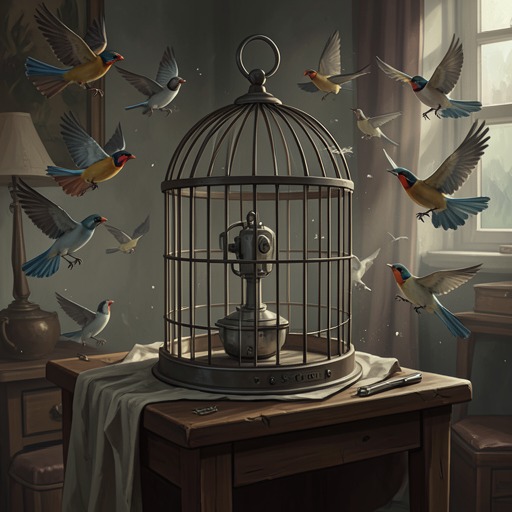
Birds
Bird BoxBirds are among the few animals whose sounds can help people survive without sight, but their usefulness is never guaranteed. In the safe house, a small group of live birds becomes an alarm system that can be heard from inside; later, birdsong marks the river’s apparent return to ordinary life, then falls silent and grows unnaturally loud. When a dead bird reaches Malorie’s fingers, the birds cease to be reliable background signals and become evidence that the surrounding world is in turmoil.
Sound in a Sightless World
On the river, birds are part of the soundscape Malorie must use in place of vision. As the morning advances, she hears birds singing in the trees, alongside the sounds of animals moving through the woods and fish jumping in the water. The contrast is central to her journey: she hears a lively environment but cannot see it, and each sound must be interpreted without visual confirmation.
Malorie has spent years preparing the children to listen. When they were babies, she carried them blindfolded to the edge of the woods and described the sounds there. As they grew, she trained them to distinguish sounds, while acknowledging that her own hearing was less finely developed: she had been twenty-four before she could tell a raindrop from a tap on a window by sound alone. The children’s listening is therefore not a natural gift she can simply assume; it is a survival skill she has deliberately cultivated, with birdsong among the environmental signals they must learn to interpret.
The river makes this dependence precarious. Malorie thinks of it as an amphitheater, a place where sounds carry, but also as a grave. The children must listen into the trees, wind, and riverbanks because the world around them may contain danger they cannot see. Birdsong can reassure her that life continues, but the same reliance on sound leaves open the possibility that a change in the birds’ voices will carry a warning.
The Safe-House Alarm
Before the river journey, birds serve a deliberately practical purpose at the safe house. Tom returns from an expedition carrying a white box large enough for a small television. It contains live birds found in a hunter’s garage; the survivors do not know what kind they are or how they endured, though they suspect their former owners left them ample feed.
The birds respond to the people approaching the box: the closer the survivors get, the louder the birds become. Tom and the others have tested this reaction, and Jules proposes hanging the box outside by the front door so the household can hear it from within. The birds are not simply food, as Felix initially wonders, but an audible alarm. Their voices can extend the housemates’ awareness beyond the covered windows without requiring anyone to look outside.
This device turns animal behavior into an improvised part of household security. Unlike an electronic warning system, the box depends on the birds’ living presence and their response to nearby people. To Malorie, it feels like progress, though the solution remains modest: the birds can announce proximity through sound, not explain what is outside or guarantee that every threat will be detected.
Silence, Return, and Alarm
On the river, the birds’ changing sound becomes a pattern Malorie watches through hearing alone. At one point, the birds in the trees go quiet. Malorie holds her breath and thinks of the children, uncertain about what is beside the boat. Later, the birds begin singing again, and the return of their songs allows her to resume paddling. The sequence offers a temporary easing of tension without confirming what caused the silence.
That uncertainty matters because ordinary animal sounds are among the few available ways to judge the surrounding world. When the birds sing again, the apparent continuation of life provides some reassurance; it does not give Malorie direct knowledge of what is nearby. The sounds function as clues, not proof, and the river’s hazards remain beyond sight.
Later, birds in the branches above the boat are cooing so loudly that the Girl says she cannot hear. Malorie stops rowing and asks the children what the birds sound like to them. The change reverses the earlier problem: instead of silence that leaves Malorie listening for danger, the birds’ abundance becomes noise that overwhelms the children’s ability to listen. The sound no longer offers a clear signal; its intensity obstructs the very skill Malorie has taught them to depend on.
Birds as Warning and Vulnerable Life
The decisive change comes when the Girl shrieks and Malorie finds something between her fingers: not a raindrop but the broken body of a tiny bird. Without looking at the sky, Malorie understands that birds above them are fighting and killing one another. The bird’s body makes the invisible disturbance tangible, while the birds’ earlier loudness gains a new, troubling significance.
This discovery complicates the birds’ earlier role as dependable alarms. Their calls had helped the household detect approach and had served as part of the natural soundscape by which Malorie navigated the river. Now their own behavior signals disorder. The animals are not merely instruments for human safety: they are living creatures affected by the same dangerous world, and their distress can itself become a warning.
Birds thus connect the enclosed safe house to the exposed river. In the house, a box of birds gives the survivors an audible perimeter alert; on the river, free birds provide signs of life, fall silent, return to song, and finally become so loud that their calls impede listening. Their changing voices carry information, but never certainty. Their final state, inferred from the small body in Malorie’s hand rather than seen directly, shows both the power and the limit of a sound-based survival system: listening can reveal that something is wrong, even when it cannot make the danger visible or controllable.