Four years
Bird BoxFour years is the measure of Malorie and the children’s blindfolded confinement in the Riverbridge house: a span in which protection becomes routine, routine threatens to become a life sentence, and the possibility of escape grows more urgent. The children have never seen the world outside—not even through a window—and Malorie has not looked in more than four years. The interval is therefore not simply time survived. It is a closed world whose shelter keeps the creatures at a distance while raising the question of what kind of life can still be protected within it.
A House Made into a Refuge
The house was once a family-ready home in a Detroit suburb. Now its windows are covered with cardboard and wood, its cupboards are bare, and the household has no running water. A wooden bucket stands on the kitchen counter; pieces of a chair, carved into little people and painted with small faces, take the place of ordinary toys. Wires from beneath the back door run to amplifiers in the first-floor bedrooms, allowing Malorie and the children to hear sounds outside. They stay indoors for long periods and, when they go out, wear blindfolds. The children’s entire knowledge of the world is shaped by this arrangement: they have never seen beyond the house, while Malorie’s last sight of it lies more than four years in the past.
That protection is also a geography of remembered danger. Malorie recognizes the kitchen, foyer, sink, and living room as places where the former household’s people and routines once gathered: Tom spoke with her near the cellar stairs, Don carried well-water buckets by the sink, and Cheryl prepared food for the birds in the foyer. The living room is now silent, crowded in Malorie’s memory with people she cannot absorb all at once. In the house, the past persists not as a safe homecoming but as a series of absences mapped onto familiar rooms.
Even the routes through the house encode the cost of surviving there. A couch has been shifted to cover marks that Malorie thinks resemble wolf heads; musty coats conceal deep purple scratches beside the attic stairs, and a black stain remains farther along the second floor. She cannot bring herself to cross that end of the house. The interior is thus neither wholly secure nor freely inhabitable: its coverings and barriers offer protection, while concealed marks and avoided spaces make fear part of domestic routine.
The Weight of the Interval
The four-year duration returns to Malorie as a thought she can scarcely contain. Sitting in a kitchen chair, she taps a bare toe against faded linoleum and wants to smash her fist through the wall. The impulse registers the strain of confinement, but the sharper fear is what comes next. Four years can become eight, she knows; eight can become twelve. By then, the children would be adults who had never seen the sky or looked through a window. Malorie wonders whether the clouds might become unreal to them, and whether the only place they would feel at home would be behind their black blindfolds.
Her concern reaches beyond whether the children can obey instructions or survive a dangerous outing. At four, they are already trained to listen and might help navigate a boat by sound; Malorie depends on their ears, and considers whether she should also trust their advice about when to leave. But the thought of asking them cannot make the decision theirs to bear. They may be too young for the journey, the October cold, or the possibility of falling into the river. An accident, after all the struggle to survive, could kill them without any encounter with the creatures. Waiting for warmer weather might reduce some risks, yet waiting also leaves open the prospect that the household’s temporary refuge will become their whole childhood.
The interval’s time is measured against Malorie’s own capacity to go on. She imagines raising the children alone until they are teenagers, then wonders if she can protect them for another ten years—and what sort of life such protection would preserve. The question is not whether she loves them enough to endure hardship; the evidence of years spent guarding and training them is already there. It is whether survival without a horizon can still serve the children it is meant to save.
Listening as Training and Risk
The children’s education has been shaped by the danger that makes sight unusable. They learn to listen so attentively that Malorie sometimes experiences their development as frightening: they seem to her like small monsters who can hear a smile and detect her fear before she has recognized it herself. That description conveys the cost of turning childhood into sensory training. The children’s patience and skill help make their mother’s survival possible, but those capacities have been cultivated under conditions in which ordinary play and vision are withheld.
The same discipline governs journeys outside. During the river escape, rowing blindfolded proves harder than Malorie expected. The boat repeatedly strikes the banks and remains stuck for minutes. In those pauses, she imagines unseen hands reaching for the children’s blindfolds, fingers rising from mud where river meets land. The children do not scream or whine; their patience is itself part of the training that makes the journey possible. When the Boy stands to push the rowboat loose against a mossy trunk, Malorie can paddle again. Birds singing, animals in the foliage, and fish splashing are all registered by sound, while nothing is seen. The river turns their practiced listening into a means of movement, but every delay also leaves Malorie alone with the threats her imagination supplies.
A smaller excursion to the well shows how thoroughly the same rules extend into daily work. Felix carries one of the household’s six buckets, a heavy wooden one with a black iron handle that he likes because it keeps him grounded. Blindfolded and tethered by a rope to a steel stake beyond the back door, he follows a path outlined by scraps of old picture frames. The frame pieces mark the limits of his route like a physical guide; when his toe touches one, he jokes that it is like the buzzer in the game Operation. Such details show how the household converts ordinary tasks into procedures, using tactile markers, ropes, and sound to make movement possible without sight.
From Confinement to the River
Malorie’s calculations about leaving are inseparable from the landscape that has held her for years. She recalls making the first decision that brought her to the Riverbridge house after answering a classified advertisement, and recognizes that every noise since then has prompted visions of dangers worse than any ordinary animal. Even a sound she tries to identify as a black bear leaves her uncertain. The habit of debating what a noise might mean has governed her actions for four and a half years, extending beyond the four-year confinement itself and showing how the interval is shaped by constant suspicion rather than by passive waiting.
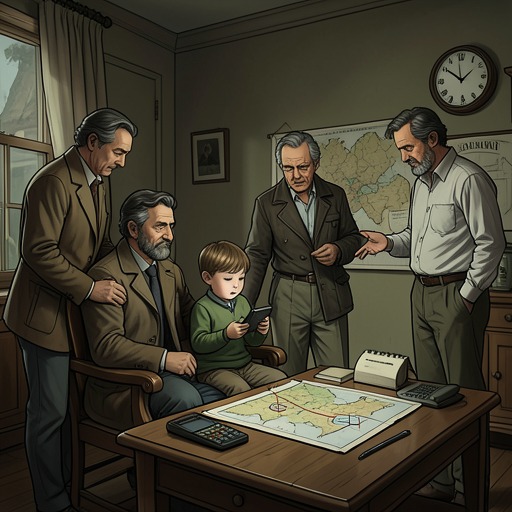
When the escape plan becomes concrete, its scale is stark. The river is eighty yards behind the house, the caller tells Malorie, but the route will require at least twenty miles of travel and include a split in the river. He describes the journey as extraordinarily dangerous, while judging that Malorie and Tom have already demonstrated the ability to attempt it. The house has offered a bounded form of safety; the river offers a route out that also exposes the family to water, disorientation, and the possibility of accident. The movement from house to boat therefore does not cancel the four years of confinement. It converts the capacities built there—blindfolded movement, listening, and the children’s trained attention—into the means of risking a different future.
Meaning of Four Years
The span gives the novel’s survival practices a double meaning. Blindfolds and amplified sounds are not merely devices for avoiding direct sight of the creatures; they organize the children’s upbringing, the family’s movement, and the limits of what counts as a home. The same house that keeps the family inside also risks making the outside world unimaginable. The same listening that equips the children to help navigate a boat reflects how much ordinary childhood has been reorganized around danger.
Four years consequently marks a threshold rather than a settled achievement. Malorie’s exasperation at the kitchen table and her fear of eight or twelve years reveal that endurance alone cannot answer the question of what the children’s lives are for. Yet leaving does not promise safety: the twenty-mile river route and its branching course make clear that escape is another exposure to risk. The interval’s decisive consequence is this tension. The refuge has kept the family alive, but its continuation threatens to turn protection into permanent confinement; the journey begins when Malorie must weigh that danger against the dangers beyond the covered windows.