Frank's notebook
Bird BoxFrank's notebook is a document of theory, obsession, and concealed authorship: Malorie discovers that Gary wrote it, despite his claim that Frank had taken it, and its pages reveal how Gary turned an argument about fear into a justification for removing the house's protections. The notebook matters not only for what it says about the creatures, but because its existence and contents expose the gap between Gary's public account and his private actions.
Appearance and Discovery
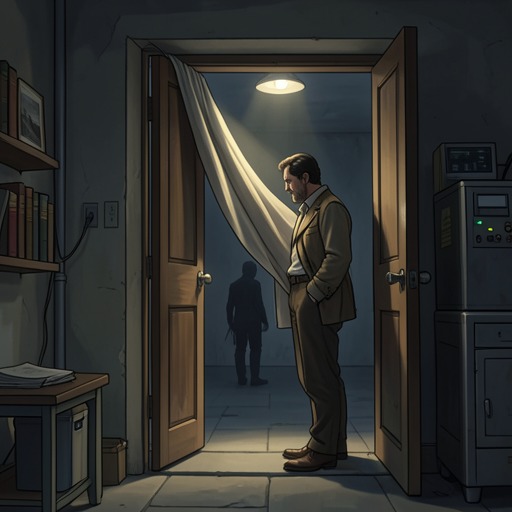
Malorie finds the notebook beneath clothes while Gary is elsewhere in the house. Its blue cover is clean, its edges unbent, and its unusually good condition makes it seem carefully preserved. She opens it and reads while keeping watch on the cellar door; the possibility that someone might come down the stairs makes the act of reading part of an immediate confrontation, not a detached investigation.
The writing is exact and meticulously composed. Its form changes as Malorie turns the pages: some sentences run conventionally from left to right, others from right to left, and others descend from the top of the page. Later, sentences spiral into orderly patterns made of words. The notebook's visual intricacy suggests sustained work, while the orderly execution contrasts with the increasingly extreme claims within it.
Gary's Theory of the Creatures
The notebook argues that a person's mental capacity determines how an encounter with the creatures affects them. Its writer claims that people differ in their capacity to comprehend the creatures and therefore in their susceptibility to what others call their rules. The writer describes the other people in the house as intellectually inferior and likely to die, while presenting himself as someone who has already proved his own point. The passage establishes a theory of personal exception: the writer treats his supposed intellectual superiority as evidence that he can withstand what others cannot.
A later entry turns from the creatures to human responses. It asks why people hide behind blankets and blindfolds as the world collapses, then presents their expectation of madness as the cause of their madness. The notebook's repeated claim that people bring the danger upon themselves culminates in the formula that man is the creature he fears. This conclusion does not establish that the external threat is unreal; it reveals the writer's conviction that fear and belief have become forces in their own right.
From Argument to Action
The notebook records an intended experiment in persuasion. Its writer says he must keep writing until he can convince himself to act, and that proof, rather than discussion, is necessary to change the minds of people who refuse discourse. The proposed proof is explicit: remove the drapes and unlock the doors. Numbered marginal notes preserve the scale of the fixation; Malorie sees entries numbered 2,343 and 2,344, part of what the narrative describes as ceaseless, endless work.
That plan gives the notebook practical stakes. Its argument about fear is not merely speculative: the writer proposes dismantling the barriers that protect the house in order to demonstrate his belief to others. The document therefore links an abstract theory to a concrete threat, showing how conviction can become a rationale for endangering the people the writer dismisses as incapable of understanding.
Authorship and Exposure
Malorie recognizes that the notebook is the one Gary had discussed as Frank's, including the account of tearing down the blankets. The preserved book makes that story untenable. She understands that Gary wrote it and that Frank did not remove the drapes at Gary's former home; the notebook's authorship exposes Gary's earlier explanation as a lie.
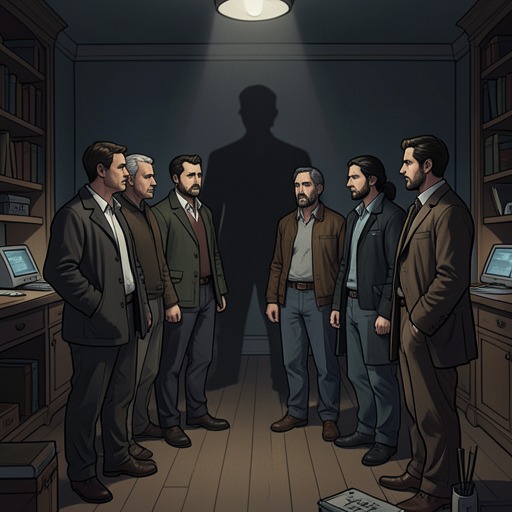
Malorie brings the discovery before the household. She tells the gathered housemates that she searched Gary's briefcase and found the notebook he had said Frank took. The room falls silent, and Tom turns his attention from the rum bottle he is holding to Gary. When Gary opens the briefcase and produces the notebook himself, he admits that he has it. Felix challenges him over keeping a souvenir from someone who endangered their lives.
Gary offers a different account of why he kept it: he says he wanted to understand what Frank had been thinking, since he had lived with Frank for weeks without suspecting what Frank was capable of. He says he retained the notebook as a warning, both against beginning to think like Frank and against the others doing so. But that explanation does not resolve the central contradiction. Malorie points out that Gary had told them Frank took the notebook, while the book she found in Gary's possession contains Gary's own writing and his plan to expose the household to danger.
Significance
The notebook operates as both a physical clue and a record of escalating belief. Its pristine cover and elaborate, controlled handwriting give material form to the care with which its writer preserved and developed his argument; the numbered notes, changing directions, and spiraling sentences make that sustained fixation visible without making its conclusions reliable. Its status as a kept object also changes: what Gary could present as a report about Frank becomes evidence against Gary when Malorie finds it and brings it into the open.
Its central irony is that the notebook condemns people's fear as self-generated while documenting a plan that could expose them to the danger they fear. Gary's claim that he kept it as a cautionary object sits beside his concealment of its authorship and his earlier account of who possessed it. In this way, the notebook connects the household's physical defenses to a conflict over trust: it records not only an argument about what the creatures are, but the danger of allowing certainty to override the evidence of what a person has done.