Gary’s claimed immunity
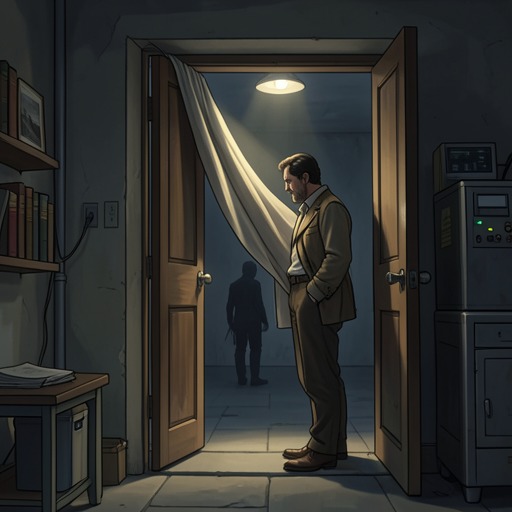
Bird BoxGary’s claimed immunity is an explanation for the creatures’ effect on people that challenges the survivors’ central rule: that seeing them brings madness. He argues that expectation, not the creatures themselves, produces the apparent insanity, and presents his own survival after looking at one as evidence that he may be immune—or may understand the phenomenon better than everyone else. The claim offers a radical alternative to blindfolded survival, but the circumstances in which Gary advances it make it inseparable from suspicion, coercion, and catastrophe.
The Theory Before It Becomes Personal
When Gary first tells the housemates about a former housemate, he describes that man as troubled and says he believed the creatures were not harmful. The former housemate’s argument was that people’s reaction was psychosomatic: in Gary’s account, the insanity was not caused by the creatures, but by people who saw them and then reacted dramatically. Tom has already been explaining the house’s history to Gary, including the supplies in the cellar, its hydroelectricity, the lack of a phone book, and George’s death. Gary’s theory enters this conversation as part of his account of another person’s ideas, but its phrasing immediately raises doubt about whose position it really represents.
Malorie notices the dismissive expression used for the survivors’ terror and wonders whether it belonged to the former housemate or to Gary himself. That uncertainty matters: the theory is not presented as a detached hypothesis but as language Gary may already share, or may be using to distance himself from it. He can attribute the argument to someone else while introducing the possibility that the community’s basic understanding of the danger is mistaken.
Frank’s Notebook and the Logic of Immunity
Malorie later finds Frank’s notebook in Gary’s possession and reads its increasingly elaborate pages. The writing changes direction and arrangement, moving from ordinary lines to reversed and downward-running sentences before forming spirals and patterns. The notebook’s argument is not simply that people exaggerate their fear. It proposes that the creatures’ effects differ according to the limits of the mind encountering them: one person’s mental capacity may have a different ceiling from another’s, while the other inhabitants are characterized as more susceptible to the rules they have assigned the creatures.
The notebook turns this hierarchy into an assertion of superiority. Its writer dismisses the others as intellectually lesser and claims to have proved his point, then argues that people go mad because they were told they would go mad. Its repeated declaration that people do it to themselves culminates in the idea that humanity is the creature it fears. The argument makes fear both the explanation for collapse and a trap the survivors may reinforce by accepting the warning that sight means madness.
The notebook’s authorship changes the significance of what Malorie has found. It is not merely a document Gary has acquired from another man: Gary wrote it. The claim that had been introduced as a former housemate’s outlook is therefore connected directly to Gary’s own written philosophy. The meticulous, patterned pages give that philosophy a material presence, but the notebook’s certainty does not establish that its account of the creatures is true.
Gary’s Firsthand Case
During the births, Gary presses the theory on Malorie while she is in pain and asks to distract her with a story. When she begs him to leave her alone, he still frames the situation as a test of his beliefs: either his philosophies are right, he says, or he is immune. His words place a possible explanation for the crisis beside a claim about himself, even as Malorie is struggling to give birth and Olympia is in grave distress.
Gary later insists that he spent seasons outside, watching the creatures for weeks at a time. He says the first time he saw one he thought he had gone mad, but that he remained of sound mind; only afterward, he claims, did he understand what had happened to his friends, his family, and everyone else. This is his central personal evidence: he says he saw a creature, experienced fear, and did not lose his sanity. Yet the account remains Gary’s testimony, not an independently confirmed demonstration that the creatures are harmless or that his response can be generalized to others.
He finally leaves the distinction unresolved even in his own formulation: perhaps he is immune, or perhaps he is simply aware. Immunity would make him an exception to the danger; awareness would make him someone who has correctly understood a danger others misread. The alternatives allow him to present himself as exceptional either way, while leaving the actual cause of the survivors’ madness unsettled.
Consequences and Narrative Significance
Gary’s theory attacks more than the survivors’ explanation of madness. If belief in the danger helps cause it, then blindfolds and rules may appear to perpetuate a collective delusion; if Gary is wrong, rejecting those precautions exposes people to precisely the danger the community has organized itself to avoid. The argument therefore offers no safe experiment. Its plausibility depends on testimony and interpretation, while testing it risks irreversible harm.
The story sharpens that conflict by placing Gary’s confident explanation within the house’s violent unraveling. As the women are in labor, he continues speaking; Malorie hears the dogs howling and believes she can hear Jules rushing below and trying to tear something apart. She thinks of how much safer Gary might have made them if he had shared useful knowledge, but concludes that he is mad. The scene does not prove which theory about the creatures is correct. Instead, it shows the human cost of Gary’s certainty: a potentially important account of survival arrives too late, under circumstances that make trust in its speaker impossible.
Gary’s claimed immunity thus remains a claim rather than a confirmed condition. Its narrative force lies in the collision between an apparently rational challenge to accepted knowledge and the danger of acting on an unverified explanation. He converts survival into evidence for his exceptional insight; Malorie’s experience of his timing and conduct makes that same certainty feel threatening. The question of whether the creatures cause madness or reveal something already within their observers stays open, while the house’s defenses and relationships collapse around the argument.