Global creature catastrophe
Bird BoxThe Global creature catastrophe is an unexplained worldwide crisis in which people who see mysterious creatures become violently deranged or kill themselves. Its decisive force lies not only in the unseen threat but in the collapse of reliable knowledge and public order: survivors must organize life around avoiding sight, even as the institutions and communications that might explain events disappear.
Reports and the arrival of the crisis
The crisis first reaches Malorie through reports that seem distant and disconnected. Online accounts from Russia describe a passenger attacking a driver on a snowy highway outside St. Petersburg, a mother in Yakutsk burying her children alive, and an axe-wielding man in Omsk filmed attacking someone who remains unseen. The stories spread rapidly across social media, but their accumulation gives them a weight no single report could carry. Malorie stops following the coverage, while Shannon continues relaying it; when Shannon reports another incident in Alaska, the catastrophe has crossed from foreign news into the United States.
Gary later recalls how the Russian reports affected his former household. His brother Duncan’s friend Kirk treated the stories as confirmation of his conspiratorial beliefs and urged people to gather at his home. Gary initially resisted, even after the reports worried him, until the Alaska incident made the threat feel close. In the story he recounts, two elderly sisters are found trying to bite people outside a hospital; a woman who goes to help them is killed, and police shoot the sisters. The ordinary setting and familiar people make the account especially disturbing to Gary, while Kirk takes it as validation of an invasion and begins preparing for armed confrontation.
A threat without an explanation
The reports establish a recurring pattern of self-destruction and violence, but do not establish what the creatures are or how they affect people. News coverage gives the crisis the name “The Problem”; Fox News cycles through terms such as “self-destruction” and “self-immolation,” while an anchorman’s phrase “personal erasing” fails to catch on. The shift in vocabulary registers an effort to describe events that remain poorly understood. Government instructions, meanwhile, are concrete: observe a national curfew, lock doors, cover windows, and do not look outside.
The difference between the clarity of the warnings and the absence of an explanation shapes the survivors’ choices. At the communal house, Tom argues that if the creatures truly wanted to enter, they could already do so, since the exposed patch of cellar wall has not become an entry point. His reasoning offers no proof of safety; it instead marks the limits of what the household can infer from the creatures’ behavior. Later, Olympia suggests that animals may lack the capacity to go mad, while Tom wonders whether intelligence is required to lose one’s mind. Their speculation leaves open whether the danger affects animals as it does people.
Institutions and information fail
The catastrophe progressively strips away the systems that once connected private life to the outside world. When Malorie arrives at the communal house, Tom explains that there is no Internet, mail, or newspaper; cell phones stopped working weeks earlier, and the residents suspect that people responsible for the cell towers have stopped working or died. A landline still functions because a local hydroelectric plant supplies power. Running water has already failed, so the residents draw from a well and carry waste to latrines dug in the woods. Their survival depends on a river and power infrastructure whose continued operation they cannot guarantee.
Radio becomes the household’s last regular link to events beyond its walls. After Malorie has lived there for two weeks, the residents still listen to Rodney Barrett, the remaining radio DJ, although he has no new information, rambles, swears, and sometimes falls asleep on air. The value of his broadcast is no longer primarily news: his voice itself maintains a connection to a world that has otherwise fallen silent. The contrast between that fragile human presence and the house’s vault-like isolation makes the loss of communication tangible.
Private rules and contested decisions
With public systems failing, protection and governance move into the household. A knock at the door is not a routine request for help: when Felix approaches it, Don grabs his arm and warns him not to open it casually. Later, faced with another decision about whether to open the door, one resident proposes a vote, while Don insists that a single person’s refusal should be enough to keep it shut. The disagreement exposes a practical and moral problem: collective decisions may be necessary, but admitting a stranger could endanger everyone inside.
The same uncertainty governs decisions about exposure and risk. Tom volunteers to drink water from the well because he is thirsty, not because he seeks to act as a champion. His willingness makes an ordinary bodily need a public test under conditions where safety cannot be confirmed in advance. Such choices do not resolve the crisis; they show how survival depends on negotiated action when evidence is incomplete and refusing every risk may also make life impossible.
Communication remade for survival
As ordinary media disappear, sound and recording take on new purposes. At a later refuge, a motion-activated speaker by the river plays a clear recording in a repeated forty-second segment, looping for thirty minutes. Rick tells Malorie that hearing this signal will mean she should open her eyes. The recording is not a general broadcast: it is a carefully placed instruction intended to guide arrivals to a specific facility, substituting for continuous human watch at a dangerous riverbank.
The catastrophe also reframes sound as something that can be produced deliberately rather than merely received. Remembering Tom’s earlier actions, Malorie recognizes that a band needs microphones and amplifiers; the thought connects music-making equipment to the practical search for sound equipment. Across the crisis, communications shift from television and Internet reports, to a faltering radio voice, to working landlines and purpose-built recordings. The change traces the shrinking scale of shared knowledge: from global news, to a household’s last connection, to a signal designed to bring one survivor safely to one place.
Consequences and unresolved danger
The crisis changes the conditions of everyday life without yielding a settled account of its cause. The household’s electricity and landline persist because of hydroelectric power, but the failure of running water, cellular networks, print news, and Internet service shows how unevenly infrastructure collapses. Even where a system continues to work, its future is uncertain; the survivors cannot know whether the people maintaining it remain present or whether it will fail next.
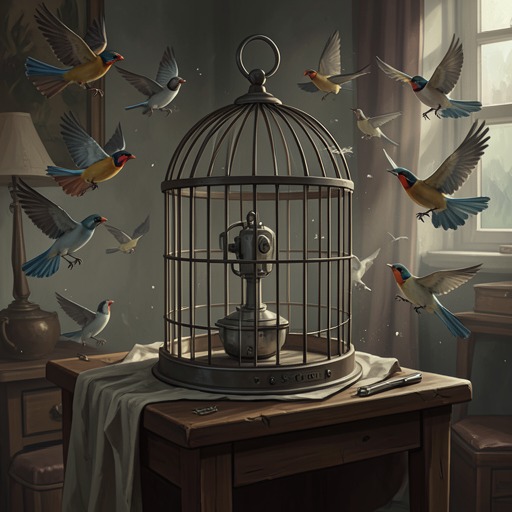
The creatures themselves remain unseen in the evidence of the catastrophe, while their consequences are unmistakable in the reports of mutilation, suicide, and violence, and in the rules built to prevent direct sight. No account confirms whether the creatures are alien, whether they affect animals differently, or whether any person is immune. The unresolved cause sustains the central danger: people must construct rules, alliances, and signals around an event they can recognize by its effects but cannot explain.