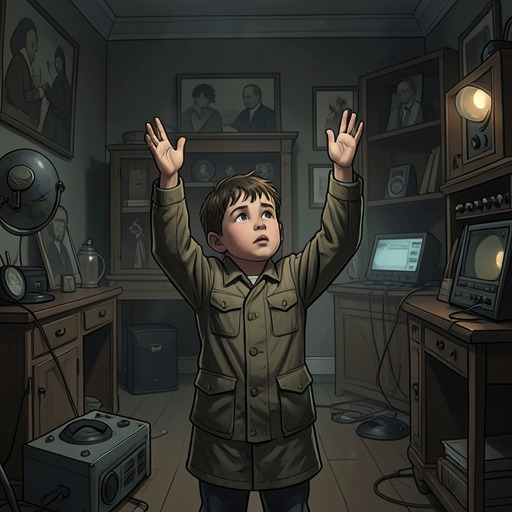
How far can a person hear
Bird Box“How far can a person hear?” is a recurring question during Malorie’s blindfolded journey down the river. It gathers the scene’s central tension: hearing lets the children learn about a world they cannot see, but it cannot make that world safe or fully knowable.
The Question on the River
As Malorie rows, the question returns between the boat’s practical setbacks and her efforts to keep moving. The rowboat repeatedly strikes the banks and gets stuck; while they wait, she imagines unseen hands reaching for the blindfolds covering the children’s eyes. Yet the children remain patient, and the Boy helps free the boat by pushing against a mossy trunk. The question follows these moments of stalled progress, making listening seem both necessary and uncertain.
Learning an Unseen World
The children have been taught from birth to interpret forest sounds. When they were babies, Malorie covered their eyes with T-shirts and carried them to the woods, describing what they could hear. As they grew, she trained them to distinguish sounds, including the difference between leaves crushed by a footstep and leaves crushed in a hand. The question of how far a person can hear therefore concerns more than distance: it also concerns how carefully sound can be interpreted when sight is unavailable.
The Teacher’s Limits
Malorie knows that her own hearing is less practiced than the children’s. She was twenty-four before she could distinguish a raindrop from a tap on a window by sound alone, and she wonders whether someone raised to rely on sight can teach children to live without it. Her question carries this doubt without answering it. She can offer lessons, but she cannot remove the danger concealed in an unfamiliar sound or guarantee that her descriptions give the children enough knowledge.
Curiosity, Knowledge, and Danger
The river journey makes the limits of such knowledge personal. The Boy loves fish: Malorie has caught them with a rusted fishing pole fashioned from an umbrella found in the cellar, and he has watched them splash in a kitchen well bucket and drawn them. Now another small splash makes Malorie fear that his curiosity might lead him to remove his blindfold. A sound that once accompanied a source of pleasure can become a threat when curiosity and sight are inseparable from danger.
Malorie needs the children to listen into the trees, wind, and dirt banks, toward a living world they cannot safely see. She thinks of the river as an amphitheater, but also as a grave. That contrast gives the repeated question its unresolved force: the river carries sounds that help them orient themselves, while also reminding them that listening cannot disclose everything waiting around them.