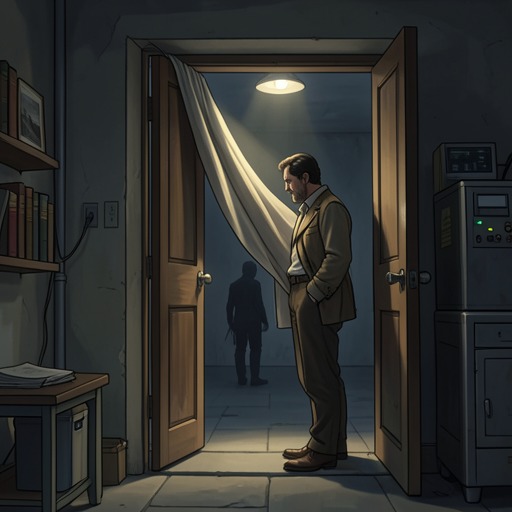
Kirk
Bird BoxKirk is an early believer in the creatures whose certainty gives him a commanding role in the household where Gary once sought shelter. In Gary’s account, Kirk responds to the emerging catastrophe not by hiding alone but by assembling men and imagining an organized fight against an invasion. His self-appointed authority and the group’s rehearsals turn fear into a performance of preparedness, while Frank’s writings offer a disturbing counterpoint: the men dismiss the one person who believes the creatures are no threat, even as his notebooks reveal a different, dangerous extremity.
Identity and Background
Kirk is Duncan’s friend and, in Gary’s recollection, one of the early believers in the reports about the creatures. Gary links that conviction to Kirk’s existing conspiracy theories and paranoia that the government or someone else was targeting the public. When Kirk proposed that people gather at his place for a few days, or until they learned more, he presented the catastrophe as an urgent danger requiring collective preparation.
Gary contrasts Kirk’s certainty with his own resistance to accepting the new reality. The reports worried Gary, but he tried to maintain disbelief until news from Alaska brought the crisis close enough to overcome his reluctance. Kirk, by contrast, had been convinced from the start. The difference establishes the basis of his influence: in a period defined by uncertainty, he acted as though he already knew what the threat meant and what response it demanded.
The Household and Its Militia-Like Turn
After the Alaska report, Kirk interpreted the incident as confirmation of his paranoid expectations. He began making plans to combat what he called an invasion, although Gary says it was never clear whether Kirk believed the invaders were aliens or something else. Kirk spoke about weapons, equipment, and guns with the manner of a veteran soldier, despite never having enlisted.
The house soon filled with what Gary describes as quasi-militant men. Kirk enjoyed his new position as their general, while Gary watched from the sidelines and warned Duncan to keep his distance. Gary believed Kirk might send his friends into harm’s way. The men became increasingly contentious, encouraged by fantasies of overthrowing the supposed villains behind the invasion. Their announced ambitions—to protect the city, eliminate the cause of the global madness, and secure a place in history—did not produce a substantive result in Gary’s account.
Kirk’s leadership also took the form of daily drills. Gary calls them useless: the men practiced target-shooting gestures in the basement without weapons. Duncan joined the group and wore camouflage paint, a visible sign of his adoption of Kirk’s outlook. Gary says that the others were, by then, truly caught up in Kirk’s ravings, while Frank’s objections were brushed aside. The drills created the image of action without giving the household a demonstrated means of meeting the danger.
Conflict with Frank and Gary’s Judgment
Frank arrived at the house because he feared the lawlessness that might overtake the country, but he believed the creatures Kirk prepared to fight were not a threat. As Kirk organized drills, Frank withdrew to an upstairs bedroom and filled notebooks with writing. Gary once saw him hunched over a desk, writing with furious persistence and muttering about the overreactive society he despised. The contrast is stark: Kirk’s followers performed military readiness together, while Frank worked alone on a written argument against their assumptions.
Gary says Frank used expressions such as “mass hysteria” and “psychosomatic idolatry” while Kirk and the others mimed target practice. The group treated him as a useless pacifist, and Duncan did not consider him dangerous. Gary, however, eventually entered Frank’s room while Frank was in the bath and read dozens of notebooks in the desk drawer. Their contents convinced Gary that Frank was dangerous: they declared the creatures harmless, described people like the others as small-minded, and called for them to be exterminated.
That discovery complicates Gary’s portrait of Kirk. Gary had regarded Kirk’s plans as buffoonery and worried that his bravado would endanger his friends, but the notebooks made him reconsider whether Duncan had been wrong to side with Kirk. Gary concludes that Frank’s writings showed him reactions to the new world worse than Kirk’s. The narrative therefore does not make Kirk’s approach a reliable answer; it sets his militarized response against another form of extremism and lets Gary’s retrospective judgment hold both dangers in view.
Narrative Role and Limits of the Account
Kirk appears in the present-day story through Gary’s account of his former household, rather than through a scene in which Kirk speaks directly. The reader receives Gary’s characterization, his recollection of the group’s conduct, and his evaluation of its failures. Kirk’s motives beyond the certainty and paranoia Gary attributes to him, and the eventual fate of his group, are not established in this account.
The episode gives Kirk a specific place in the novel’s larger pattern of decisions made under incomplete knowledge. At Malorie’s communal house, Tom argues that if the creatures could enter the house, they likely would already have done so; when the group debates whether to admit Gary, Tom calls for a vote. Kirk’s former household presents a different collective response: it treats fear as proof of an invasion and rehearses a campaign against it. Gary’s story does not settle what the creatures are or prescribe one universally safe response. Instead, Kirk’s imagined war, the ineffective drills, and the ignored warnings make visible how conviction can become social authority before its claims have been tested.