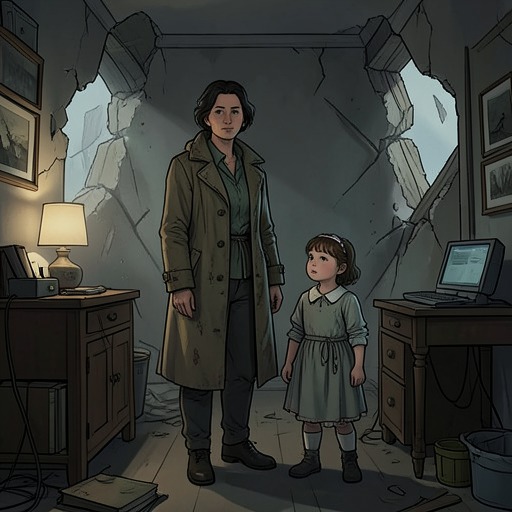
Malorie and Olympia relationship
Bird BoxMalorie and Olympia relationship is a bond formed under catastrophe and given its clearest expression at Tucker, where Malorie protects the child, recognizes her as a person with a name, and embraces her as family. Its ending joins the relief of reaching safety to the recovery of an intimate gesture that the years of survival had postponed: Malorie names the Girl Olympia, and the child smiles in response.
A bond shaped by survival
For most of the children’s lives, Malorie’s care has had to operate under severe limits. They have lived inside the house and have never seen the world outside it; Malorie’s immediate responsibility is therefore not simply to bring them somewhere safer, but to manage what they encounter and when. At the end of the river journey, she tells Constance that she has two children with her and that the three of them are alone. The statement defines their small family by its shared dependence and by Malorie’s responsibility for both children.
When Constance reaches out to help them leave the boat, she helps Malorie get the children out first. Their hands clasp as Malorie herself is pulled from the boat, making the transition a shared, physical act of rescue rather than a solitary arrival. The scene places Olympia within the family unit Malorie has carried through the journey: the children are not incidental companions, but the people whose safety determines what Malorie is willing to do next.
Protection at Tucker
Arrival does not immediately dissolve Malorie’s fear. Constance tells her that it is safe to open her eyes, but Malorie refuses to let the children be exposed before she has faced the moment herself. Still gripping Olympia and Tom, she insists that she will do it first. Her response makes the order of protection explicit: even at the threshold of a place that appears safe, she puts the children’s welfare ahead of her own.
This protective reflex belongs to a life in which sight has carried danger. Malorie and the children have survived by keeping their eyes covered, and the Girl has never seen outside the house. At Tucker, the possibility of opening their eyes marks an enormous change, but Malorie does not treat the new setting as sufficient proof that danger is over. She holds the children close while confronting the transition, maintaining her role as their shield even as she enters a community prepared to receive them.
Naming Olympia
Once the children are safely at Tucker, Constance asks their names. The question strikes Malorie as newly important: until then, names have seemed like a luxury she could not afford. Her answer changes the relationship’s expression without changing its history. She places a bloodied hand on the Girl’s head and calls her Olympia, giving the child the name of the woman whose death and madness have marked Malorie’s life at the safe house.
The Girl responds immediately. She looks up at Malorie, blushes, and smiles; the narration makes clear that she likes the name. The exchange is brief, but it is reciprocal: Malorie speaks a name into the child’s life, and Olympia’s response shows that the name has been received as something personal and welcome. The naming links the child to the lost Olympia while also allowing her to exist as herself, not merely as one of two children identified by their places in Malorie’s survival routine.
Malorie then names the Boy Tom, pressing him to her body as she does so. That parallel matters to her relationship with Olympia: both children are recognized together as individuals at the same moment, but each receives a distinct name and an individual response. The Girl’s smile is not presented as a general reaction to reaching safety; it follows specifically from being named Olympia.
Recognition and release
After naming the children, Malorie kneels and embraces them, crying with a relief that the narration distinguishes from laughter. Her tears gather several changes into one moment: the family is out of the house and off the river, the children are no longer concealed by their blindfolds, and Malorie can respond to them without immediately organizing the next act of survival. The relationship has not become secure merely because they have reached Tucker, but the setting allows care to take a more openly affectionate form.
The Girl and Boy look toward Rick and listen, quiet and uncertain in a place they have never seen before. Their unfamiliarity underscores the cost of the protection that kept them alive: the outside world is entirely new to them. Malorie’s closeness and their attention to her make her a point of orientation as they begin to encounter it. In that context, naming Olympia is both intimate recognition and a first step into a life in which the children may be more than people to guard.
Significance of the relationship
The relationship’s final scene binds care to memory without reducing Olympia to a memorial. The Girl receives a name associated with someone Malorie lost, but the child’s own delighted response gives the name a new, living meaning. Malorie’s choice carries the past forward while acknowledging the particular person before her.
The scene also contrasts the emergency grammar of the journey with the social possibilities at Tucker. Earlier, Malorie’s words establish that the three of them are alone and her actions keep the children from being exposed before she is ready. At the facility, a question about names can matter; the children can listen, look around, and begin to be addressed as individuals. The bond between Malorie and Olympia is therefore defined not only by protection against danger, but by the moment protection makes room for recognition, tenderness, and a future beyond the immediate task of staying alive.