Malorie and the children arrive at Tucker
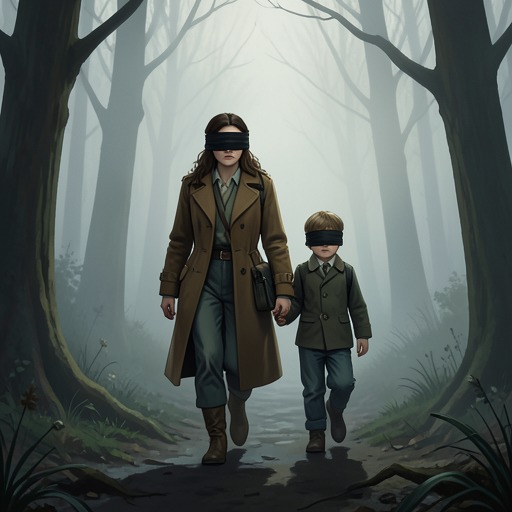
Bird BoxMalorie and the children arrive at the Jane Tucker School for the Blind after four and a half years of survival shaped by blindfolds, fear, and relentless training. Their arrival changes the terms of that survival: Malorie can finally uncover the children’s eyes, and Rick’s community offers shelter maintained by collective security rather than the irreversible blindness its members once imposed on themselves. Yet the school is not a frictionless promise of safety. Malorie reaches it exhausted and wary, and the relief of arrival remains tempered by what the journey has cost and by the community’s account of its own losses.
The Final Approach
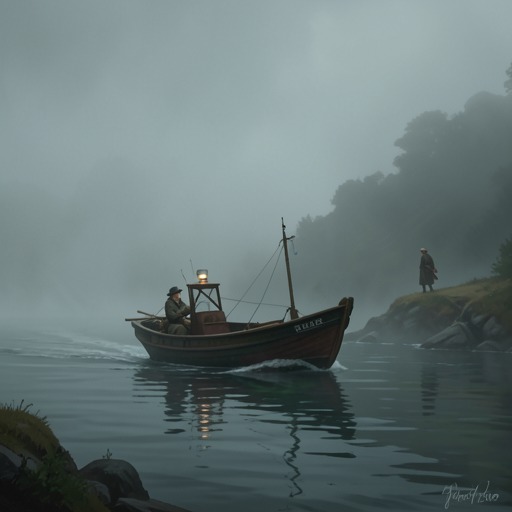
The arrival begins not with a welcome but with impact. The rowboat crashes into the fence around the school, setting off Rick’s alarm. Malorie checks the children, then realizes what they have struck. With the paddling no longer necessary, she turns her head toward the sky and yells; the outburst carries relief, anger, and everything accumulated during the escape. The alarm marks a threshold in sound before the school can be understood as a place: the family has reached a protected perimeter, but its inhabitants must still establish who has arrived and whether they can be trusted.
A woman approaches and identifies herself as Constance, saying she is with Rick. Malorie’s first concern is whether Constance’s eyes are open. Constance answers that she is wearing a blindfold. That exchange preserves the practical caution that has governed Malorie’s world: even at the supposed destination, safety cannot be assumed from a reassuring voice alone. The encounter does not erase the rules of the journey; it tests whether those rules can be met by people on the other side of the fence.
Rick and the School
Then a man recognizes Malorie by name. His voice is familiar from a telephone conversation years earlier, one she has wondered whether she would hear again. He is Rick, the voice connected to the possibility of refuge. Only after she hears him does Malorie pull at her blindfold and slowly open her eyes. The act is tentative: she squints against the facility’s harsh white light rather than immediately taking in her surroundings without difficulty.
The place she sees is a large school hallway, bright and long, with high ceilings, domed light panels, bulletin boards, desks, glass cases, and a clean, cool brick floor. There are no windows, yet the air feels fresh. Above an arch, brass letters identify the institution as the JANE TUCKER SCHOOL FOR THE BLIND. The name gives a definite destination to the route Rick had represented at a distance; the crowded boards and institutional spaces also show that the refuge is a functioning community, not merely an isolated room or a promise made over the telephone.
When Malorie tells Rick that he is blind, he confirms it and says that many people there are blind, although Constance can see clearly. His appearance makes blindness visible as a lived condition rather than an abstract policy: his eyes are open but unfocused, his gaze glassy and gray, and a faded scar marks the area near his left eye. He touches the scar apprehensively while holding a worn wooden walking stick. Malorie has reached people whose bodies bear the consequences of the choices made to survive, even as the school itself suggests that those choices have changed.
The Community’s History and Security
Rick explains that the school’s present arrangements grew out of an earlier, more desperate period. When the group first arrived, its members were starving and lacked the amenities and security they have now. They hunted for food; during one outing, a creature got inside. Many people died. Rick recounts that a mother who had been rational suddenly snapped and killed four children in a fit of rage. The episode gives the community’s strict history a specific cause: exposure meant not only individual danger but a catastrophe that could destroy families and unsettle the whole group.
In response, the survivors blinded themselves with whatever they could find, including forks, kitchen knives, and their fingers. Rick calls blindness absolute protection, but distinguishes that earlier response from the school’s current practice. After a year, the community judged the site sufficiently fortified to ease that burden, and Rick reports that it has had no security lapses since. Malorie looks to Constance, who has no scars, as Rick describes the old method. The contrast does not make the risk disappear; it reveals that the community has tried to adapt its defenses as its capacity for security has grown.
That account unsettles the simple meaning of arrival. Malorie understands why the school’s people once treated self-blinding as necessary, and she remembers George’s failed experiments and how close she herself came to blinding the children in a desperate act of protection. The refuge offers another model, but it does not retroactively make the choices that kept the family alive less grave. Its promise rests on collective measures and a history of failure, grief, and rebuilding—not on the claim that danger has ceased to exist.
The Children’s First Sight
At last, exhausted and free of both the house and the river, Malorie kneels and removes the blindfolds from the children. The Boy and Girl open their eyes, blinking and straining against the bright lights. They stare quietly, unsure where they are, and look to Malorie for guidance. This is the first place outside their home they have seen in their lives. The scene gives arrival a second threshold: the school is not only a destination reached by boat but the first visible world the children have been allowed to encounter.
Their silence matters against the severity of the training that brought them there. As babies, they were taught to wake with their eyes closed: Malorie waited beside their chicken-wire beds with a flyswatter, struck an arm when a baby opened its eyes, and closed the child’s eyes with her fingers; keeping them shut brought the reward of being fed. At three, the Boy was sent along the path to the well with a rope tied around him and Malorie, while she listened for the bucket and made him repeat the task when he dropped it. The Girl resisted, saying the ground was too bumpy and seemed to her as if people lived beneath the grass; Malorie withheld food until she agreed. In another exercise, she moved around the living room and asked the children where she was and where she had been, shouting when they pointed incorrectly. The children soon became consistently accurate.
These methods had made obedience and attention instruments of survival, but they had also narrowed childhood to what Malorie believed the children had to know. Now they can look, and neither cries nor complains; they watch and listen. Their quiet does not erase the cost of their upbringing, but the scene changes the function of their alertness. At the school, looking is no longer simply a forbidden exposure. It becomes a new experience that they must navigate with Malorie beside them.
A Cautious Refuge
The school’s visible signs of routine distinguish it from the isolated house and the dangerous river. Handwritten banners record progress in recovery, while flyers set out daily work in farming and water purification, alongside a medical evaluation timesheet filled with appointments. Rick says the facility extends beyond the hallway, that its people grow their own food, and that they have captured animals: chickens for eggs, a cow for milk, and two goats they hope to breed. He also describes the hope of searching for more animals and building a small farm. These details make the refuge concrete as organized work and shared provision, not simply safety bestowed on newcomers.
As others emerge from rooms farther down the hall, Rick places a hand on Constance’s shoulder and they begin walking deeper into the facility. The group appears to give Malorie and her children a moment alone. Malorie embraces the children and thinks of the house and river as if they were mythical places lost somewhere in infinity. The ending offers relief without declaring the world harmless: here, they are no longer quite so lost, and, more decisively, they are no longer alone. Arrival changes isolation into the possibility of belonging, while the community’s history and security practices keep that possibility grounded in vigilance and hard-won collective care.