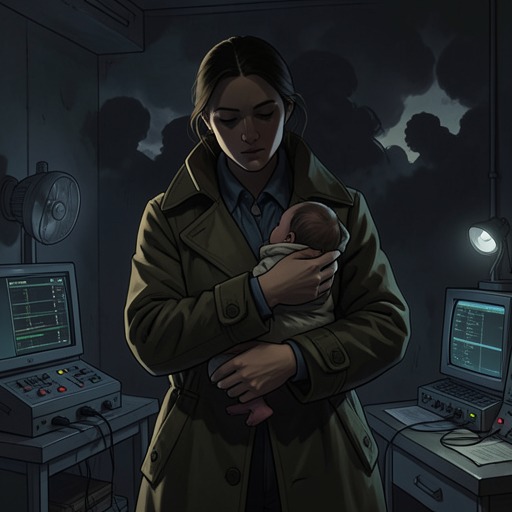
Malorie discovers she is pregnant
Bird BoxMalorie discovers she is pregnant through a private reckoning that becomes an immediate decision about the future. A missed period and weeks of worry give way to a positive test; with Shannon’s help, she tells her parents and resolves to have the child even though she expects to raise it without Henry Martin. The choice becomes the beginning of a motherhood tested by disaster, isolation, and the demands of survival.
Recognition and Confirmation
Weeks before taking a test, Malorie is already anxious that she should have been more careful with Henry Martin. Alone before the bathroom mirror, she studies her belly and tries to reassure herself that she has missed a period before. The reassurance does not settle her uncertainty: she feels pregnant, even while the evidence is not yet confirmed.
When Shannon calls from the living room, Malorie turns toward her without expression. Shannon notices that something is wrong, and Malorie begins to cry. Still standing before the mirror, she nods as Shannon realizes what she fears. In the pink bathroom, Shannon holds her and tries to keep the moment from becoming panic, proposing the practical next step of getting a test.
The test makes the suspicion concrete. By the time Shannon reaches the bathroom door, Malorie is already staring at the pink strip and shaking her head. She says she must call her parents; even as the result sinks in, she is beginning to steel herself to have the baby. The shift is decisive: pregnancy is no longer a fear she can put aside, but a future she has started to accept.
Choosing to Have the Child
Shannon urges Malorie to call Henry Martin, but Malorie has already concluded that he will not play a large role in raising the child. That expectation does not change her decision. She tells her mother that she is pregnant and describes it as an accident; when asked whether she will keep the baby, she answers that she will, although she has only just found out.
Malorie estimates that she is five or six weeks pregnant. She has written to Henry Martin and says she will call him as well, but her account makes clear that informing him is separate from deciding what to do. She is single and expects little involvement from the father, yet she commits to continuing the pregnancy. The decision is made under uncertainty rather than after a long period of preparation: she has known the result for minutes, but already speaks with resolve.
Shannon and the Family Response
Shannon’s response is immediate and practical. She recognizes Malorie’s distress, comforts her physically, and accompanies her toward the test and the difficult calls that follow. Her support does not remove the uncertainty, but it gives Malorie company at the point when private apprehension becomes a fact she must share.
The call to Malorie’s mother brings the decision into the family. Her mother asks about the pregnancy and whether Malorie is serious with someone; Malorie answers that the pregnancy was accidental and confirms that she intends to have the child. The exchange records a clear distinction between circumstance and choice: the pregnancy was not planned, but Malorie’s commitment to it is explicit.
Pregnancy Under Catastrophe
The later circumstances of Malorie’s pregnancy turn her early decision into a long test of endurance and care. In the safe house, she worries about the day she will give birth without a doctor, medicine, friends, or family. She tries to imagine labor as quick and concentrates instead on the moment afterward, when she will hold the baby, avoiding what may happen in between. Pregnancy makes the absence of ordinary medical and social support a persistent concern rather than an abstract hardship.
When Malorie gives birth, she faces an anguished decision about the newborn Girl. She cannot carry out what she has considered doing and withdraws, leaving the baby crying. The episode does not erase her earlier commitment to motherhood; instead, it exposes the extremity of the conditions under which she is trying to protect the children. Her choices are made within a world where care and fear are inseparable.
The labor also leaves a bodily cost. After the delivery, Malorie’s back remains tight, movement is painful, and she tires easily, yet she undertakes the difficult work of preparing a vehicle for a blindfolded journey. Later, after Tom’s death and the birth, she must clean herself and the children and search the home for danger before she can safely open her eyes. These later episodes show how the pregnancy decision extends beyond the test: it commits Malorie to a continuing practice of protection and care under conditions that offer neither rest nor reliable help.
Loss and Continuing Responsibility
The story places Malorie’s pregnancy within a wider pattern of bereavement. Shannon is later found dead in the bathroom, and Tom recounts the death of his eight-year-old daughter Robin, whom he found in a bathtub. These losses do not alter the circumstances of Malorie’s original decision, but they give its consequences a stark context: the child she chose to have will arrive in a world where family, companionship, and ordinary safety can disappear.
After the birth, Malorie is temporarily cut off even from knowing what has happened around her. With her eyes closed, she steps past Tom’s body without recognizing him, mistaking what her foot nudges for a bag of sugar. She begins the laborious work of cleaning herself and the children at the well-water bucket. The contrast between the beginning of the pregnancy and this aftermath is severe: the bathroom mirror and test had made a private future visible, while childbirth leaves Malorie responsible for the immediate survival of the newborn and the older children without being able to see the room around her.
Malorie’s discovery is therefore both an individual turning point and the start of a sustained caregiving burden. The positive test establishes a choice she maintains through fear, physical hardship, and loss. Its significance lies not in making motherhood secure, but in showing the resolve that will be required when the world offers no safe or orderly way to carry it out.