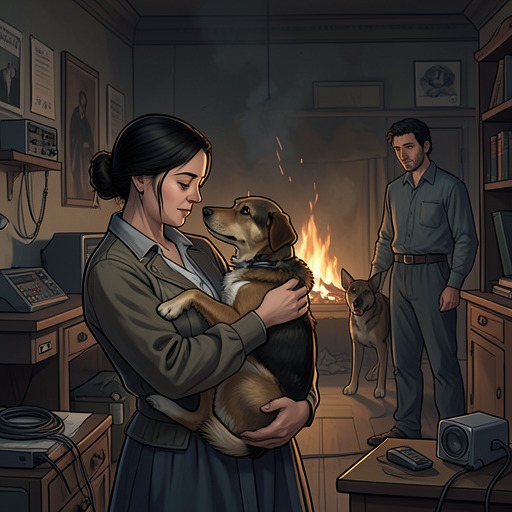
Malorie drove to the bar to look for equipment
Bird BoxMalorie’s blindfolded drive to the bar is a dangerous supply mission undertaken soon after she gives birth to Boy and Girl. Following Tom’s example, she improvises a vehicle she cannot see through and sets out to retrieve a microphone, but the journey tests both her physical strength and her ability to navigate without sight. She eventually reaches the bar and finds the equipment; there, a cellar door and Victor’s sudden struggle turn the expedition into an immediate fight to get back to the babies.
Purpose and Preparation
The mission grows out of Tom’s lingering ideas about taking risks rather than remaining stagnant. Malorie recalls his account of walking around the block with Jules, gathering dogs, and using them to make their way to his house. The sequence had worked because each step made the next possible. Applied to the present crisis, Tom’s example gives Malorie a practical precedent: she decides to paint the windshield black and drive.
The plan requires her to leave the newborns behind and go alone, although she intends to take food for Victor and rely on him to guide her between the car and her supplies. Her recent delivery makes even ordinary movement painful: her back muscles remain tight, her groin seems liable to snap if she moves too quickly, and she tires easily. She nevertheless prepares the Wagoneer while blindfolded, painting its windshield with cellar paint and covering the inside of the glass with socks and sweaters. She uses garage wood glue and cellar duct tape to fasten blankets and mattresses to the bumpers, building protection without being able to see the vehicle she is modifying.
Her intended route is precise. She plans to drive a quarter mile in the direction opposite to her arrival, turn left and continue four miles, then turn right and go another two and a half miles before searching for the bar. She judges that five or six miles per hour should be slow enough to be safe. The careful arithmetic offers a sense of control, but it cannot tell her what lies in the road.
Learning to Drive Blind
The first attempt exposes how little the route plan can protect her from the uncertainty of blind driving. The Wagoneer bounces as it runs over objects she cannot identify. Malorie strikes the curb twenty times, hits poles twice, and collides once with a parked car. Each click of the odometer brings the expectation of another collision or injury. She returns home empty-handed, her nerves shattered and her confidence badly shaken.
She tries again despite that failure. Finding the Laundromat on her seventh attempt gives her a landmark she remembers from her first drive to the house, and that recognition restores enough courage to continue. Her blindfolded search carries her through a boot store, a coffee shop, an ice-cream parlor, and a theater. In an office lobby, her shoes echo across a marble floor; elsewhere, she knocks a shelf of greeting cards onto the ground. These encounters demonstrate how familiar commercial spaces become disorienting when she must navigate by touch and sound rather than sight.
On the ninth afternoon, Malorie enters an unlocked wooden door and recognizes that she has reached the bar. The sour fruit, stale smoke, and beer smell welcome her after the repeated failures. She kneels to hug Victor around the neck and tells him, “We found it,” but finding the building does not end the mission: she must still locate the supplies inside it.
Searching the Bar
Malorie searches by touch, moving among chairs and striking her elbow against a post. She trips, but a table stops her from falling. The equipment is difficult to identify without sight; she feels around, trying to determine what might belong to the kitchen and what might be used for mixing drinks. Victor tugs playfully at her, and when she turns toward him she bangs her stomach against a hard object. It is the bar.
She ties Victor’s leash to what she believes is a steel stool, then feels behind the bar for bottles. Each movement reminds her how recently she gave birth. One by one she brings the bottles to her nose, identifying whiskey, peach and lemon drinks, vodka, gin, and finally rum. Holding the bottle feels like the culmination of a long deprivation. She carries it around the bar, finds the stool, and drinks. The rum also links the present search to the night the housemates tried to enjoy when Olympia arrived, bringing an earlier occasion in the communal house into this isolated, dangerous expedition.
The Cellar and Victor’s Attack
Victor stops and scratches at the floor. Malorie first thinks he has found a mouse, then sweeps her shoe across the ground until it strikes something small and hard. By touch, she identifies a steel ring and short rope as a cellar-door handle. Although she recognizes the opening, she initially tells Victor they should leave it alone and collect what they came for.
Instead, she calls out and receives no answer, then kneels and pulls the door open. A smell rising from the cellar chokes her, and the rum comes back up as she vomits. She understands that something is rotting below, but the danger becomes more immediate when she realizes that someone else is in the room. Her fear changes from the sustained terror of driving blind to the sharper knowledge of an unseen presence nearby.
Malorie reaches the stage and finds the object she came to retrieve: a microphone, an oblong shape with steel netting at its end. At the same moment, she hears Victor’s bone pop and his fur and flesh tear. Victor has seen something, though Malorie cannot see what has attacked him or where it has gone. The discovery of the microphone is therefore inseparable from the loss of safety: the needed equipment is in her hand, while Victor is being violently hurt.
Return and Significance
After rising, Malorie doubts that her body can bear any more effort, but she stands and feels her way with her back against the wall while Victor continues to struggle. Tears come, yet a precious calm takes over. The narration identifies it with motherhood: her actions seem to operate for the babies alone. That focus carries her through the bar even as she can feel some part of Victor brush her leg and cannot tell whether he is saying goodbye or reaching her with his tongue.
Malorie makes it back to the place where she and Victor entered. The open cellar door is nearby, but she does not know where it is. The episode thus ends with the microphone secured but escape still uncertain. Its central reversal is stark: the blindfold and improvised vehicle let Malorie undertake a journey she once could not make, yet the same refusal of sight leaves her unable to locate the immediate danger inside the bar. Tom’s example helps propel her into action; the newborns become the reason she persists when the mission turns from a supply search into a struggle to get out.