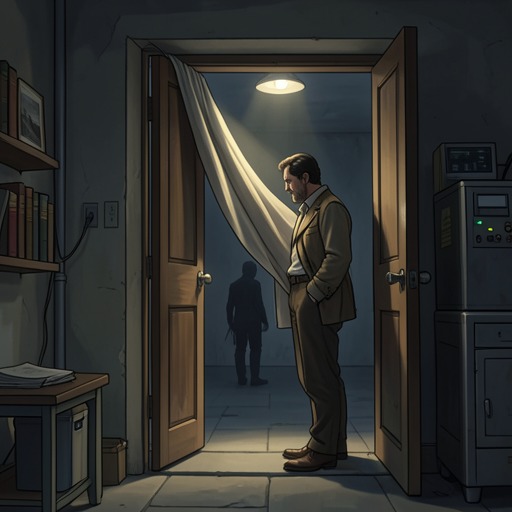
Malorie searches Gary's briefcase
Bird BoxMalorie’s investigation of Gary’s briefcase is the moment suspicion becomes proof. Acting while the house sleeps, Malorie takes the case from beside Gary and finds a carefully preserved notebook inside. Its pages reveal that Gary wrote Frank’s extremist arguments and planned to remove the drapes and unlock the doors. The discovery makes the briefcase more than a private possession: it is the hidden record of a danger already admitted into the house.
Suspicion and the decision to search
Late at night, while her housemates sleep, Malorie thinks about the briefcase. Tom has asked her to take more of a leadership role in his absence, but her concern is not simply a matter of authority. Gary’s interest in Don troubles her, as does the grandiose, artificial manner of Gary’s speech. The case gathers these separate misgivings into a single, tangible question: what has Gary brought into their shared home?
Malorie recognizes the moral cost of investigating. People forced to live together still need privacy, and snooping would violate that necessary boundary. Yet with Tom away, she wonders whether protecting the group makes it her duty to find out whether her suspicions are justified. The conflict is practical as well as ethical: she must choose between respecting Gary’s privacy and confronting a possible danger to everyone in the house.
The sleeping house makes the decision covert. Malorie listens for movement, passes Cheryl’s room and Olympia’s room, and descends the stairs with a hand on the railing. In the living room, Victor’s eyes seem to look back at her, though Felix is asleep on the couch; the place Tom usually occupies on the floor is empty. The vacant space emphasizes that Malorie is acting without the person who had urged her to lead.
Taking the briefcase
The stove light provides only a dim, humming pool of visibility. From the dining room, Malorie sees Gary asleep on his back and the briefcase leaning against the wall within arm’s reach of him. She crosses the room softly, but the floorboards creak. Kneeling near Gary, she watches his bearded, open mouth and steady wheezing, holding her breath as she tries not to wake him.
A shadow briefly makes her freeze and scan Gary’s eyes. They are closed; what appeared to be a threat was only a trick of the shadows. Once she is sure he remains asleep, she lifts the briefcase and leaves. At the cellar door she stops to listen, then opens it as quietly as she can. The hinges still whine, seeming louder in the silent house, before she slips through the narrow opening and the house grows quiet again.
The sequence turns an everyday object into an obstacle that must be approached with care. Its position beside Gary’s sleeping body forces Malorie to risk being discovered before she can learn what it contains. The briefcase is not dangerous in itself, but its closeness to Gary makes access to its contents inseparable from the danger of approaching him.
What the case contains
Aching and in need of rest, Malorie nevertheless wants to see what Gary brought with him. Sitting on a wooden stool, she clicks open the case. Its ordinary contents—a worn toothbrush, socks, a dress shirt and deodorant—initially make it look like a traveler’s luggage. Beneath the clothes, however, lie papers and a notebook. Malorie listens for footsteps, hears none, and draws the notebook out.
The notebook’s blue cover is clean, and its edges are unbent, as though Gary has kept it carefully preserved. Its physical condition contrasts with the disturbing material inside. The handwriting is exact and meticulously crafted, but the pages refuse a single orderly direction: some sentences run left to right, others right to left, and others descend from the top. Later lines spiral into neat patterns made of words. This is not a casually kept record; its controlled appearance and elaborate forms give the writing a forceful, deliberate presence.
The notebook identifies its author
The notebook argues that people differ in their capacity to comprehend the creatures and claims that the writer’s mind is superior to that of the other people in the house. It describes them as hysterical and intellectually inferior, and predicts that they will not survive. The passage does not merely express confidence: it provides Malorie a written account of how its author sees the group, setting his self-image against their presumed weakness.
The next pages attack those who hide behind blankets and blindfolds as the world collapses, calling such fear typical of most people. Another passage insists that people produce their own madness and culminates in the declaration, “MAN IS THE CREATURE HE FEARS.” These claims connect the notebook’s abstract theory to the group’s concrete survival practices. Malorie’s companions treat blindness as protection; the writer instead frames that protection as evidence of human weakness and blames people for the danger they experience.
The decisive recognition comes when Malorie realizes that this is Frank’s notebook and immediately asks herself why Gary has it. Her answer transforms the evidence: Gary wrote it. Frank, she understands, was not the person who tore down the drapes at Gary’s old place. Gary was. The question of possession therefore becomes a question of authorship and responsibility. Gary is not merely carrying another person’s dangerous ideas; the notebook links those ideas to his own actions.
A plan to expose the house
After standing with her heart racing, Malorie remembers that Tom is not home: he is on a three-mile walk to his house. That absence makes the discovery more urgent. She watches the light visible beneath the cellar door, imagining the possibility that shoes might suddenly block it, and looks among the shelves for something she could use as a weapon if Gary comes after her. The evidence has changed her task from discreet inquiry into preparation for an immediate confrontation, though no one has yet appeared at the door.
Malorie reads further. The notebook describes repeated attempts to persuade others through proof, insisting that discourse has failed and that the writer must make the others believe. Its marginal notes are numbered, and matching numbers run across the top of the page; Malorie sees entries in the thousands, including 2,343 and 2,344. The painstaking sequence suggests an argument rehearsed and recorded again and again rather than a sudden impulse.
The writing finally states the intended demonstration plainly: “I will remove the drapes and unlock the doors.” The plan gives concrete meaning to Malorie’s discovery of Gary’s earlier act at his old place. Together, the notebook and the torn-down drapes establish that his conduct was not an isolated breach but part of an effort to prove his beliefs by exposing people to danger. The scene ends with Malorie holding that evidence in the cellar while Tom remains away, and the case’s hidden contents have turned her private suspicion into knowledge that the household’s safety is at stake.