Malorie’s communal house
Bird BoxMalorie’s communal house is both a shelter from the creatures and a structure of confinement: its covered windows, secured attic, cellar stores, well, and improvised routines make survival possible while leaving the residents dependent on fragile barriers and imperfect information. The house’s importance lies not only in the refuge it offers but in how completely the household’s life is organized around it. When the coverings fail, its rooms become the site of birth, death, and the long aftermath Malorie must endure before she can leave.
Setting and Defensive Design
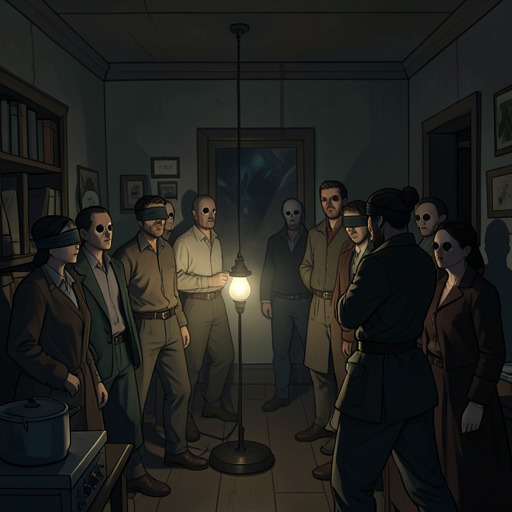
The house is introduced as a lived-in space whose ordinary furnishings coexist with precautions against the outside. Its living room contains a couch, end table, telephone, lamps, an easy chair, carpet, and a wall calendar; black blankets cover the windows. Victor, a six-year-old border collie whom Jules has raised since puppyhood, approaches Malorie, while pictures line the stairs and the bedroom windows are also covered. Familiar domestic details remain visible, but every view outward has been blocked.
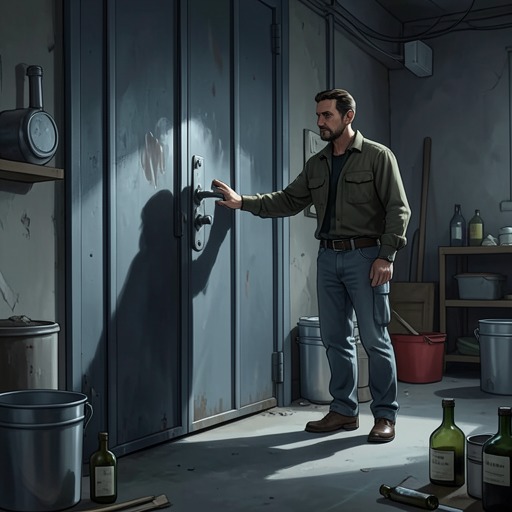
The household weighs the cellar against the attic as a place to retreat if a creature enters. The cellar door has a lock, but its age and delicacy make it less reassuring; the attic door has a powerful bolt and is judged the more secure refuge. This distinction gives the house a defensive geography: safety depends not simply on being indoors, but on which threshold can be secured if the outer protections fail.
A well behind the house supplies water, but drawing it requires a carefully managed route. Felix carries the heavy wooden bucket, whose iron handle helps him feel grounded, while blindfolded; a rope tied around his waist leads to a steel stake outside the back door, and pieces of old picture frames mark the path. The bucket fits the well’s iron hooks. Cheryl listens from inside the closed back door as the designated safety net, while Jules waits outside near the stake. Even routine water collection is therefore a coordinated operation linking the house’s interior, its threshold, and the exposed yard.
Domestic Life and Shared Systems
After Malorie has lived there for two weeks, the residents rely mostly on canned food from the cellar and whatever frozen meat remains. Each morning she is relieved that the electricity still works. The radio, with the last remaining DJ, Rodney Barrett, is their only news source; his broadcasts offer little new information, and he sometimes rambles, swears, or falls asleep on air. Yet the household keeps listening because his voice is its final link to the outside world. The house is materially provisioned, but its connection to public life has narrowed to a failing broadcast.
Other routines turn the property into a shared warning and training system. Birds kept in a box outside react to activity: they coo when Gary arrives and sing when Cheryl feeds them. Tom and Jules train the huskies for many hours a day in the house and yard, preparing them to guide blindfolded people. The dogs are given raw meat as a reward during training. For Malorie, their progress makes Tom’s plan to use them to enter the outside world feel like an approaching change in the household’s risk-taking, not an abstract possibility.
The house also contains the equipment associated with life before the disaster. Recalling a band that needed microphones and amplifiers, Malorie connects those objects to the chain of Tom’s earlier initiatives: one experiment or excursion made the next possible. The remembered sequence gives the household’s rooms and possessions a second meaning. They are not merely shelter and stores, but the setting in which plans accumulate and the limits of staying put are repeatedly challenged.
Breach and Collapse
The house’s defenses ultimately fail. During the crisis below, Gary identifies Don as the person trying to persuade the others to accept what Gary has taught him; a voice from downstairs carries clearly into the attic, where Gary insists that Don has pulled down the blankets and that the creatures will not hurt them. The sound crossing the house’s levels makes the breach unmistakable: the covered rooms no longer separate the inhabitants from the danger outside.
The consequences are not confined to the moment of entry. After giving birth, Malorie rehanges the blankets, closes the doors, and searches the home inch by inch with a broomstick, keeping her eyes shut. She will not feel safe enough to open them for six hours. During that interval she moves through the living room and steps over Tom’s body without recognizing him, mistaking it for a bag of sugar when her foot nudges it. The familiar interior has become a place she must navigate by touch and memory, with death mixed into ordinary domestic movement.
In the months that follow, Malorie speaks with Rick several times by telephone, but eventually the lines to the house die. The communication infrastructure that once offered a narrow connection beyond the household disappears as well. Cleaning the house takes six months. Malorie finds Don on the kitchen floor, reaching toward the cellar, but never finds Gary; his absence leaves open the possibility that he remains somewhere in the world.
Aftermath and Spatial Memory
Most of the housemates are buried in a semicircle around the well. Because Malorie dug and filled their graves while blindfolded, she continues to feel their uneven mounds whenever she comes to draw water for herself or the children. The well, once the focus of a hazardous but necessary daily routine, becomes inseparable from the household’s dead. The repeated walk to obtain water thus carries a physical reminder of the cost of the house’s failed protection.
Tom is buried closer to the house, in a patch of grass where Malorie takes the children blindfolded to get fresh air. She hopes their spirits run freest there. His grave occupies a space still used in caring for the children, joining the routines that sustain the living to the memory of the person who helped shape them. Malorie’s communal house remains a refuge in the practical sense, but it is also the landscape of loss she has to traverse before escape becomes possible.
The House as Refuge and Trap
The property’s protective logic is built from barriers and controlled movement: blankets shut out sight, doors divide safer from more exposed rooms, the well demands a tethered route, and listening substitutes for looking. These measures preserve daily life for a time, but they also make the inhabitants’ survival dependent on the continued integrity of coverings, doors, power, radio, and telephone. When the blankets come down, the house’s internal organization cannot keep danger at a distance.
Its changing meanings are concentrated in recurring locations. The attic is considered the strongest refuge but becomes a place from which the household’s collapse can be heard; the cellar stores food and water but is also the direction toward which Don reaches; the well sustains the family and marks the graves of its former members. By the time Malorie leaves, home is no longer a simple opposite to the hostile outside. It has sheltered her, contained the community’s routines, and become the site of the losses she must carry beyond it.