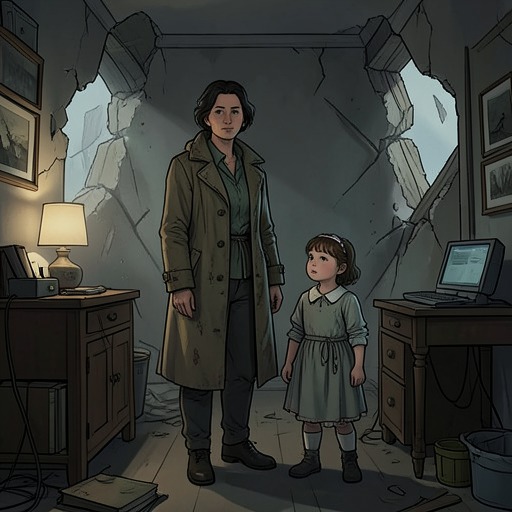
Olympia arrives at the safe house
Bird BoxOlympia arrives at the Shillingham house at a moment when the outside world’s collapse is audible but cannot be seen. Her entrance turns the house’s rule-bound threshold into a test of whether its residents can risk admitting another stranger, and reveals that she, like Malorie, is pregnant.
Background and the crisis outside
By the time Olympia reaches the house, public life has contracted around fear of the Problem. News reports describe people killing themselves, government instructions call for a national curfew and covered windows, and broadcasts warn people not to look outside. The collapse is also disrupting ordinary communication: Tom explains to Malorie that the Internet is down, the cell phones stopped working weeks earlier, mail and newspapers no longer arrive, and the house relies on a landline whose continued operation is uncertain. The circumstances make a knock at the front door more than a routine request for help; the residents have little means of verifying who is outside or what admitting them may bring.
The arrival follows a radio broadcast by Rodney Barrett. Don recognizes the desolation in Barrett’s voice and predicts that he is going to kill himself. Barrett then says he will take the last thing left that others can take from him. When Cheryl reaches to switch off the radio, a gunshot comes through the speakers. The broadcast ends in silence, and Tom turns the radio off. Its abrupt end establishes the crisis that immediately precedes Olympia’s appeal: the housemates have heard a death without seeing its circumstances, then must decide how to respond to a voice at their own door.
The threshold and admission
A knock follows the gunshot, then another. Felix moves toward the door, but Don grabs his arm and warns him not to open it casually. The knocking resumes, and a woman calls out. Malorie urges someone to answer and starts to get up, but Tom reaches the door first and calls back to ask who is there. The woman identifies herself as Olympia and asks to be let in. Her name is the only information the residents have about her before they decide whether to admit her.
Tom does not simply open the door. He tells Olympia that, when she hears it open, she must step inside quickly. After she confirms that she understands, he opens it; there is a commotion, and the door shuts. The admission repeats the basic structure of Malorie’s own arrival two weeks earlier, when the housemates brought her inside, but the brief exchange also makes clear that the household has developed a procedure for receiving someone whose identity and condition cannot be checked from the threshold. In this world, hospitality depends on controlled movement and coordinated trust rather than an ordinary face-to-face welcome.
Once the door is closed, the housemates keep their eyes shut while a broomstick is moved against the walls, floor, ceiling, and door. Only when the inspection is complete does Tom tell them to open their eyes. The sequence makes entry a collective act of precaution: Olympia has crossed the threshold, but the residents do not treat that crossing as sufficient proof that the danger has passed. Their response to her is shaped by the same fear that governs the rest of their lives.
Pregnancy and the household’s changing stakes
When Malorie opens her eyes, she sees Olympia standing beside Tom. Olympia thanks them breathlessly. Before Tom can begin asking her questions, Malorie asks whether she is pregnant. Olympia looks down at her belly, then nods and says she is four months along. Malorie replies that she is about the same. The shared pregnancy is the decisive revelation of the encounter: Olympia is not only another person seeking shelter but someone whose immediate circumstances parallel Malorie’s.
The timing gives the exchange particular weight. Malorie had wanted to drive north to Michigan, but Shannon refused, arguing that even a short trip would be dangerous and a nine-hour drive would be suicidal. The household’s refuge is therefore not simply a temporary stop on a journey; it is where Malorie is living while the outside world becomes harder to navigate. Olympia’s arrival places two pregnant women in that enclosed, uncertain community, while the housemates still face shortages, failing infrastructure, and the need to protect the house from unseen danger.
Consequences and narrative significance
Olympia’s admission changes the household’s composition and introduces a new relationship between her and Malorie, founded initially on their nearly identical stages of pregnancy. The text does not establish how their relationship develops beyond this first recognition, so the significance of the moment lies in the fact it makes visible: each woman is facing pregnancy within the same emergency, and neither can rely on ordinary medical or social systems as the household’s communications and services fail.
The episode also sets a lasting pattern for the refuge. Don’s warning against opening the door without care and Tom’s later proposal to let a group decide whether to admit someone show that access remains contested rather than automatic. Olympia’s arrival is thus both a successful act of shelter and an early measure of the housemates’ competing obligations: protecting those already inside, while deciding whether to extend that protection to someone outside. The gunshot on the radio and the controlled opening of the door form a stark sequence, linking the collapse of public communication to the increasingly consequential decisions made at the house’s private threshold.