Security contractor's well
Bird BoxThe well behind the Riverbridge safe house is the household’s indispensable source of water and a perilous point of contact with the unseen world outside. Its routine use depends on ropes, path markers, and another person’s voice; when Felix hears something moving within it, that carefully organized task turns into an emergency. The well’s importance is practical, but its role is also structural: it links the house’s daily survival to a danger that no one can verify by sight.
Setting and Essential Use
When Malorie arrives, Tom explains that the house has no running water. The well out back supplies water for everything, while the river flows about eighty yards behind it. The house still has electricity and a working landline because a local hydroelectric plant powers them, but the residents cannot assume those systems will last indefinitely. The well, by contrast, is an immediate necessity: water must be drawn and carried by hand, and even that ordinary labor must be performed blindfolded.
The household has six buckets, including an old wooden one with a black iron handle that Felix prefers because its weight keeps him grounded. The well is reached along a path outlined with pieces of old picture frames. A rope tied around Felix’s waist runs back to a steel stake outside the rear door, giving the people at the house a way to keep track of him. At the well, its cobblestone lip scratches his thigh as he bumps against it. These concrete markers make the task navigable without sight, but they cannot make it safe in the same way that direct observation might.
The Water-Collection Routine
Fetching water is a shared task, not a solitary excursion. Jules waits blindfolded beside the stake and talks while Felix walks toward the well, telling him how far he is from the house. His speech is less important for its content than for its continuity: Felix needs to hear another person as he moves through an environment he cannot see. Cheryl listens behind the closed back door from the kitchen, ready to serve as an additional safety net if something goes wrong outside.
Felix keeps the rope away from his legs so he will not trip, and the frame pieces along the path help him stay within bounds. He jokes to Jules that touching the wood is like playing Operation, with a buzzer sounding whenever his toe reaches it. The humor does not remove the strain. When Felix reaches the well, the unevenness and danger of moving slowly are sharply apparent; he thinks how much worse a fall could be if he were running.
Lowering the bucket requires another sequence of sounds and counts. Felix turns the crank, hears the bucket knock against the stone sides, and expects about twenty revolutions before it reaches the water. He counts aloud, hears a splash at nineteen, and draws the filled bucket back up. The repeated count offers a measure of control, but it is only a measure: it cannot tell him what else may be in the well.
Felix’s Encounter and the Household’s Response
During a later trip, Felix hears a sound from inside the well. He releases the crank, and the bucket falls against the stone before splashing below. The sound suggests that something has moved in the water, but Felix cannot see what it is. He touches the cobblestone rim to judge how wide the opening is, then resumes cranking quickly, trying to get back inside rather than remain beside it.
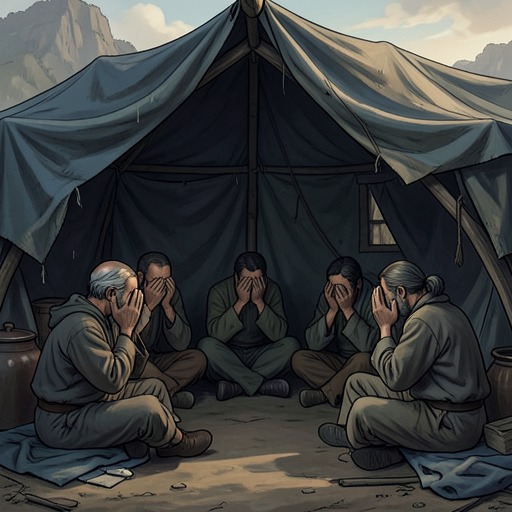
When Felix believes he has retrieved only water, wet feet sound on the grass behind him. He drops the bucket and runs, then falls. Jules reaches him, and other hands help bring him through the back door. In the house, Don and Cheryl shout, Tom tries to calm everyone and tells them to close their eyes, and Olympia asks what has happened. Jules finally calls for silence. Felix’s alarm has thus become a collective crisis: the housemates must respond without being able to look outside or establish what approached him.
The two buckets Felix filled remain untouched on the kitchen counter. Twenty-four hours pass without the residents drinking from them, and their dry lips register the cost of the decision. Felix’s experience does not prove what was in the well, but it makes the water seem unsafe to the household. The uncertainty itself is enough to interrupt the basic routine on which they depend.
Water, Risk, and Dependence
The residents cannot simply abandon water. Tom reminds Malorie that they cannot go days without it and points to her baby; Malorie replies that the baby is precisely what she is thinking about. Felix asks whether they can drink from the river instead. Tom then says he will drink it, not to claim a heroic role but because he is thirsty. The well’s danger therefore redirects the household toward another source rather than ending its dependence on water.
The contrast exposes how narrow the household’s margin for survival is. The safe house has stored canned food, yet water collection remains a repeated, exposed task. The well is close enough to the back door to be reached by a marked path, but the need to work blindfolded turns that short distance into a coordinated operation. Rope, buckets, a crank, path markers, and spoken guidance can organize the work; none can establish what Felix heard.
The well also belongs to a larger map of dependence and movement. When Rick later directs Malorie to take the river, he says the route will be dangerous and at least twenty miles long, while locating it behind the house and about eighty yards from the well. The same watercourse that sustains the house and offers a route out is not presented as risk-free. The well and river together make survival depend on navigating water without being able to see what might be near it.
Meaning in the Safe House
As an object of daily use, the well is meant to be dependable: its bucket can be lowered, counted down, and raised again. Felix’s encounter makes that expectation unstable. The rope and voices that guide him to it provide practical protection from missteps, yet the decisive threat arrives as a sound whose source remains unseen. The scene turns a familiar chore into a test of what the household can know and trust.
The well also gives the house’s rules a physical boundary. Residents gather at the rear door, stake, and path to send someone out and wait for him to return, while the water itself lies below a stone rim that Felix can only assess by touch. Once the bucket remains unused, the boundary extends inward: danger at the well affects the kitchen counter, the household’s thirst, and the debate over whether another source is safer. The well is not merely a backdrop to the emergency but the point at which essential need, coordinated care, and uncertainty meet.