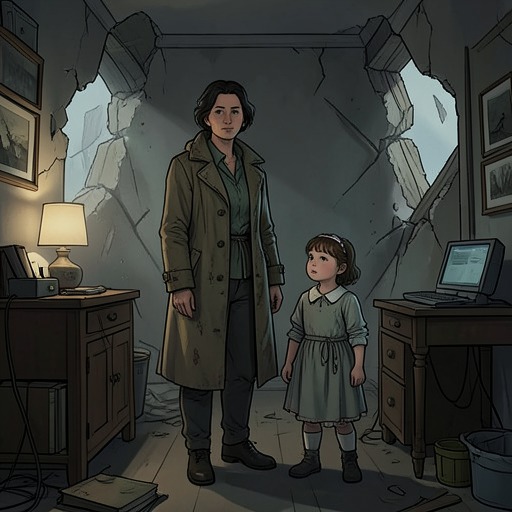
The creature attack at Tucker
Bird BoxThe creature attack at Tucker is the disaster Rick cites to explain why the school’s residents once blinded themselves and why they later changed that policy. His account connects a creature’s entry during a food-gathering trip with multiple deaths, a community’s lasting fear of another breach, and the eventual decision that stronger security could make blindness unnecessary.
Background and the Attack
When Malorie arrives, the community’s former practice is not immediately clear to her. Rick explains that the residents had initially been starving and had gone out to hunt because they lacked the amenities they had later established. They were also less secure: while a small group was away searching for food, a creature entered the school. The attack revealed the risk of leaving the community exposed while people sought supplies beyond its defenses.
Rick describes consequences extending beyond the attack itself. Many people were lost, and one mother, previously rational, killed four children during a sudden fit of rage. The community took months to recover and rebuild. The account makes the attack both a direct security failure and a rupture in the social order the residents were trying to preserve.
The Old Protection Policy
In response, the residents vowed not to take the same risk again, framing the decision as necessary for the good of the whole community. Rick says they blinded themselves with whatever was available, including forks, kitchen knives, or their fingers. In that earlier period, blindness was treated as absolute protection from the creatures: the policy removed sight as a point of vulnerability, but imposed a severe burden on the people who adopted it.
The attack therefore shaped the community’s collective rules rather than remaining a single past emergency. Rick’s explanation distinguishes this earlier condition, which he calls the old way, from the safer arrangements in place when Malorie arrives. The policy arose from hunger, inadequate defenses, and the memory of catastrophic loss; it was not presented as an unchanging or voluntary tradition.
Recovery and Change
The residents eventually fortified Tucker. After a year, Rick says, the improved security allowed them to ease the burden of self-blinding, and they had experienced no security lapses since. The community’s history thus turns on a change in its assessment of risk: initially, blindness seemed indispensable, while later, stronger defenses made it possible to live without that measure.
Malorie’s response gives the revelation a personal dimension. She thinks of George and his failed video experiments, and remembers that she nearly blinded her children in an act of desperate protection. She also observes that Constance can see and has no scars. That contrast underscores that Tucker’s present practice is not shared by everyone and that the community’s earlier policy belonged to a particular period of fear and vulnerability.
Significance
The attack is known here through Rick’s retrospective explanation, not through a direct account of the scene itself. Its importance lies in the sequence of causes and consequences he sets out: a food search exposed an inadequately defended community, the breach brought deaths and prolonged recovery, and the response transformed blindness into a collective security measure. Tucker’s later defenses then changed what the residents considered necessary.
This history also places the community’s survival strategies beside Malorie’s own choices. The children remain sighted beneath their blindfolds, and Malorie has contemplated permanently taking that capacity from them; learning Tucker’s history gives her a concrete example of both the reason for such fear and the possibility that protective rules can change when circumstances change.