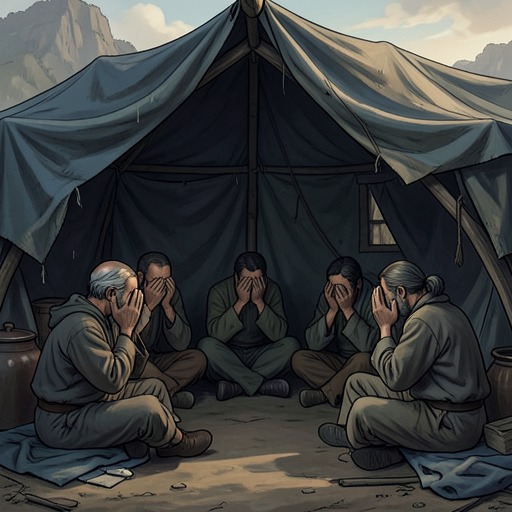
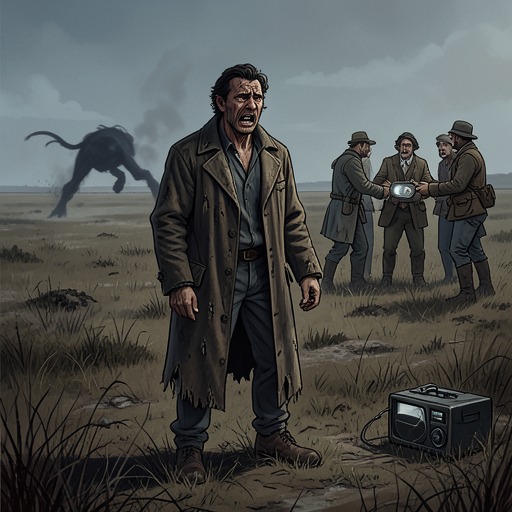
The safe house falls and the twins are born
Bird BoxThe safe house falls and the twins are born in the same crisis: the household’s protective barriers fail just as Malorie and Olympia go into labor. Gary’s presence in the cellar and Don’s act of pulling down the blankets make the house vulnerable to the creatures, while the two births force Malorie to divide her attention between immediate danger and the lives of the newborns. The episode ends not with a restored refuge but with a survivor responsible for two babies, the housemates dead, and Gary’s whereabouts unknown.
A refuge made vulnerable
The house’s defenses have always depended on its divisions and barriers. Earlier, Felix had noted the contrast between the cellar door’s fragile lock and the attic door’s strong bolt, identifying the attic as a place the household could secure itself if a creature entered. That arrangement makes the attic a refuge within a refuge, but it also puts the people sheltering there behind another closed door, dependent on what they can hear from the rest of the house.
The danger is announced from below. A voice reports that Don has pulled down the coverings and opened the door, and repeats that the creatures are in the house. The warning reaches the attic clearly, but hearing the threat does not reveal where it is or make the household’s defenses whole again. A thunderous knock at the attic’s floor door follows. Malorie recognizes the voice as Tom’s, bringing the household’s crisis to the threshold of the room where she is giving birth.
Gary’s discovery and the breach
When the rain returns, Malorie opens her eyes and sees Olympia with her head bent toward the ceiling. As she scans the attic—boxes, the window, old books and clothes—she understands that someone else is there. It is Gary, whom she identifies as having been hidden in the cellar. The discovery joins the previously concealed danger inside the house to the household’s sudden exposure: the threat is not only outside the barriers but entangled with the people and spaces on which the survivors have depended.
The warning about Don’s actions supplies the immediate cause of the breach. Don has pulled down the blankets and opened the door, allowing the creatures into the house. The account does not establish every step that led to his decision, but it makes the consequence unmistakable: the coverings that kept the creatures from view and the house’s doors that controlled access no longer protect the household. The attic’s secure bolt cannot undo what has happened elsewhere in the building.
Two births under threat
The danger coincides with the event Malorie has feared for years: giving birth without doctors, medicine, or the ordinary help of friends and family. She had tried to imagine labor as brief, moving in thought from her waters breaking to holding the baby rather than dwelling on what lay between. Now the emergency is no longer something she can defer imagining. She and Olympia are both in labor in a house where the coverings have been pulled down and the creatures are inside.
Olympia’s baby cries first. Malorie’s own child then comes, and she cups its eyes, believing she has reached the baby in time to shield them. In the same endangered space, she must protect two newborns as well as deliver her own. The births are therefore not a separate, peaceful conclusion to the household’s crisis: they happen within it, and their immediate care depends on Malorie’s hands and attention.
Olympia’s choice and the aftermath
Olympia hands her child to Malorie. Malorie remembers this act as something that will always shine for her: even after Olympia has lost her mind, she does right by her baby. The handoff preserves a distinction between Olympia’s terrifying circumstances and her final act of care. For Malorie, the child’s survival is bound to that choice, not simply to the fact of the birth.
The danger continues as the attic window shatters and something strikes the house. Olympia dies, and Malorie remains with the babies amid the house’s collapse. Later she hangs up the phone and cries for twenty uninterrupted minutes; then Victor scratches at the cellar door, barking to be let out. He has been locked in the cellar, perhaps because Jules anticipated what was coming. Malorie rehanges the blankets and closes the doors, then uses a broomstick to search the house without opening her eyes. Six hours pass before she feels safe enough to look.
The consequences extend well beyond the delivery. Malorie will find Tom’s body in the house and spend six months washing away the bodies and blood. She finds Don on the kitchen floor reaching toward the cellar, as though he had raced there in madness to ask Gary for his mind back. She searches everywhere for Gary but never finds him, and remains aware of the possibility that he is still somewhere in the world. The house has ceased to be a functioning refuge; survival now means carrying the two babies forward without the people who shared that shelter.
Narrative significance
The episode turns the safe house’s spatial logic against itself. The attic, once identified as the strongest place to retreat, becomes a narrow enclosure where Malorie hears warnings and knocks without being able to establish what is happening below. The cellar, meanwhile, is both the place where Gary has hidden and the place toward which Don reaches at the end. Doors and coverings do not merely set the scene: their failure organizes the crisis and determines what the survivors can know or do.
The birth sequence also makes care an action under pressure rather than a promise of safety. Malorie shields her baby’s eyes and takes responsibility for Olympia’s infant; Olympia’s handoff is remembered as an act of maternal care at the instant her own capacity to respond to the crisis has failed. The two children survive the house’s collapse, but the cost is immediate and lasting: Olympia and Tom are dead, Don is dead, and Malorie faces the next stage alone with the babies and the unresolved possibility of Gary’s survival.