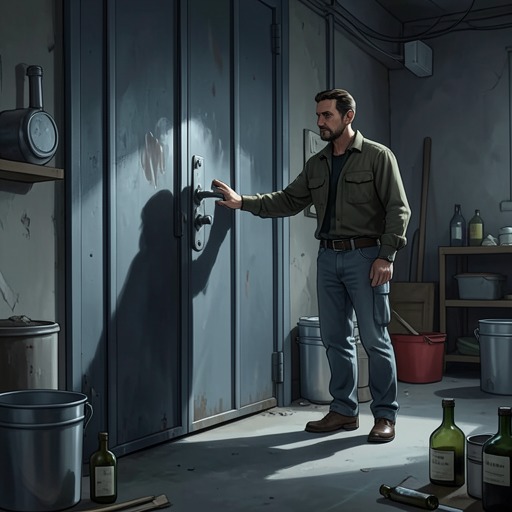
Three-mile supply expedition of Tom and Jules
Bird BoxTom and Jules’s three-mile expedition is a carefully planned but deeply consequential attempt to extend the household’s survival beyond its immediate surroundings. They set out for Tom’s house, relying on trained dogs and a song-paced route to travel blind, and return with groceries, supplies, and a phone book. The journey tests whether the community can turn practiced routines into long-distance navigation, while its outcome gives the house a new means of seeking help.
Purpose and Stakes
By the time the expedition is proposed, Tom and Jules have been training the dogs for ten or twelve hours a day, first inside the house and then in the yard. The birds kept outside serve as an alarm: they coo when Gary arrives and sing when Cheryl feeds them. The preparations have made a longer journey seem possible, but they also signal that Tom intends to put the dogs’ training to a more demanding test by using them to enter the outside world again.
The destination is Tom’s house, three miles away. He considers it the only place whose contents he can be completely sure of, and says he has supplies there that the household needs: Band-Aids, Neosporin, aspirin, and bandages. Malorie is encouraged by the prospect of medicine, but fears the danger and duration of Tom’s absence. The practical need is clear; so is the uncertainty of sending two people into a landscape where ordinary sight cannot be used for navigation.
Tom’s proposal belongs to a larger pattern of adapting familiar tasks to life under blindfolds. Earlier, he had suggested protective helmets, butcher knives, and dogs as guides, with a plan to release a dog if it became dangerous. The three-mile trip makes that experimental approach concrete. The dogs are not merely companions: they are being trained as guides, while the household’s preparations attempt to anticipate how an animal’s behavior might change outside.
Route and Departure
Felix explains the navigation plan: Tom and Jules will walk to the rhythm of a single song, “Halfway to Paradise,” playing it repeatedly on a radio. The route has been mapped in advance, including the number of steps required for each direction and each portion of the trip. Gary jokes about the men dancing, but Tom rejects the description and insists that they are walking to get help. The exchange clarifies the expedition’s purpose: its method may sound peculiar, but it is intended to provide a reliable rhythm for movement and a way to follow agreed directions without sight.
The household has reason to treat the distance as a significant escalation. On an earlier outing, Tom and Jules were gone for two days to cover a single block. The three-mile walk therefore raises the question of how long they will be away and whether they will return at all. Malorie remembers that the previous journey brought back children’s shoes, a modest but tangible benefit that offers some basis for hope without making the new trip safe.
Tom and Jules leave in the morning after Felix reviews the map with them once more. Gary encourages them, and Olympia gives Tom a Petoskey stone that she says has always brought her good luck. Malorie says nothing as the front door closes behind Tom for the second time: she neither calls after him nor embraces him nor says goodbye. The omission becomes painful to her only hours later, when the men are still away. Her silence does not cancel her concern; it gives that concern a regretful form, because the departure may have been the last opportunity to speak to him.
Return and Supplies
The expedition ends with Tom and Jules back at the house. Tom explains that he had planned to telephone the others from his own house, but its phone was out. Rather than bringing the expected message by telephone, he arrives with a different form of help: the two men have raided a grocery store, where someone had already been, but they still managed to collect a substantial amount of useful food and other goods.
Tom reports that the dogs worked and led them. His pride and happiness make the return a practical confirmation of the training plan: the dogs could guide the men along the journey. The outcome does not establish that such travel is safe in general, but it shows that this particular expedition succeeded in reaching stores and bringing supplies home.
Tom also retrieves a phone book from his house. He proposes calling every number in it, convinced that someone will answer. The book is an ordinary object, but its function changes in his hands: a directory becomes a plan for reaching anyone who may still be alive and willing to respond. Since the telephone at Tom’s house was out, the phone book does not itself provide contact; it gives the household a larger set of possible numbers to try from its own position.
Significance
The journey joins several forms of improvised knowledge: Felix’s map, a counted sequence of steps, the repeated rhythm of a song, and the dogs’ trained guidance. None replaces sight in isolation; together, they allow Tom and Jules to attempt a journey that the household could not otherwise make. The preparations turn navigation into a shared procedure that can be explained, reviewed, and followed rather than an act of unaided intuition.
Its consequences reach beyond the food and medical supplies that motivated the trip. The dogs’ successful work strengthens the household’s confidence in a method for travel, while Tom’s return with the phone book redirects that success toward communication. The expedition therefore moves from the concrete need for medicine to the broader hope of finding help: the men go out to retrieve what the household lacks and come back with a way to ask whether anyone beyond it remains reachable.