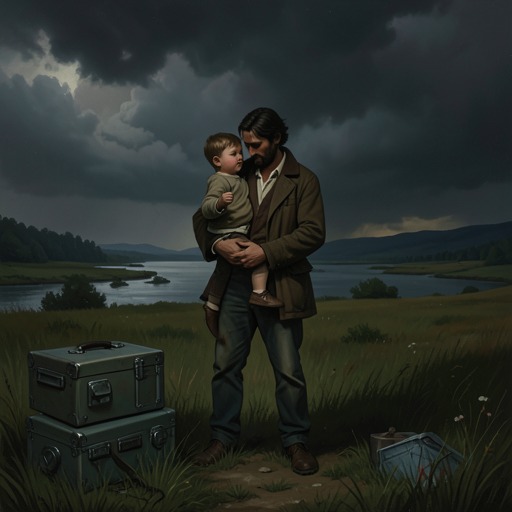
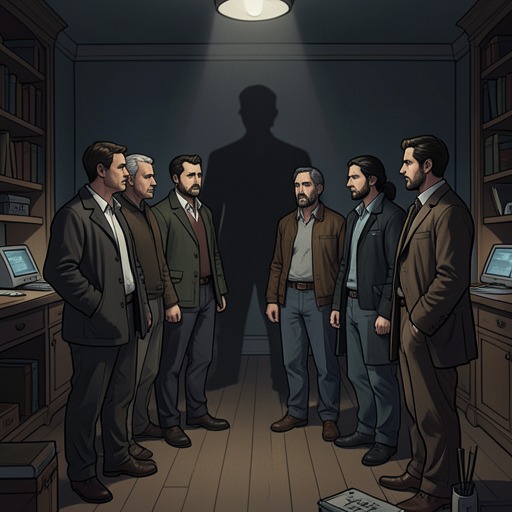
Tom and Jules search for dogs
Bird BoxTom and Jules search for dogs is a blindfolded expedition from the Shillingham house into the surrounding neighborhood, organized around the hope that dogs can guide the sightless and help the community survive. The undertaking tests a carefully assembled plan against the disorienting silence beyond the house; its return brings two huskies and a box of birds, extending the residents’ means of navigation and warning.
Purpose and preparation
Tom frames the search as a practical response to the limits of moving through an unfamiliar world without sight. His plan is to use dogs as guides, while preparing for the possibility that an animal might become dangerous. He and Jules therefore work on helmets intended to protect their blindfolds, and plan to carry large knives; Tom’s contingency is to release a dog if it goes mad and defend themselves if it attacks.
The equipment is assembled in stages. By the next morning, Tom and Jules are putting the finishing touches on the second helmet. Two duffel bags are stocked halfway with canned goods, flashlights, and blankets. The expedition’s other tools include large knives, kitchen-stool legs reshaped into sharp stakes, and broomsticks to use as walking sticks. This mixture of supplies, improvised weapons, and walking aids makes the mission more than a simple errand: the pair prepare to travel, gather provisions, and respond to danger without relying on vision.
Cheryl’s role is to remain inside as a precaution. She listens from the kitchen behind the closed back door, positioned as a safety net in case something goes wrong outside. Her presence establishes a division of responsibility: Tom and Jules take the risk beyond the house, while another housemate stays ready to respond if their plan fails.
Departure and exposure
Felix and Cheryl help strap the duffel bags to Tom and Jules’s backs. Tom then asks to be let out, and the front door opens. The men’s shoes cross the porch before the door is shut behind them, marking the threshold between the familiar shelter and the exposed space they must navigate.
Outside, the two men move like blind walkers, tapping the ground with broomsticks. When Tom senses the change from concrete to lawn only a few feet from the porch, the shift unsettles his sense of place: without sight, the house seems to have disappeared, and he feels vulnerable. The expedition’s first obstacle is thus not an attack but the loss of the ordinary visual map that makes even a short step beyond home feel comprehensible.
The danger of relying on sound appears in the men’s uncertainty about what may be nearby. At one point, a sound is heard for a third time, but the evidence does not identify its source. Later, Tom and Jules encounter a body. They follow voices and feel their way along the bricks until they reach the front door; Jules knocks and calls out, while Tom worries that his voice may attract something in the silent world. He nevertheless explains that they mean no harm and are looking for supplies. After further knocking and waiting, no one responds. The encounter leaves their search framed by the possibility of other people, the need to communicate without seeing, and the absence of reassurance from inside the house.
Return and what they bring back
The housemates initially have reason to fear that something is at the door, but the visitors prove to be Tom and Jules. Their return changes the sound and movement of the foyer: paws on the tile make it seem as if many people have entered, and two huskies move quickly through the space, sniffing the floor and investigating the people and Victor. The dogs’ presence offers the kind of animal companionship and potential guidance that Tom’s plan had sought, while their movement also makes the returning party impossible to mistake for a quiet entry.
The men have also brought a box of birds. Tom presents it to Cheryl and identifies its contents; he then calls the birds an alarm system. In this way, the search yields two different kinds of assistance: dogs that may help people travel, and birds whose alarm function can warn the community. Animals are not simply background to the house’s survival. Their behavior and presence become part of the residents’ practical system for moving through and monitoring a world they cannot safely see.
Significance of the expedition
The expedition’s central contrast is between the gear the men can prepare and the uncertainty they cannot remove. Helmets, knives, stakes, walking sticks, and provisions make the journey deliberate, but none restores sight or guarantees what a sound means. Tom’s unease on reaching the lawn and his later concern that speaking could attract danger show how quickly a planned route becomes an encounter with unknown space.
The return nevertheless produces a consequential result. The dogs and birds enlarge the house’s resources through different animal roles: the huskies can potentially guide movement, while the birds are introduced as an alarm. That arrangement remains dependent on animal behavior rather than human control, a dependence sharpened elsewhere by a dog’s unfamiliar growl and by a dead bird found during Malorie’s river journey. The expedition therefore marks both the usefulness and the vulnerability of relying on other species in a catastrophe that unsettles human and animal life alike.