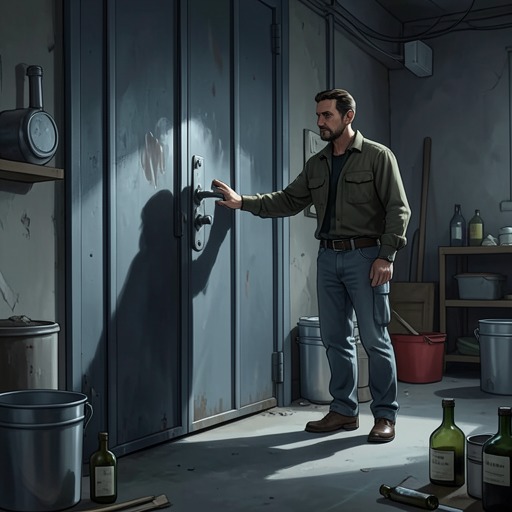
Tom drinks water from the well
Bird BoxTom drinks water from the well to test whether the house’s water supply is safe, making a personal risk the answer to a problem that has left the exhausted household without a dependable source of water. The test’s significance lies not only in the result: Tom accepts the danger without claiming heroism, and his survival gives the housemates a reason to emerge from fear and begin putting their shared home back in order.
The water crisis
The housemates have slept crowded together on the living-room floor, and few have slept well. Malorie refuses to drink the well water. Tom counters that they cannot go days without water and reminds her to think of the baby. The immediate need is therefore not abstract: the group must weigh possible contamination against thirst, while Malorie is pregnant and the household is already worn down.
The house offers no easy alternative. Three buckets of urine and feces sit in the cellar because nobody wants to take them outside; their strong smell reaches the kitchen and lingers faintly in the living room. Cheryl says she would risk drinking river water, but Olympia points out that something could be just beyond the door. Jules adds that if the well has been contaminated, the river may be as well. The possibility of contamination makes every source uncertain, while fear of going outside closes off the most immediate alternative.
Tom decides to act without presenting himself as a champion. He says he will drink the water; when Don tells him they do not need a champion, Tom replies that he is thirsty. The exchange keeps the decision grounded in bodily necessity rather than a bid for status. Felix urges him to wait and find another solution, but Tom asks to be locked in the cellar while he drinks, accepting even the foul conditions there as part of the test. Cheryl warns that the smell could make him sick. Tom smiles sadly, and the group proceeds despite its reservations.
The test and its result
Before Tom drinks, he pauses as he passes Malorie and enters the kitchen. She follows and the other housemates file in behind them. When Tom takes a glass from the cupboard, Malorie gently catches his arm and offers a coffee filter, uncertain whether it will help but unwilling to leave the water untreated. Tom accepts the filter, meets her eyes, and dips the glass into the wooden well bucket.
The housemates gather in a semicircle as he lifts out the glass and stare at its contents. The risk remains real to Malorie: the thought of contamination returns, and she remembers that there was no water where she had put her hand. The scene turns on a small domestic object—the glass—and on the group’s watchful silence. A common act of getting water has become a test whose outcome everyone must await, without any promise that caution can make the water safe.
Instead of being confined to the cellar, Tom is locked in a bedroom. Malorie hears the door close upstairs, then listens as Jules ties a rope around the doorknob and fastens it to the staircase railing. The arrangement keeps Tom apart while the others wait to learn whether drinking the water has harmed him. The rope makes the uncertainty tangible: the household can secure the door, but it cannot control what the water may do inside it. Malorie compares the confinement with George’s, linking Tom’s test to an earlier instance of a housemate being shut away.
Survival and the household’s response
Jules asks through the closed door whether Tom drank. He answers that he did and that he is fine. At the sound of his voice, Malorie exhales and reaches for the railing to steady herself. The other housemates, gathered behind her, begin speaking quietly, then with growing excitement. Jules unties the rope, and Tom emerges holding the empty glass before him. His return establishes the outcome that the group needed: he has drunk the well water and, at least in the immediate aftermath, appears unharmed.
Olympia asks what it was like. The question is darkly funny in the moment because drinking a glass of water has acquired the weight of a dangerous ordeal. Tom calls it probably the best glass of water he has ever had, then looks Malorie in the eye as he descends the stairs. He tells her that he liked the filter idea. His response recognizes her attempt to reduce the risk, even though the test does not show that the filter itself made the water safe.
Tom sets the empty glass on the end table beside the telephone and turns to the others with a practical instruction: they should put the furniture back in order and restore the house. The gesture carries the result beyond his own survival. The group’s anxious vigil gives way to a concrete task, and Tom uses the return to ordinary domestic order as the next step after the emergency. His survival offers relief, not proof that every danger has passed; the scene records his experience of the water and his immediate condition, rather than establishing a lasting guarantee about the well.
Risk, discipline, and the limits of protection
The test also belongs to the household’s broader effort to survive by controlling exposure and behavior. Malorie’s rule to the children is absolute: neither is ever to remove a blindfold, and disobedience will be met with punishment. As babies, the children were trained to wake with their eyes closed through a pattern of punishment and reward: Malorie struck an arm when a child opened their eyes, closed them with her fingers, and fed the child when the eyes stayed shut. At three, they were made to fetch water from the well under Malorie’s supervision; she tied a rope around herself and the Boy, sent him to feel his way with his toes, and made him repeat the trip whenever the bucket fell. She also trained both children to locate her by sound and to remember where she had been, yelling when they pointed incorrectly until their answers became reliably accurate.
These practices show the household treating the body as something that must be disciplined for survival: eyes remain covered, movement is learned through touch and hearing, and error brings correction. The well-water test differs from the children’s training because Tom voluntarily assumes the risk himself, rather than imposing a repeated lesson on someone dependent on him. Even so, his confinement and the group’s watch at the door show how thoroughly danger has shaped domestic life. The glass, the filter, the rope, and the closed room are ordinary things repurposed as instruments of caution.
The later account of the community at Tucker gives that caution a wider context. Rick explains that, in the early period there, the residents went out to hunt for food without their later security. A creature entered during one such absence; many people died, and a mother killed four children in a rage before the community could recover. The survivors responded by blinding themselves with whatever was at hand, including forks, kitchen knives, and their fingers. After fortifying the place, they eventually abandoned that practice, and Rick says there had been no security lapses in the year since. Malorie, looking at Constance and seeing no scars, thinks of George’s failed experiments and of her own near attempt to blind the children.
Against that history, Tom’s well test is a limited but consequential act of judgment: the group cannot remove uncertainty simply by making rules, but it can confront one immediate necessity together and respond to what happens. Tom’s survival does not abolish the danger outside or settle every question about contamination. It does, however, interrupt the household’s paralysis. The empty glass placed beside the telephone marks a return to shared practical life, while the rope that had held Tom apart is untied. In a home organized around what its inhabitants must not risk seeing or doing, this brief experiment makes the need to live and act visible again.