Wolves
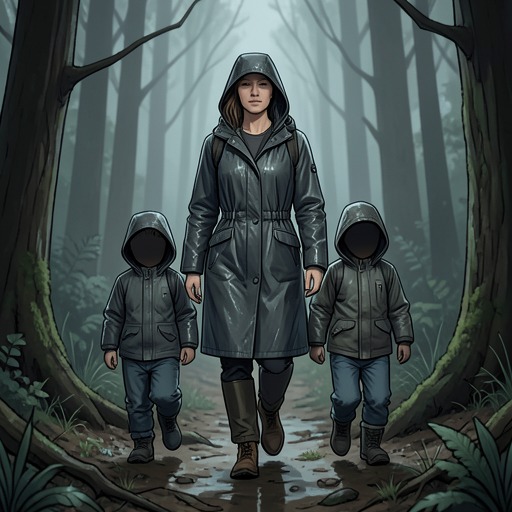
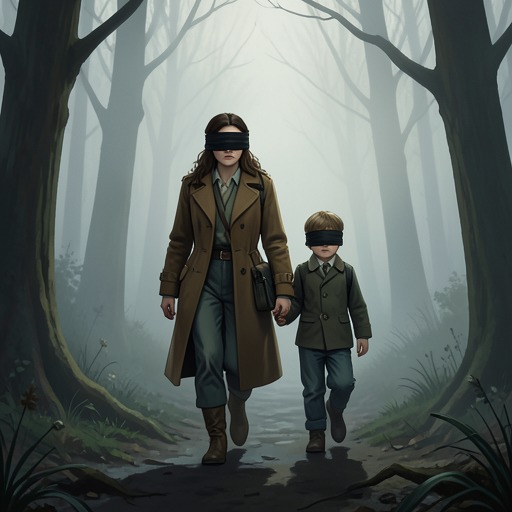
Bird BoxWolves are among the animal dangers that make the river escape perilous for Malorie and the children. Their attack turns the boat’s blindfolded passage into a close struggle in which sound must identify the threat, the children remain exposed, and Malorie must free the craft without being able to see. Against the earlier hope that dogs might help people survive, the wolves show how little control humans retain over animals in the changed world.
Animals in the survival landscape
Before the river attack, animals appear both as companions and as possible aids to survival. When Malorie first enters the living room at the Shillingham house, a border collie approaches her and waits at her feet. Jules identifies him as Victor, says he has had him since he was a puppy, and gives his age as six. Malorie pets him and thinks Shannon would have liked him. Victor is introduced not as a warning device but as a familiar presence associated with the household and its inhabitants.
Animal companionship also informs the survivors’ practical plans. Tom proposes that the group might use dogs to lead a blindfolded expedition, alongside helmets intended to protect their blindfolds and butcher knives to use if an animal went mad and attacked. The plan depends on animals being useful guides, but it also anticipates the possibility that they might become dangerous. Cheryl’s role as a safety net during Felix’s trip to the well expresses the same precariousness in another way: a housemate listens inside the closed back door in case something goes wrong outside, while Felix works blindfolded with a rope around his waist and a bucket secured to the well. These arrangements make human survival depend on careful procedures, not on confidence that the surrounding world is benign.
The river attack
During the escape, something large breaks through the branches as the Girl screams for Malorie. Malorie hears a growl and initially cannot determine whether it comes from the stranger or from one of the creatures. A second growl allows her to identify the sound as canine; she realizes that wolves are attacking. The sequence makes recognition auditory rather than visual: the threat is first an uncertain noise, then an animal presence established by repeated sound.
The attack injures Malorie and leaves the children in immediate danger. As she tries to defend them with the paddle, the rowboat’s bow catches on something and begins to swivel. She hears more growling and understands that a pack is involved. Unable to see what holds the boat, she moves toward the bow while the children scream, the water splashes, and the boat rocks. Reaching into the darkness, she feels one stump and then a second. The boat is wedged against them; the obstacles, rather than the wolves alone, have to be overcome before the family can continue downstream.
Malorie pushes against the obstruction and frees the boat. The attack therefore ends not with a visible confrontation or a confirmed defeat of the pack, but with the immediate escape of the rowboat. The episode shows how the river can serve as a route away from the house while also exposing its passengers to dangers they cannot inspect. Later guidance directs Malorie and the children to take the river despite its risks, estimating that the journey will require at least twenty miles and warning that the river splits. The wolves’ attack gives concrete force to that warning: staying on the route requires continuing into hazards that blindfolded travelers can only detect as they occur.
Animal behavior and the limits of control
The wolves belong to a wider pattern in which animals cannot be treated as stable instruments of human safety. The proposed use of dogs as guides is conditional from the outset: if a dog goes mad, the travelers are to release its leash and defend themselves. In the river scene, the wolves are neither companions nor usable guides; they are a pack acting against the boat while the humans cannot see their position. The contrast exposes the fragility of plans built on animal assistance when the catastrophe has made ordinary expectations unreliable.
Victor’s later behavior deepens that contrast. During Malorie’s return to the house, the dog produces a growl unlike any sound she has heard from him or, as the narration puts it, from any dog on Earth. He moves violently enough that Malorie thinks he has broken free, and the wooden post splinters. Victor had been her last link to the housemates, so this change is also a loss of the familiar bond that his earlier introduction established. The evidence does not identify Victor as one of the wolves or explain the cause of his behavior; instead, it places his altered sound alongside the broader threat of animal instability.
The birds offer a further sign that the effects of the new world extend beyond human beings. Malorie feels what she first takes for rain and discovers that it is a tiny broken bird. She realizes that birds are fighting and killing one another in the sky above her. Together, the friendly household dog, the proposed guide dogs, the attacking wolves, Victor’s abnormal growl, and the dead bird trace a change in the meaning of animal life: animals may offer companionship or warning, but they can also become dangerous or suffer violence beyond human control. Wolves are a particularly stark instance of that uncertainty because their attack is encountered through sound, obstruction, and the perilous effort to keep moving without sight.