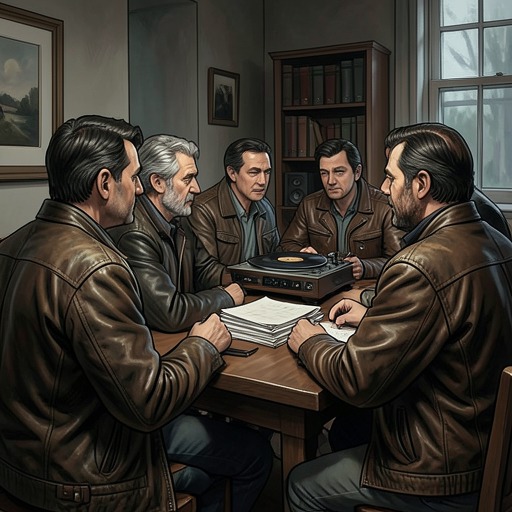
A Pre-History of Late-Stage Capitalism
Blind Willow, Sleeping WomanA Pre-History of Late-Stage Capitalism is the narrator’s retrospective name for the 1960s, a period he recalls as unusually vivid, energetic, and direct. The phrase captures both his generation’s sense of possibility and the limits of its understanding: the decade seemed to make its conflicts and ideals visible, yet its afterglow did not necessarily teach those who lived through it how to make sense of their experience.
Naming a Generation
The narrator locates his perspective in a specific life course. Born in 1949, he entered junior high school in 1961 and college in 1967; he reached twenty during the student movement. He describes his younger self as vulnerable and immature, but also as inhabiting a precious period in a decade organized around living intensely in the moment. The music of Jim Morrison, the Beatles, and Bob Dylan supplies its remembered soundtrack, while the image of kicking open doors gives youthful participation the force of action rather than passive observation.
He calls himself a typical child of the sixties, but does not present that identity as proof that he understood the period. His name for it—A Pre-History of Late-Stage Capitalism—is explicitly personal. It is a retrospective label for an age he experienced from within, not a claim that he can offer a definitive historical explanation of it.
The Feeling of the Sixties
The narrator insists that the decade felt special even while it was happening. Asked to specify what made it so, however, he expects only to stammer out a trite answer. His central comparison is cinematic: his generation was absorbed in an exciting movie, physically caught up in its drama, but after the theater emptied, the exhilaration ultimately seemed to mean nothing. The memory retains the force of the experience while withholding a clear lesson from it.
His account of the period is therefore a catalogue of impressions rather than a neat verdict. It had momentum, energy, and a powerful sense of promise; it also carried a persistent irritation, like looking through the wrong end of a telescope. Heroism and villainy, ecstasy and disillusionment, martyrdom and betrayal, silence and eloquence all seemed sharply outlined. These opposites existed in other periods as well, he acknowledges, but in his generation’s “Our Age” they appeared more colorful and graspable, almost as if displayed together on a shelf.
Directness and Its Limits
The contrast with the present gives the expression much of its meaning. Contemporary reality, in the narrator’s account, comes entangled with hidden advertising, discount coupons, store reward cards, and options imposed before a person understands what is happening. The past, by contrast, seemed to offer things without this accumulation of confusing additions. He recalls taking what was offered directly into one’s hands and carrying it home, comparing the simplicity to bringing home a baby chick from a nighttime stand.
That sense of directness extends beyond consumer life. The narrator remembers cause and effect as close companions and thesis and reality as naturally joined. He suspects the sixties were the last time such a relationship could feel self-evident. Yet his metaphor does not turn the period into an uncomplicated golden age: he admits that he cannot fully explain its specialness, and that the excitement might have passed without yielding understanding. The apparent clarity of the decade is thus both the substance of his memory and one of its unresolved questions.
Youth, Sexual Norms, and Retrospection
The narrator connects his account of the era to its young people and their sexual lives, identifying this as one of his themes. He describes virginity as carrying greater weight in the sixties than in his own present, while qualifying his claim as a general impression rather than the result of a survey. In his estimate, about half the girls of his generation had lost their virginity by twenty; among the girls he knew, the other half seemed still to be virgins, whether by conscious choice or not. The distinction supplies a concrete example of how the era’s social expectations shaped the way young people understood adulthood.
His recollection of a close high-school couple also exposes the limits of youthful perception. The narrator and the boys he spent time with neither mocked the pair nor paid them much attention: they were absorbed by sex, rock and roll, Jean-Luc Godard films, political movements, and the novels of Kenzaburō Ōe. He calls the boys ignorant and conceited, and recognizes that they had no special access to the meaning of life. The couple’s apparently ideal pairing and the boys’ own assumptions belonged to different versions of illusion, not to a simple opposition between purity and sophistication.
Historical Distance and Private Memory
The phrase gains resonance from the way other lives in the book carry history forward. The narrator’s memories of the student movement belong to the same generation marked by the war’s aftermath: Shozaburo Takitani, returning to Japan in 1946 after imprisonment, learns that his parents died in the Great Tokyo Air Raid and that his brother disappeared at the front. His matter-of-fact sense that people eventually end up alone contrasts with the narrator’s retrospective effort to name what his own generation experienced. Elsewhere, Officer Sakata recalls his brother’s death in the 442nd Regimental Combat Team and the lasting change in his mother after the loss. These accounts do not define the narrator’s term, but they show how private recollection can connect an age’s atmosphere to losses that exceed its youthful image of itself.
A later return to a childhood hometown offers another counterpoint to the narrator’s idea of historical clarity. After the recurring nightmares associated with K, the narrator leaves the seaside town for Nagano Prefecture. Much later, after studying K’s watercolor, he knows he must return. The town has been transformed by development: a gift shop has become a mall, a movie theater a supermarket, and the houses and trees familiar from childhood have vanished. His former home is only scraped ground, and K’s house has given way to a parking lot. The altered landscape makes the past tangible precisely by showing that it cannot be recovered intact. A Pre-History of Late-Stage Capitalism names a remembered world whose force remains vivid, even as the narrator recognizes that experience, history, and hindsight do not resolve into a single simple account.