Blind willow
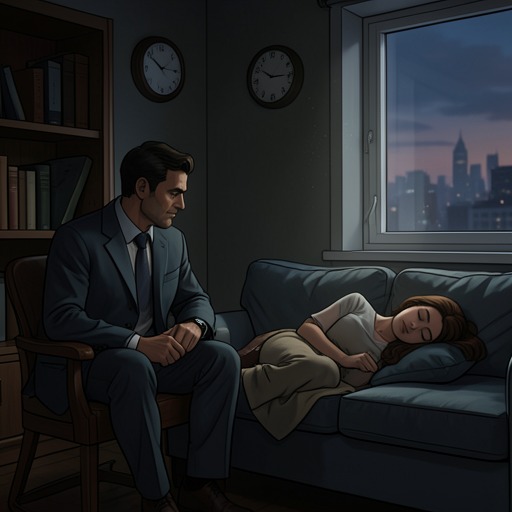
Blind Willow, Sleeping WomanBlind willow is a fictional tree created by a girl in a poem inspired by a dream. Its pollen carries tiny flies into a sleeping woman’s ear, where they consume her; a young man nevertheless climbs the hill to find her. The image returns years later as the narrator remembers the girl’s drawings and recognizes, in the tale’s ruined chocolates and unfinished rescue, the carelessness of a summer afternoon his friend and he failed to understand.
Creation and Description
The blind willow enters the narrator’s recollection through a small gold pen and a paper napkin. The girl draws a hill with a house on top, a sleeping woman inside, and blind willows surrounding it. When her friend asks what a blind willow is, she explains that she invented it. The scene makes the tree’s strangeness explicit: it is neither an inherited legend nor a botanical fact, but an image the girl has made and is now elaborating for her companions.
On a fresh napkin, she draws the tree itself. It is only the size of an azalea, flowering amid dark green leaves that she compares to gathered lizard tails; despite its name, it does not look like a willow. Its diminutive appearance conceals a different kind of scale. The girl says that its roots run incredibly deep: after a certain point, it stops growing upward and pushes farther into the ground, as though darkness nourishes it. The image joins an ordinary, small plant to a hidden, downward expansion, making the tree’s visible modesty a poor measure of its reach.
The Pollen and the Sleeping Woman
In the girl’s account, the blind willow produces abundant pollen, and tiny flies coated with it crawl into a woman’s ear and put her to sleep. The flies do not simply cause a temporary dream or a recoverable rest. They remain inside the woman and eat her flesh. The story’s mechanism moves from a small, nearly invisible agent to bodily invasion and destruction: pollen travels on the flies, the ear becomes an entrance, and sleep leaves the woman unable to resist what happens within her.
The narrator later recalls the image with particular force while examining his cousin’s ear. He imagines the flies nesting in his friend’s girlfriend’s ear, carrying sweet pollen on their legs, burrowing into its warm darkness, drawing out her juices, and laying eggs in her brain. The scene gives physical shape to an earlier invented horror, but its emphasis falls on how difficult the danger would be to perceive: the flies cannot be seen, and the sound of their wings cannot be heard. The ear’s twists and hollows, described as a dark cave, turn an ordinary body part into concealed territory.
The Poem and Its Unfinished Rescue
The girl wrote a long poem about the blind willow during a summer when she was confined to bed for a week. She said the story came from a dream she had one night, and the poem was the only homework assignment she completed that summer. Her friend asked to read it, but she refused because she was still revising it. Rather than share the poem, she drew pictures and summarized its plot, leaving the group with fragments of a work that remained in progress.
One of those fragments introduces a young man who climbs the hill to rescue the woman. In the fuller scene she describes, he pushes through thick blind willows, brushing away swarms of flies with one hand as he slowly ascends. He is the first person to climb the hill since the willows took over, and his purpose is to see the sleeping woman and wake her from her deep sleep. The friend assumes the young man is himself. The girl tells him no, then insists she knows this despite not knowing why. His half-joking anger exposes a small but meaningful difference between his eagerness to claim a place in her story and her refusal to grant him one.
The rescue remains unresolved in the account the girl shares. The friend points out that by the time the young man reaches the top, the woman’s body has essentially been eaten by the flies. The girl answers, “In a sense,” leaving the boundary between awakening and destruction unsettled. The young man’s climb is real within the poem, but the beloved he hopes to reach may already be beyond recovery; the poem’s unfinished, secondhand telling does not convert his effort into a successful rescue.
Return Through Memory
Years later, the narrator’s attention to the blind willow is folded into a memory of taking a box of chocolates to the hospital where the girl was staying. She opened the box happily, only for the visitors to discover that all twelve chocolates had melted, sticking to their paper separators and the lid. The narrator and his friend had left the box in the hot August sun while they parked their motorcycle by the seaside and spent time talking on the beach. Their self-absorption had spoiled the gift before they arrived.
The narrator understands the mess retrospectively as something the visitors should have noticed in time. Either boy could have said something, but neither sensed what was happening; instead, they exchanged foolish jokes, said goodbye, and left the hill still overgrown with blind willows. The collapsed chocolates do not prove a literal connection to the girl’s poem, but the remembered circumstances make the image of a woman consumed while others fail to intervene resonate with their own inattentiveness. The blind willow’s story becomes a means of recovering not just a strange invention, but the failure of two boys to recognize what their carelessness had already done.