God of jazz
Blind Willow, Sleeping WomanThe “god of jazz” is the narrator’s joking name for a force that appears to answer his musical wishes and align an ordinary moment with the title of a record. The phrase captures the tension at the heart of the coincidences: he is not committed to the supernatural, yet their precision makes chance feel briefly addressed to him.
The Name and Its First Appearance
The expression emerges from two incidents involving jazz. In the first, the narrator is watching pianist Tommy Flanagan and privately imagining how perfect it would be if he played two particular pieces. Flanagan gives no sign of having noticed him, but closes his set with exactly those choices: first the ballad “Star-Crossed Lovers,” then an up-tempo “Barbados.” The narrator is left speechless, not only because the selections match his unspoken wish, but because he considers both performances extraordinary.
The coincidence has a concrete musical history. The narrator knows Flanagan’s crisp, memorable playing on both pieces: “Barbados” appeared on a 1957 album with the J. J. Johnson Quintet, while “Star-Crossed Lovers” appeared on a 1968 album with Pepper Adams and Zoot Sims. That knowledge explains why these were his requests, but cannot explain why Flanagan chose them at that moment. The “god of jazz” names the gap between the narrator’s informed expectation and the astonishing result.
The Record-Store Coincidence
The second incident takes place near the Berklee School of Music, in a used-record store. The narrator finds a mint-condition first pressing of Pepper Adams’s 10 to 4 at the 5 Spot for seven or eight dollars. He already owns the Japanese edition, but has played it so often that it is scratched; finding an original in such good condition at such a low price feels like a minor miracle.
As he leaves the shop, a young man asks him the time. The narrator checks his watch and answers, “Yeah, it’s ten to four.” Only after speaking does he register the match between the time and the record’s title. He imagines the god of jazz hovering above Boston and winking at him, a comic image that turns an accidental verbal echo into a moment of apparent recognition. Neither incident changes the direction of his life, but together they make him attentive to the possibility that improbable alignments do occur.
Chance Without a Supernatural Verdict
The narrator distinguishes his response from belief in occult powers. Fortune-telling and paranormal phenomena do not interest him; when faced with a problem, he would rather think through a solution than consult a fortune-teller. He does not insist that supernatural things are impossible, but says they hold no personal appeal. The jazz-god image therefore works less as a doctrine than as a lighthearted way to describe an experience that ordinary explanation leaves emotionally vivid.
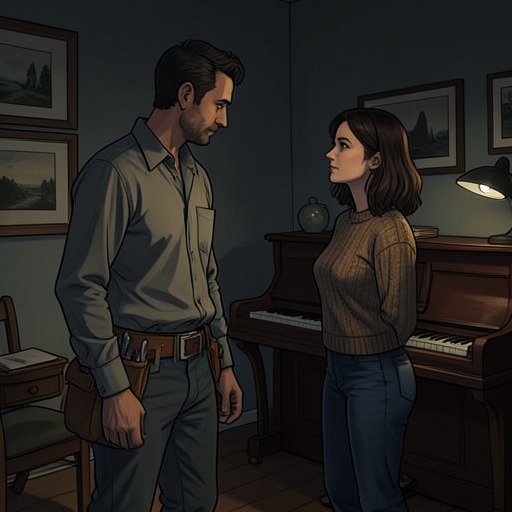
A later conversation offers another account of coincidence. The piano tuner suggests that such events may be common, while most pass unnoticed, like fireworks in daylight: faintly audible, but invisible in the bright sky. When someone is hoping for something, however, an occurrence may rise into view like a message and seem legible. The narrator considers this explanation but remains unconvinced that everything can be neatly accounted for. He says he would rather believe in something simpler, like a god of jazz. The phrase preserves both possibilities: coincidences may be everywhere, or a playful presence may seem to answer a particular wish.
A Motif Left Open
The god of jazz is not presented as a force that demonstrably controls events. The narrator explicitly says the incidents did not redirect his life, and the story supplies no proof that Flanagan’s selections or the time at the record shop were anything but chance. Their significance lies in the vividness with which coincidence can be experienced: a private hope appears to meet the world, and a record title seems to speak through an ordinary question.
The motif also keeps the ending open. The narrator has no news about the piano tuner’s later life or whether he encountered the woman from the bookstore café again. He imagines that the tuner may still drive across the Tama River to the café on Tuesdays, but cannot confirm it. That uncertainty echoes the god of jazz itself: a name for an alignment one can notice and cherish without being able to prove what, if anything, stands behind it.