Greece
Blind Willow, Sleeping WomanGreece becomes the refuge chosen by the narrator and Izumi after their affair destroys both marriages, and later the setting of a spare, improvised life on a small island near Turkey. The move promises distance from the wreckage in Japan, but the life they find there is defined less by renewal than by isolation, repetition, and the uneasy intimacy of two people living with what they have done.
The decision to leave Japan
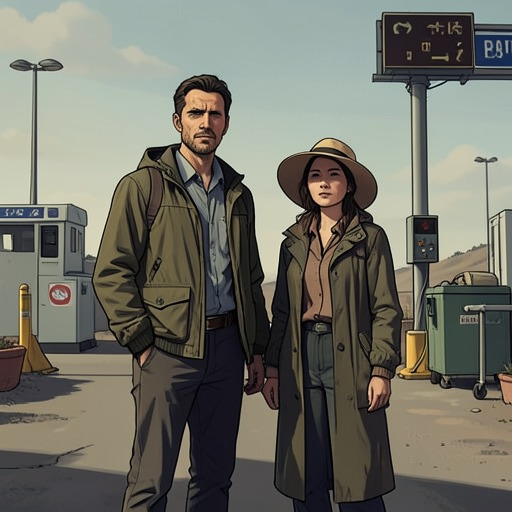
After the affair is exposed, the narrator’s wife takes their son to her parents’ home in Chigasaki, while Izumi’s husband leaves her after beating her and cutting her clothes to pieces. The couple meet in Shibuya and drink through the night; at dawn, over coffee and breakfast at a Denny’s in Harajuku, Izumi proposes Greece. She has long wanted to go there, once imagining it as a honeymoon destination, and argues that staying in Japan will only depress them.
Their plan is as practical as it is desperate. Izumi has two and a half million yen in savings, the narrator another one and a half million: four million yen in all. She estimates that discount air tickets will cost about four thousand dollars, leaving enough to live in the Greek countryside for perhaps two and a half years, or three if they stretch it. The narrator has no particular interest in Greece, but agrees. The destination is selected not through an established attachment to the country but as a way out of a life that has abruptly become unlivable.
The island and its history
The couple settle in an efficiency apartment on a small Greek island they had never heard of before arriving. They choose it in the off-season, when rent is cheap; it is not much of a tourist destination. Near the Turkish border, the island lies closer to the Turkish shore than to the next Greek island, and on clear days the greenish mountains of Asia Minor are visible. The locals joke that on windy days the smell of shish kebab carries over from Turkey. The landscape makes the border feel immediate: the couple are in Greece, but Asia is plainly in view.
In the town square stands a weathered statue commemorating a hero of Greek independence. He had led an insurrection on the Greek mainland and planned an uprising against the Turks, who then controlled the island. Captured and executed on a sharpened stake, he is remembered at the place where the killing supposedly occurred. Sea wind, dust, and gull droppings have worn away his features, and the islanders scarcely look at the shabby monument. Its physical decay sits beside the brutality of the story it preserves: the island’s everyday quiet contains a history of violent rule and resistance, largely ignored by those who pass through the square.
Life in the off-season
The island gives the couple distance from Japan but little structure. They do not work and have no friends; there are no cinemas, tennis courts, or books to read. The narrator, who loves reading, has brought no books in their abrupt departure. He rereads two novels bought at the airport and the tragedies of Aeschylus that Izumi brought, then finds nothing appealing among the English paperbacks sold at the harbor kiosk. The unexpected abundance of free time becomes a shortage: the imagined pleasure of reading cannot be realized because the couple have arrived unprepared for the stillness they sought.
Izumi studies Greek from a textbook, carrying around a chart of verb conjugations and reciting them aloud until she can speak, haltingly, with shopkeepers and café waiters. Through her, the couple make a few local acquaintances. The narrator tries to revive his French, but finds no French speakers; they get by in English, while some older islanders know Italian or German. Their language efforts thus develop unevenly: Izumi’s Greek opens small social connections, whereas his French has no practical use.
With little else to occupy them, they walk around the island and try fishing in the harbor. They catch nothing, not because fish are scarce but because the water is so clear that the fish can see the hook and the person holding it. The narrator buys a sketchbook and watercolors, drawing scenery and local people while Izumi studies beside him. Residents gather to watch; when he gives them portraits, they sometimes repay the drawings with a beer, and one fisherman gives the couple a whole octopus. Art and language lessons become modest ways of entering a place where their original plan has left them without work, books, or an established community.
A refuge made of routines
The couple’s life on the island settles into a narrow daily pattern. On sunny days they walk to the harbor, buy an Athens English-language newspaper, and sit at a café beside the tax office. The narrator reads articles and summarizes them in Japanese for Izumi, although her English is fluent enough for her to read the paper herself. She explains that she has always dreamed of sitting in a sunny place with someone reading aloud, and that no one had done so for her before. She values not only the articles but the narrator’s voice; he, in turn, enjoys reading aloud and recalls doing so for his son in Japan.
One day, he reads her a report about a seventy-year-old woman in an Athens suburb who lived alone with three cats. After she collapsed, apparently from a heart attack, a week passed before anyone found her. With the doors and windows shut and no food available, the trapped cats eventually ate her body. The article brings death and isolation into the couple’s otherwise modest ritual of coffee and shared reading. Their time in Greece has not erased the losses that drove them there; in this scene, the daily practice they have made together gives those losses a quiet, unsettling form.
The island is therefore neither a simple escape nor a restored home. Its cheap apartment, visible Turkish coast, neglected monument, clear water, language lessons, sketches, and repeated newspaper readings make up a life assembled from small routines. Greece provides the couple with the distance they asked for, while the stories and absences that accompany them remain present within that distance.