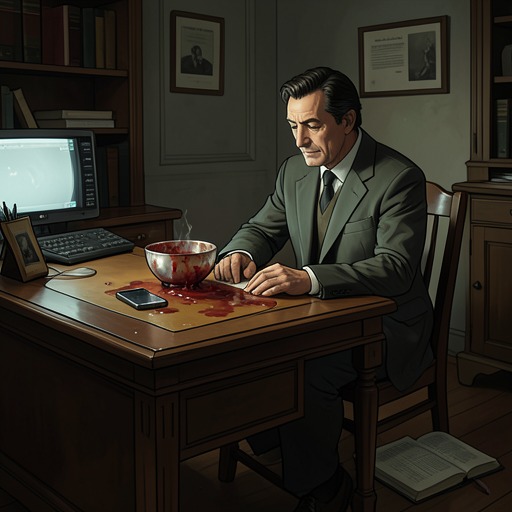
Illustrator’s Forty-Day Vomiting Episode
Blind Willow, Sleeping WomanThe Illustrator’s Forty-Day Vomiting Episode is a precisely dated bout of unexplained vomiting that runs alongside a series of anonymous calls and then ends as abruptly as it began. The illustrator describes forty consecutive days of vomiting, often without feeling ill, while a caller repeatedly says his name and hangs up. Neither doctors nor the narrator can establish a cause or connection. The episode’s close tracking of food, bodily routine, and telephone calls makes the ordinary mechanisms of eating and communication feel unreliable, while its carefully recorded ending offers certainty about dates but none about meaning.
The First Day and the Changed Sensation
The first bout came on June 4, after the illustrator had drunk heavily and slept with a friend’s wife the previous night. At eight in the morning he vomited the contents of his stomach. In isolation, that might have seemed an unsurprising consequence of the night before; what unsettled him was that he did not feel sick. He flushed the toilet, sat down at his desk, and worked with unusual vigor. By noon he had a healthy appetite.
After making a ham-and-cucumber sandwich and washing it down with beer, he vomited again half an hour later. He described the food rising without the familiar knot in the stomach, discomfort, resistance, or suffocating smell. The episode did not feel like ordinary nausea brought on by drinking or travel. Because it happened twice in one day, he began to worry and decided to avoid alcohol. The next morning, however, he vomited again, bringing up eel and an English muffin with marmalade almost intact.
Forty Days Beside the Telephone
The illness continued every day from June 4 through July 14, and the calls began during the same stretch. A man’s voice said the illustrator’s name, then the line went dead. The caller did not identify himself or explain why he was calling. The illustrator rejected the suggestion that it was a jealous husband or boyfriend: he knew the voices of the women he had slept with, and this voice was unfamiliar, with a nasty ring to it.
The calls arrived once a day, but at no predictable hour; they might come in the morning, evening, or middle of the night. The illustrator could have stopped answering, but the telephone was also how he received work and calls from women. He therefore remained exposed to the interruption, never knowing when the same brief exchange would recur. He noticed that the calls and vomiting coincided almost exactly, although he could not explain how one might cause the other.
He vomited almost everything he ate, then became hungry and ate again, making the days a cycle of appetite and expulsion. He estimated that he kept down roughly one meal in three, probably just enough to stay alive. The recurrence was not a vague impression: the illustrator tracked the pattern closely enough to distinguish the calls from the vomiting and preserve the end of each in his diary.
Medical Tests and the Hotel Turning Point
Concerned that the vomiting might indicate cancer, the illustrator went to a fairly large neighborhood hospital. He underwent X-rays and urine tests, but the doctors found nothing wrong; he was pronounced the picture of health. They prescribed medicine for what they called chronic stomach fatigue or perhaps stress, and advised him to go to bed early, get up early, drink less, and avoid letting small things bother him. He dismissed this explanation because the familiar signs of stomach trouble—heaviness, heartburn, and loss of appetite—were absent. He was often hungry, felt well apart from the vomiting, and remained mentally clear.
A later call was followed by the illustrator vomiting every last bit of a meal of fish and rice. He experienced the timing as if the call had opened a door through which nausea could enter. At a hotel, he considered two possibilities: someone might have discovered where he was and arranged a malicious call, or he might have imagined hearing the phone and the voice. He asked the front desk to check whether a call had come in, but its system recorded outgoing calls only, leaving no way to verify the incoming one.
The hotel stay became a turning point not because it solved the mystery, but because it made the illustrator take the coincidence seriously. He spent two nights there, then returned to his apartment; the vomiting and calls continued. He also stayed with friends to see whether changing location would make a difference. The calls followed him, always when he was alone in their houses. The sense of an unseen presence that knew when to call and when to make him vomit sharpened his unease, though he recognized that worrying about schizophrenia did not itself explain what was happening.
Exact Endings, Unresolved Cause
The illustrator’s diary gives the final day an unusual precision. At 9:30 in the morning on July 14, he vomited toast, tomato salad, and milk. At 10:25 that night, while listening to Erroll Garner’s Concert by the Sea and drinking Seagram’s VO, he received the last call. The caller said his name, as before, but then added, “Do you know who I am?” He waited in silence for ten or fifteen seconds. The illustrator said nothing, and the caller hung up; only the dial tone remained.
The following morning brought neither another call nor another bout of vomiting. Both stopped all at once and never returned. The illustrator compared the sudden disappearance to the end of a Hitchcock film in which one opens the door and finds that everything is gone. He regained the weight he had lost, returning to 140 pounds, and kept the suit and two pairs of trousers made for his thinner body hanging in his closet as souvenirs. The final clothes preserve a material trace of the episode, but not an explanation for it.
Routine, Record, and Ambiguity
Food provides the episode’s most concrete measure of disturbance. The illustrator’s account moves through specific meals and their return: a sandwich, eel, marmalade toast, fish and rice, then toast, tomato salad, and milk on the last morning. Hunger repeatedly follows vomiting, only to begin the cycle again. His body’s rejection of food is at odds with his clear mind and sense of physical well-being, separating this experience from the ordinary illness doctors sought to diagnose.
The daily calls impose a second routine, equally exact in repetition and equally resistant to interpretation. The caller’s first and last known words are the illustrator’s name, with the final question breaking the established pattern but yielding no answer. The diary can fix the last vomiting at 9:30 a.m. and the last call at 10:25 p.m.; it cannot determine whether the two phenomena shared a cause, whether the caller knew anything about the illness, or even whether every call was real. That distinction between a reliable record of events and an unknowable explanation is central to the episode’s force: its pattern is unmistakable, but pattern alone does not resolve the mystery.