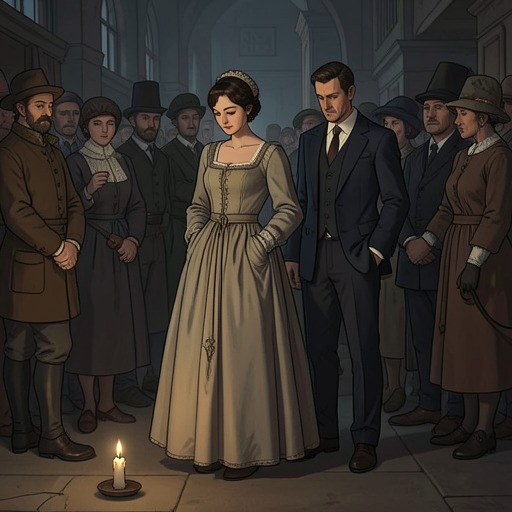
Junpei and Kirie
Blind Willow, Sleeping WomanJunpei and Kirie’s relationship begins as an unplanned meeting and ends without a confrontation, but its quietness conceals a decisive change in Junpei. He has long managed relationships so that they can dissolve without conflict; Kirie, by contrast, names the limits she needs and pursues a life organized around intense concentration. Her absence reveals to Junpei the weight of an attachment he had not known how to measure, and leads him to reject the countdown that once governed his thinking.
Meeting and Early Intimacy
Junpei meets Kirie at a party for the opening of a small French restaurant on a street leading out of central Tokyo. He is thirty-one; she is thirty-six. A friend has canceled their plan to meet, leaving Junpei alone with a glass of Bordeaux at the bar. As he prepares to leave, the tall woman approaches him with a purple cocktail and asks whether he is a writer. She introduces herself as Kirie. Junpei notices her composed bearing and distinctive, individual style, and their conversation begins with his uncertain description of himself as a writer.
The encounter grows into a repeated, easy intimacy. Kirie spends the night in Junpei’s room, and the next morning he wakes to find she has gone to work, leaving a note with her phone number. He calls, and they meet for dinner the following Saturday; again, she leaves early the next morning, this time writing that she has to work and is disappearing. Junpei does not yet know what her work is, but he learns that it can begin early and sometimes take place on Sundays. Their relationship is not confined to physical closeness: they have plenty to discuss, and Kirie’s wide-ranging knowledge and sharp mind impress him. She reads biography, history, psychology, and popular science, and Junpei is particularly struck by her detailed knowledge of prefabricated housing.
Different Terms for Intimacy
The relationship takes shape around a difference that Kirie states plainly. She tells Junpei that she likes him deeply and feels happy and calm when they are together, but does not want a serious relationship. When she asks whether that relieves him, Junpei does not answer directly; he asks why she wants to keep their relationship that way. Her explanation is not specific to him: she cannot have a serious everyday relationship with anybody. Living with someone or becoming deeply emotionally involved, she says, could interfere with concentrating completely on what she is doing. She wants their existing arrangement to continue rather than risk that distraction.
Kirie’s boundary unsettles Junpei, even though it resembles the distance he has maintained in other relationships. For months, he has tended to observe a new partner until some small irritation or point of discomfort gives him a private sense of relief; relationships then fade without quarrels. His father’s theory that a man has three women of real meaning has also become an obsession for him, despite Junpei’s estrangement from his father after a violent argument around the time he graduated from college. He has wondered whether changing the object of his desire might free him from the supposed countdown, but recognizes that women remain the focus of his sexual interest. Kirie becomes important not because she fits comfortably into this pattern, but because she makes its limits visible.
The Story and the Silence
Kirie’s presence enters Junpei’s writing. After finishing a story he feels she has, in a sense, inspired, he tries to call her, intending to let her read it. The call cannot be completed. He repeats it, assumes there may be a technical problem, and waits for her to get in touch. A month passes, then two, then three; winter arrives, the new year begins, and the story appears in the February issue of a literary magazine under the title “The Kidney-Shaped Stone That Moves Every Day.” Junpei hopes Kirie might see the advertisement, read the story, and call to tell him what she thinks. Nothing comes but further silence.
The story he has written gives their relationship an unsettling imaginative echo. In its conclusion, a doctor parts with her surgeon lover, throws a dark kidney-shaped stone from a ferry into the sea, and resolves to begin again. The stone returns to her desk the next day, only to disappear later for good. This invented sequence is distinct from the events between Junpei and Kirie, but its movement from attempted separation to return gives form to the question Junpei cannot settle: whether a bond can simply be cast away, or whether its meaning persists beyond the moment of parting.
Kirie and the Wind
Junpei next hears Kirie rather than meeting her. In early spring, while he is in a taxi held up in traffic, her voice comes over the radio. At first he only thinks it resembles hers; then he recognizes her measured, relaxed way of speaking. The interviewer explains that Kirie is a high-rise tightrope performer. She assembles sponsors for performances, has appeared at a cathedral in Germany, and wants to keep challenging herself on buildings higher than those she has crossed before. She also runs a window-cleaning company because the performances do not provide a living. Her ambition is specifically directed toward high-rise buildings.
Kirie describes the height as a place where she must change herself in order to survive. Once she steps out into that space and concentrates fully, she says, fear vanishes; there is only her and the wind, which envelops and rocks her, and which she feels understands her. She imagines the two of them accepting one another and continuing to live together. There is no room there for anybody else. The declaration makes her earlier boundary newly legible: her refusal of an everyday partnership is not a concealed rejection of Junpei alone, but part of a life whose central commitment is this solitary encounter with the wind. Hearing it, Junpei gets out of the taxi and walks the rest of the way, looking up at tall buildings and passing clouds. He realizes that no one can come between Kirie and the wind, and feels a forceful jealousy whose object he cannot make ordinary sense of.
Separation and Junpei’s Change
For several more months Junpei waits for Kirie to contact him and wants to talk with her, including about the kidney-shaped stone. His calls still cannot be completed. When summer comes, he gives up hope of seeing her again. Their relationship ends quietly, without quarrels or shouting, in the same outward manner as the earlier relationships Junpei had allowed to dissolve. Yet this familiar ending no longer means that the attachment was slight. The silence exposes a loss more painful than he had anticipated: he repeatedly wishes Kirie were there, misses her smile and speech and the closeness they shared, and finds no comfort in music he loves or new books by favored writers. Even these sources of pleasure feel remote. He begins to think that Kirie may have been woman number two.
Junpei postpones deciding whether to count her among the three women of real meaning. During the six months he gives himself, he writes a large number of short stories and often imagines Kirie at some height with the wind, while he remains alone at his desk. Recalling her words, he recognizes a feeling unlike anything he has felt for another woman: deep, definite, and not exchangeable for anything else. He cannot fully name it, and the possibility that he may never see her again does not diminish its lasting presence; he expects to continue feeling her absence.
At the end of the year, Junpei decides that Kirie was the second woman of real meaning in his life. But the decision does not leave him frightened by the prospect of the third. He concludes that numbers are not what matter and that the countdown has no meaning beside the decision to accept another person completely. The relationship therefore ends in separation, not reunion, but changes the terms by which Junpei understands love: what matters is not whether Kirie returns, but that he has learned to acknowledge the full weight of having accepted her.