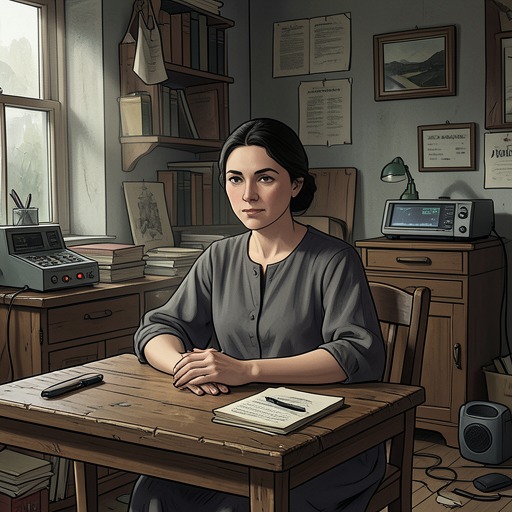
Mizuki Ando's episodic inability to recall her name
Blind Willow, Sleeping WomanMizuki Ando’s episodic inability to recall her name turns an ordinary act of identification into a recurring rupture in her sense of self. The lapse is strikingly specific: she remembers other people, numbers, and practical details, but under sudden questioning her own name disappears. As the episodes become more frequent, a name that links her to marriage, work, and public life becomes a fragile point of access to herself; the story ultimately connects that failure to two stolen name tags.
The Shape of the Lapse
Mizuki’s difficulty appears most often when someone unexpectedly asks her name. At a boutique, a clerk asking how to address her while arranging a dress alteration can leave her blank; on the telephone at work, the same question can interrupt a conversation while she searches her purse for her driver’s license. The pause is visible to the other person, who may wonder what has happened, while the license provides a practical but awkward way back to her identity.
The failure depends on surprise. When Mizuki brings up her name herself, or knows in advance that she will be asked, she can remember it. But when she is hurried or caught off guard, effort does not help: the more she struggles to retrieve the name, the more completely a featureless blank seems to occupy her mind. The symptom is therefore not a general inability to remember, but an episodic breakdown tied to the moment her identity must be stated for someone else.
Everything beyond her own name remains available. Mizuki remembers other people’s names, her address, telephone number, birthday, passport number, and the phone numbers of friends and important clients. She has always had a decent memory. The contrast makes the lapse both narrower and more disturbing: she can supply the surrounding facts of her life while losing the word by which she is known.
A Name Between Marriage and Work
The name at issue is not simply one fixed label. Mizuki’s married name is Mizuki Ando, while her maiden name is Ozawa. She married Takashi Ando in the spring three years before the events described. At first, the new name felt and sounded wrong to her; repeating it and signing it gradually made it more familiar, until she could feel comfortable with it. Yet the name she has laboriously adopted is the one that later begins to slip away.
At work, she continues to use Mizuki Ozawa. Changing her official workplace records would require her to update the dealership’s computer data herself, so she keeps postponing the paperwork and eventually settles into using her maiden name. It remains on her business cards, name tag, and time card, and colleagues address her in several familiar forms, including Ozawa-san, Ozawa-kun, Mizukisan, and Mizuki-chan. The arrangement is practical rather than a deliberate attempt to reject her married name: if someone else handled the changes, she would be willing to use Mizuki Ando at work.
Her husband knows she uses Ozawa professionally and accepts it as a matter of convenience. The story thus places the memory problem amid several legitimate, everyday versions of her name: the name she acquired through marriage, the maiden name retained at work, and the forms of address used by colleagues. But it does not explain the episodes as mere confusion between those names. The lapse persists even though Mizuki can ordinarily manage the distinction, and neither name is especially unusual or dramatic.
Fear, Diagnosis, and Concealment
As the blank episodes grow more frequent—from roughly once a month at first to at least once a week—Mizuki begins to fear that they signal a serious illness. She wonders whether forgetting her own name could be an early sign of Alzheimer’s or another disease whose initial symptoms might be slight. The thought of an unknown illness spreading through her body transforms an odd inconvenience into a source of sustained anxiety.
A doctor at a large hospital asks whether she forgets anything besides her name. When she says she does not, he dismisses the problem as more likely psychiatric and tells her to return if she begins forgetting other things, when tests could be run. His response offers no explanation for the sharply selective symptom and leaves Mizuki without the reassurance she had sought.
She also keeps the problem from Takashi. She expects him to interpret it as proof that she is unhappy with their life together. In her view, he is overly logical, habitually theorizes about matters, and tends to persist once he has begun an argument; she does not think he means harm, but the mismatch in how they approach the world makes disclosure unattractive. Her silence keeps the symptom private within her marriage even as its effects depend on encounters with other people.
To avoid being caught without a way to identify herself, Mizuki buys a thin, simple bracelet and has it engraved with “Mizuki (Ozawa) Ando.” She wears it whenever she leaves home, relying on the name written on her wrist rather than repeatedly pulling out her driver’s license. The precaution is concrete and effective as a workaround, but it also makes the loss palpable: she compares the need to carry her name visibly to being a cat or dog with an identifying tag.
The Name Tags and the Explanation
Mizuki eventually seeks help through the counseling center opened by the Shinagawa Ward office. At a later appointment, the counselor, Mrs. Sakaki, tells her that she has discovered the reason for the lapses and that a solution has been found. Mizuki asks whether she will stop forgetting her name; Mrs. Sakaki answers that the problem has been solved.
The explanation is that Mizuki’s name tags were stolen, and that their theft is why she has trouble remembering her name. Mrs. Sakaki says that she recovered them so Mizuki can recover her name, then directs her to ask the person responsible how the tags could have been taken and for what purpose. The disclosure shifts the story’s account of the symptom away from disease and toward a literal, uncanny loss: the name that Mizuki struggles to recall has also been taken from the objects that publicly bear it.
The episode’s resolution binds identity to both language and material signs. Mizuki’s names already vary across marriage and workplace, and her bracelet has become a portable substitute for memory. The stolen tags extend that pattern: her difficulty is presented not only as an inward failure of recall but as a disturbance in the things through which she is recognized. Recovering the tags is therefore offered as the condition for recovering the name, though the explanation arrives through Mrs. Sakaki’s startling assertion rather than a medical account.
Narrative Significance
The symptom makes self-identification contingent on circumstance. Mizuki does not cease to exist when she cannot remember her name, and she retains many facts that locate her in the world; nevertheless, the sudden blank leaves her feeling like a nobody, a woman without a name. The distinction between continued existence and temporary loss of a usable identity gives the episodes their peculiar force: what fails is not her whole memory but the word required at the threshold of social recognition.
The story also sets the ordinary bureaucracy of naming beside an extraordinary theft. Mizuki’s workplace name remains Ozawa partly because changing computer records is too much trouble, while her married name has taken time to become familiar. Her bracelet records both surnames, and her name tag belongs to a daily working identity. Against these mundane arrangements, Mrs. Sakaki’s claim that the tags were stolen and their recovery can restore Mizuki’s name makes the material token seem capable of carrying more than a label. The unexplained gap between ordinary memory, public naming, and the counselor’s supernatural-sounding solution is central to the state’s meaning.