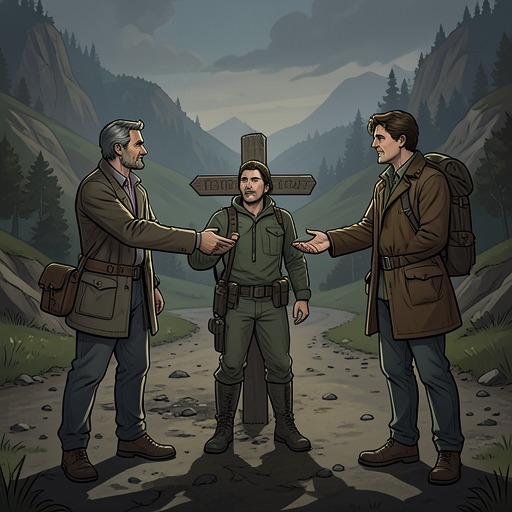
Mr. Murakami
Blind Willow, Sleeping WomanMr. Murakami narrates “Nausea 1979” as a listener drawn into an illustrator’s account of forty days of vomiting and anonymous phone calls. He is neither a doctor nor an investigator capable of settling the matter. Instead, he asks questions, tests possible explanations against the details, and leaves the story suspended between bodily illness, psychological distress, and an external threat.
Identity and Narrative Position
Mr. Murakami is the first-person narrator of the story’s framing conversation. He and the illustrator are friends who collect jazz records, and their meetings to trade albums give their relationship a familiar, unceremonious setting. The account of the illness begins after one such trading session, while the two men are drinking whiskey in the illustrator’s apartment and their conversation has moved from music to alcohol and drunkenness.
This framing makes the extraordinary story arrive as personal testimony rather than as a confirmed case history. Mr. Murakami is present to hear and question it, but the events of 1979 are recounted by the illustrator. The narrator’s role is therefore double: he gives the reader access to the story, while his responses expose how little either man can establish with certainty.
Listening to the Account
When the illustrator says the vomiting continued every day for forty days, Mr. Murakami asks whether he saw a doctor. The question turns the conversation from anecdote toward diagnosis, but the answer does not resolve the episode. The illustrator describes hospital tests, including X-rays and urine tests, and says that doctors found no physical explanation. Their diagnosis of “chronic stomach fatigue” or stress strikes him as a poor fit: he says he felt well apart from the unexplained vomiting.
The narrator also hears how the calls and the nausea seemed to operate together. The illustrator says that the phone calls followed him even when he stayed with friends, arriving when he was alone, while the vomiting continued without a day’s break. Mr. Murakami does not treat this coincidence as proof of a supernatural cause or of a single medical explanation. He listens as the illustrator reports that the university hospital’s psychiatrists would not take him on and that the police dismissed the calls as crank calls, leaving him to feel that no institution would help.
Questions and Competing Explanations
Mr. Murakami’s questions do not claim expertise; they make room for uncertainties the illustrator cannot settle. When the illustrator wonders whether unconscious guilt could have produced nausea or made him hear nonexistent voices, Mr. Murakami corrects the attribution: that is the illustrator’s own suggestion, not his. The distinction keeps a possible psychological reading in view without endorsing it as fact.
He then proposes another possibility: someone deceived by the illustrator’s sexual relationships might have hired a private detective to follow him and make the calls, while the vomiting could have been a temporary condition coinciding with them. The illustrator notes a difficulty with this theory: he did not stop sleeping with the women, yet the calls suddenly ceased. Mr. Murakami offers further possible explanations, including that the person behind the calls gave up or ran out of money, but stresses that the difficulty is deciding which theory to accept and what to learn from it.
Limits of His Witness
The illustrator asks Mr. Murakami what he himself would have done. Mr. Murakami says he does not know, and explicitly confirms that this is not a pose: he has no idea. His candor marks the boundary of his role. He can listen, ask, and imagine explanations, but he cannot reconstruct the unseen cause or tell the illustrator how to act.
That restraint is central to the narration. Mr. Murakami helps organize the account by probing its medical, psychological, and interpersonal possibilities, yet none becomes definitive. The story gives the reader a witness to the telling, not a solution to the mystery; its uncertainty remains part of what the narrator faithfully conveys.