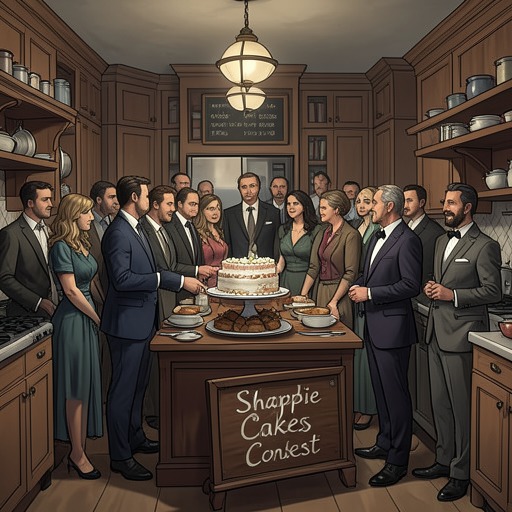
Sharpie Cake competition’s Crow taste test
Blind Willow, Sleeping WomanThe Sharpie Cake competition’s Crow taste test turns a dispute over what counts as a Sharpie Cake into a trial by the company’s own living tradition. After the entrant learns that the board has delegated its decision to the Sharpie Crows, he is brought to their guarded quarters and watches the birds react to his new cakes. The test ends in chaos, not a clear judgment: some crows eat the cakes, while others reject them, and the flock turns against itself. He leaves the competition, giving up prize money that could have helped him marry his girlfriend and move into a new apartment.
The contest and its stakes
The entrant decides to compete after hearing that the Sharpie Cake Company wants new products based on its established confection. He has a month to make a cake inspired by Sharpies, and the prize is two million yen. That sum has a concrete purpose for him: it could enable him to marry his girlfriend and move into a new apartment. Confident in his ability to make bean jam, cream fillings, and pie crusts in different styles, he prepares two dozen new Sharpie Cakes and delivers them on the due date.
The test therefore puts more at stake than an argument about recipes. The entrant sees the competition as a chance to apply his skill and improve his circumstances. The company, meanwhile, has solicited new ideas because it considers its traditional confection in need of renewal. The eventual trial will pit this call for change against an unusually literal authority grounded in the old product.
The crows as judges
The board’s decision to let the Sharpie Crows determine the winner comes as a surprise to the entrant. The managing director explains that the birds are a special family that has survived for centuries on nothing but Sharpie Cakes. Their quarters lie beyond a heavily secured door on the sixth floor: a cavernous room with high ceilings and long perches, occupied by more than a hundred unusually large crows.
Their role turns the company’s heritage into a judging mechanism. The birds’ lifelong dependence on the original cakes is presented as the reason their response can decide whether a new product qualifies. But the arrangement also leaves the entrant facing a test whose rules are starkly simple: the director says that if the crows eat his cakes, he wins; if they do not, he loses. The company has delegated a cultural dispute to appetite, without offering a more discriminating standard.
The taste test breaks down
When the director scatters the new cakes across the floor, the crows’ responses divide. Some eat them eagerly; others spit them out and call for Sharpies. Birds unable to reach the cakes become agitated, and the feeding turns into conflict among the flock. The entrant objects that the director has presented the cakes too suddenly and that the stimulus was too strong. His protest registers the immediate failure of the test: rather than calmly establishing whether the new cakes count as Sharpies, the procedure has intensified the birds’ reaction.
The scene makes the distinction between a Sharpie and a non-Sharpie a matter of life and death for the crows. The original confection is not merely a taste they can compare with an alternative; it is the sole food on which their special family has depended for centuries. Their conflicting responses expose the weakness of treating that inherited dependence as an impartial standard for judging innovation. The birds’ authority is absolute within the contest, but their reaction produces no orderly consensus.
Withdrawal and consequence
The entrant leaves the room alone, takes the elevator down, and exits the Sharpie Cakes building. He knows he is forfeiting the two-million-yen prize, money that could have supported marriage and a move to a new apartment. Even so, he refuses to spend the rest of his life connected to the crows. His withdrawal is not a victory in the competition, but a decision to reject the terms on which the company has made him compete.
He resolves to make and eat the food he wants instead of shaping his work around the crows’ judgment. The ending thus brings the contest’s practical stakes and its comic horror together: the opportunity to change his life is real, yet he abandons it when winning would bind him to an institution whose tradition has become an oppressive, self-perpetuating test. The crows remain with the company and its cakes; the entrant leaves to reclaim his own choice.