Tetsuko Sakaki
Blind Willow, Sleeping WomanTetsuko Sakaki is a counselor at the Shinagawa Ward Office counseling center whose attentive, unshowy manner proves more consequential than her modest surroundings suggest. As Mizuki Ando’s counselor, she listens to Mizuki’s recurring inability to remember her own name, gradually identifies the hidden cause, and helps recover the two stolen name tags. Her character joins practical care to an unexplained perceptiveness: she treats Mizuki’s distress seriously while pursuing a solution that the ordinary counseling office could not have anticipated.
Identity and Introduction
Sakaki is a short, heavyset woman in her late forties, with short light-brown hair, a broad face, and an amiable smile. At her first meeting with Mizuki, she wears a light summer suit, a shiny silk blouse, artificial pearls, and low heels. Her appearance suggests a friendly neighborhood housewife more than a specialist, an impression that becomes important when Mizuki initially doubts whether she can help.
Sakaki explains that her husband works at the ward office as section chief of the Public Works Department, and that his position helped secure support for the counseling center. The program is new, and Mizuki is its first client. Sakaki welcomes her warmly and proposes that they take their time, since she has no other appointments that day. She speaks slowly and deliberately, a manner that sets a calm pace for the conversation rather than pressing Mizuki toward a quick explanation.
The Counseling Relationship
The center’s modest furnishings make its newness tangible. Sakaki sits behind a plain metal desk while Mizuki takes a place on an old, musty sofa with failing springs. Sakaki acknowledges that the center could not yet provide the comfortable couch she had hoped for and blames the delay on town-hall red tape. The setting is unpolished, but Sakaki’s attention is careful: as Mizuki explains how she came to forget her name, Sakaki listens without interrupting, asking no questions and showing little overt surprise. Her faint smile remains in place, apart from an occasional thoughtful frown.
After Mizuki finishes, Sakaki praises her practical response: Mizuki has put her name on a bracelet so that the lapses will cause less inconvenience. Sakaki commends her for addressing the problem realistically rather than becoming overwhelmed by guilt or anxiety, and also remarks that the bracelet looks good on her. The response recognizes both the usefulness of Mizuki’s adaptation and the distress behind it. When Mizuki asks whether forgetting one’s name could be linked to a serious illness, Sakaki’s listening becomes the starting point for a different kind of inquiry.
Inference and the Stolen Name Tags
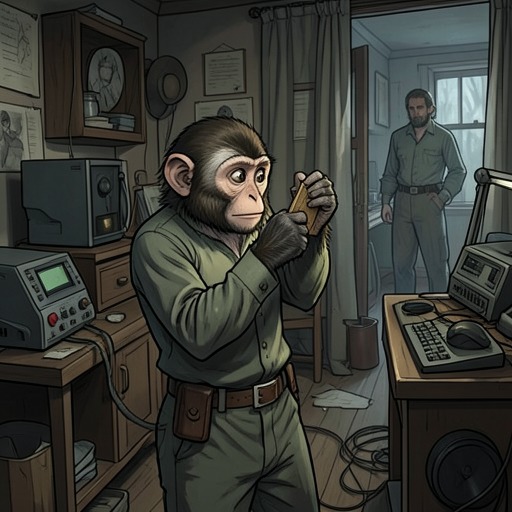
Over the following two months, Sakaki pieces together what Mizuki has told her. She concludes that something has been stealing names and must be concealed somewhere underground nearby. In an urban setting, she reasons, the likely places are the subway or the sewers. She tells her husband that a nonhuman creature may be living in the sewers and asks him to investigate; the search finds a monkey there.
Sakaki later tells Mizuki that the two name tags were stolen from her and that their recovery is why Mizuki can recover her name. The explanation gives a concrete cause for what had seemed like a baffling personal failure: the name tags were not merely reminders, but the objects whose loss was tied to Mizuki’s difficulty remembering herself. When Mizuki is astonished that Sakaki could have known this, Sakaki briefly claims professional expertise, describing herself as a licensed practitioner with extensive experience and warning against judging counselors by their inexpensive office or unassuming appearance. She then laughs and admits she was teasing. She calls herself an oddball, says she does not get along with organizations or academia, and prefers to work independently.
Powers, Methods, and Resolution
Sakaki does not present her conclusion as a sudden revelation. She describes it as an inference formed gradually through the conversations, like fog lifting: first the pattern of stolen names, then the need for an underground hiding place, and finally the sewer as the plausible location. Her husband supports a less ordinary account of her abilities. He says that, over their twenty-two years of marriage, he has witnessed strange events and considers his wife to possess unusual powers. He helped establish the counseling center because he believed the residents of Shinagawa could benefit if she had a place to use them. Sakaki’s own explanation stays grounded in observation and reasoning, leaving the source of her insight open.
After the monkey is found and the name tags are recovered, Sakaki returns with Mizuki to the counseling center and asks whether she would like to meet again the following week. Mizuki says her problem seems solved and thanks her for what she has done. Sakaki asks whether there are still things Mizuki wants to discuss, including what the monkey told her. The exchange marks the end of the immediate counseling problem without suggesting that the discovery has exhausted everything Mizuki might need to confront. Sakaki’s role is both practical and uncanny: she creates a patient space for a client’s account, follows its implications beyond conventional diagnosis, and helps restore the physical tags associated with Mizuki’s missing name.