The Poor Aunt leaves the narrator
Blind Willow, Sleeping WomanThe Poor Aunt leaves the narrator without spectacle or explanation: after he steps off a train into the cold, he notices that the figure who had clung to his back is gone. Her sudden absence does not restore a secure sense of self. Instead, it leaves him wondering what his “original self” means and prompts him to call a companion simply to learn that she is still alive. The episode converts an impossible bodily attachment into a quieter loneliness, and makes separation the beginning of uncertainty rather than its cure.
The Vanishing
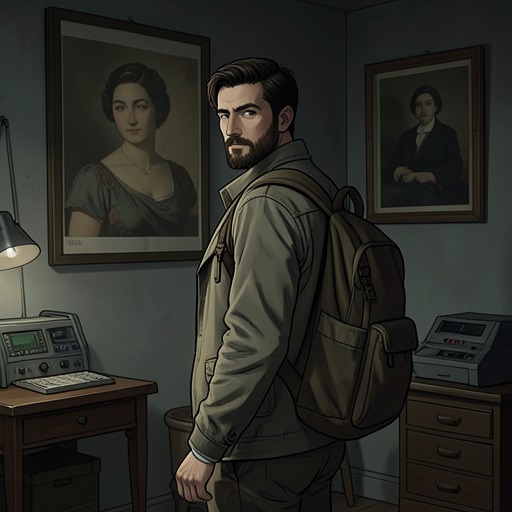
The narrator becomes aware of the Poor Aunt’s absence only after leaving the train. A cold winter wind is blowing; sweater weather is nearly over, and he is already thinking about whether to buy a new coat when he reaches the stairs and exits through the gate. The ordinary business of dressing for the weather briefly occupies him before he realizes that the aunt has disappeared from his back. The delay matters: her departure does not arrive as a dramatic confrontation, but enters his awareness as a gap in the body’s familiar burden.
He cannot tell when she went. Just as she had appeared, she seems to have left before anyone noticed, returning to wherever she had originally existed. There is no explanation, farewell, or observable transition. The disappearance repeats the uncanny logic of the aunt’s arrival, leaving the narrator with an event that has happened but no clear moment at which he can say it happened.
The Self After Her Departure
The aunt’s absence does not simply return the narrator to an intact former identity. He says he is his original self again, then immediately doubts what that phrase can mean: the person now present may only be another self who strongly resembles the original. The physical attachment has ended, but its consequence persists as a disturbance in self-recognition. What had seemed to be a return is therefore also a new estrangement.
He imagines himself alone like a blank signpost in the middle of a desert, stripped of direction. The image gives spatial form to the uncertainty left by the disappearance: the aunt is no longer there, yet the narrator cannot confidently locate himself in the life that remains. His question about what to do next grows out of that disorientation, not out of any practical problem the departure has solved.
The Pay-Phone Call
With no clear sense of where to turn, the narrator puts a hand in his pocket and feeds every coin he finds into a pay phone. He waits through eight rings, then nine, before his companion answers. She has been sleeping after working through the night and finishing only two hours earlier. The mundane detail of her exhaustion sets her firmly in the ordinary world that the narrator, newly unburdened yet unsure of himself, is struggling to re-enter.
He explains that he called only to make sure she is still alive. His concern is direct, but the call also exposes his own need for contact: rather than asking her to solve his uncertainty, he checks that she continues to exist and can answer him. She responds that she is alive and working hard to stay alive, though dead tired, and asks whether he is relieved. He says he is. The exchange offers no grand resolution, but it turns his isolation toward another person and confirms a living connection after the aunt’s unexplained departure.
Separation Without Certainty
The episode ends not with an account of where the Poor Aunt has gone, but with the companion’s weary acknowledgment that life is hard. Her statement broadens the moment beyond the narrator’s mysterious experience without explaining it away. The call cannot establish whether he has recovered his former self; it can establish that someone else is there, tired and alive, and that he is relieved to hear her voice.
The movement from attachment to absence and then to a telephone conversation gives the departure its emotional shape. First the narrator discovers that the aunt is gone; then he finds that her leaving has unsettled the identity he expected to regain; finally he reaches outward, using every bit of change in his pocket to make contact. The separation is therefore both an ending and a threshold: the uncanny presence disappears, but certainty does not return with it.