The Seventh Man’s trauma and recovery
Blind Willow, Sleeping WomanThe Seventh Man’s trauma and recovery form the long aftermath of a childhood catastrophe: during a typhoon, he runs to safety while his friend K is taken by a giant wave. Unable to forgive himself, he spends decades fearing the sea and reliving the moment in nightmares. Only when he revisits the beach and looks again at K’s paintings does he begin to revise what he believes he saw in his friend’s face. His eventual recovery does not erase the loss; it changes the meaning he has made from it and allows him, at last, to approach the water without fear.
The Wave and the Moment of Abandonment
As children, the Seventh Man and K were close. K was physically frail and had a speech impediment, and the narrator took on the role of his protector. He admired K’s gentle character and his exceptional talent for painting, especially the seascapes he made after spending hours at the shore. That history makes the disaster more than a sudden loss: the boy who had habitually watched over K is confronted with a chance to save him and runs away.
The typhoon had been expected to be the worst in ten years. The family secured the house, prepared food and water, and waited as damaging winds battered the area. During a brief lull, the narrator’s father explained that the storm’s eye had passed over them and warned that the wind would return. The boy went outside and eventually found K on the beach. When he sensed the approaching wave, he recognized what was happening and knew he should run to K, but instead fled alone toward the breakwater. From there he shouted a warning. K looked up too late, and the wave swept him away.
The narrator survived by ducking behind the breakwater. When he looked back, K and his dog had vanished, and the wave was rushing back out to sea. He stayed on the seawall, expecting further waves, and another arrived soon afterward. In the years that followed, he returned repeatedly to the decision that defined the event for him: he believed that he could have reached K in time, but fear had made him save himself instead.
Guilt, Loss, and Repeated Fear
K’s body was never found, nor was the dog’s. The search continued for a long time with help from local fishermen, but eventually ended without a body or a funeral. K’s parents moved between searching the beach and shutting themselves away at home, chanting sutras. They did not blame the narrator, and his own parents avoided mentioning the incident in front of him. Their silence did not relieve him. He felt the unspoken truth more sharply because no one accused him: in his own judgment, he had abandoned the friend he had always tried to protect.
After the disaster, he stayed away from school, ate very little, and spent much of his time in bed. His father later said that the shock and high fever had been severe enough to raise concern about lasting neurological harm. He recovered physically, but the memory returned in recurring dreams. In one, K appeared in the tip of the wave, smiling and reaching toward him; in another, K pulled him underwater. The nightmares made the childhood scene repeat in altered form, turning the fear of having left K behind into a fear that K would take him too.
At the end of the year, the narrator asked his parents to let him move away from the beach and from the life that kept bringing the event back. In January he went to live with his father’s family in a mountain village near Komoro in Nagano Prefecture. He remained there through school and later built an ordinary working life, but the move reduced rather than ended the nightmares. They continued to return, particularly when he seemed close to forgetting, and he would wake screaming, drenched in sweat.
A Life Organized Around Avoidance
For more than forty years, the narrator stayed away from his hometown and from the shore where K had disappeared. His avoidance extended to other bodies of water: although he had once enjoyed swimming, afterward he would not go to a pool, approach deep rivers or lakes, or travel by boat. He also refused to fly abroad. These precautions could not remove the image of himself drowning; the feared outcome remained present in his mind even when he kept away from places and situations associated with it.
The trauma also affected his relationships. He believed that this was probably why he never married: he did not want to wake a sleeping partner by screaming in the night. He had fallen in love with several women but had never spent a night with any of them. In his account, the terror was something lodged too deeply to share. His outwardly ordinary life and his occasional friendships, including companions for mountain climbing, therefore coexisted with a private fear that limited intimacy and narrowed his world.
K’s Paintings and a Revised Memory
The possibility of returning began with a box of childhood belongings sent to him after his father’s death. His brother had found it while clearing the old house, which had been sold. Inside was a bundle of paintings K had given him. At first the pictures reawakened the old terror, and the narrator tried to put them aside. He could not throw them away, however, and eventually made himself look at the watercolors closely.
The landscapes showed the familiar coast, beach, pine woods, and town. Their clarity and color brought back not only the places the boys had shared but also the way K had once looked at the world. As the narrator studied the paintings, he recognized that K’s vivid vision had also been his own as a boy. He began looking at one painting each day after work, and the pictures gradually became more than reminders of the catastrophe: they offered a way back to the friendship and childhood he had shut out.
This return to K’s work altered the memory of the wave. The narrator reconsidered the smile he had interpreted for decades as hatred or resentment. K may already have lost consciousness; the expression might have been an effect of angle or light, or a gentle farewell. The hatred he thought he saw, he realized, could instead have been a reflection of his own terror. Looking at the paintings, he found in them only K’s gentle and innocent spirit. The change does not undo the narrator’s flight or establish exactly what K felt in his final moments; it loosens the certainty with which guilt had made him read the scene.
Return and Recovery
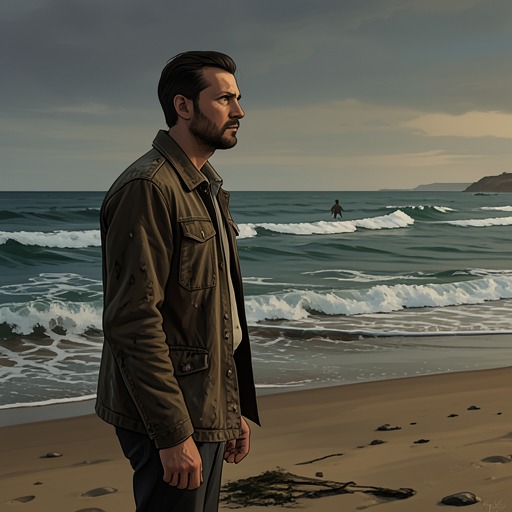
The following spring, the narrator returned to the beach. He found the coastline seemingly unchanged: the long shore, the waves, and people walking at the water’s edge. Sitting by the breakwater, he could hardly reconcile the calm scene with the typhoon and the loss that had governed his memory of it. Then he recognized that the darkness inside him had disappeared. He walked into the surf with his shoes on and his cuffs unrolled, allowing the water to reach his ankles. The waves that had once stood for terror now touched him without driving him away.
The return brought the past and present together. Remembering his childhood search for the eye of the typhoon, he experienced time as if the intervening decades had collapsed into one moment. He fell into the water and lay there unable to stand, but he was no longer afraid. The nightmares stopped; he no longer woke screaming. He knew that starting life over might come too late, yet he was grateful that he had reached a kind of recovery before the end of his life.
When he later spoke about the experience, he distinguished fear itself from the act of turning away from it. Fear, he said, comes in many forms and can overwhelm a person; the deeper danger is closing one’s eyes and surrendering what is most precious. In his own case, that surrender was to the wave. The story’s recovery is therefore neither the recovery of K nor a simple erasure of guilt. It is the narrator’s belated ability to face the event, question the accusing image that had defined it, and return to the shore without allowing fear to determine what he could remember or how he could live.