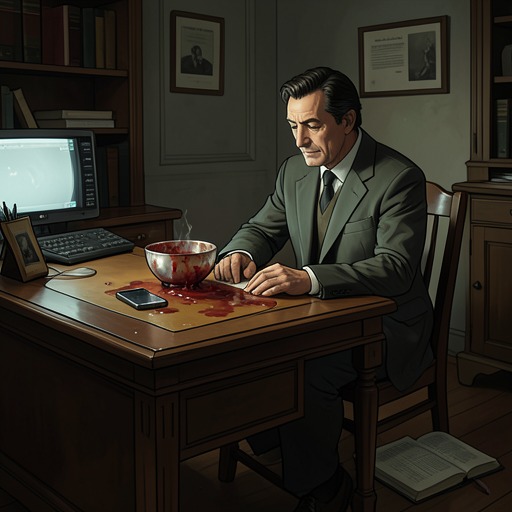
The illustrator checks into a hotel to escape the harassment
Blind Willow, Sleeping WomanThe illustrator’s hotel stay, undertaken on the fifteenth day of recurring vomiting and anonymous calls, briefly offers an ordinary day—and then turns into a decisive test of whether the two disturbances are connected. Food stays down, the calls seem absent, and he begins to hope the episode has passed. At 2:15 a.m., the familiar voice says his name; he vomits everything he has eaten. The contrast moves him from treating the symptoms as separate nuisances toward recognizing a connection he cannot explain or verify.
The decision to leave
For two weeks, vomiting and phone calls have continued together. On the fifteenth day, having had enough of both, the illustrator takes time off work and goes to a hotel. He cannot make himself stop vomiting, but he can at least try to escape the calls. His choice changes the setting rather than resolving the problem: he spends the day watching television and reading, away from his apartment and its familiar routine.
The change initially appears to help. He eats a roast beef sandwich and asparagus salad for lunch and keeps them down. At 3:30 p.m., in the hotel tearoom, he has cherry pie and black coffee with a friend’s girlfriend; these stay down too. They then go to bed, an encounter that also passes without difficulty. After she leaves, he eats dinner alone at a nearby restaurant: Kyoto-style broiled mackerel, tofu, vinegared vegetables, miso soup, and white rice. He continues to avoid alcohol. By the time the evening’s ordinary sequence is established, the absence of nausea seems to make a full day away from the illness possible.
A day that seems to work
Back in his room, he watches the news and starts a new Ed McBain 87th Precinct novel. At nine o’clock, still without nausea, he feels relieved and allows himself to think that things may return to normal. The physical fact of a full stomach matters: after two weeks in which eating has been followed by vomiting, he can enjoy a simple meal without anticipating its loss.
He continues the evening by watching an old western, then the late news. Wanting a whiskey, he considers going to the upstairs bar, but stops himself so as not to spoil what he regards as a clean day. He turns off the reading lamp and goes to bed. The sequence is measured out through familiar meals, television, a book, and the restraint of not drinking; its apparent calm makes the interruption in the night more forceful.
The call at 2:15
At 2:15 a.m., the hotel phone rings. Still groggy, the illustrator takes the receiver almost unconsciously and says hello. The now familiar voice pronounces his name, then the connection cuts off. The call has followed him into a place he chose precisely to get away from it.
He immediately vomits everything in his stomach, including the fish and rice from dinner. In his account, the call seems to have opened a door through which the nausea could enter. The hotel’s promise of separation collapses in one abrupt sequence: the voice reaches him, and his body reacts as it has throughout the preceding two weeks. The episode does not establish who called or how the caller found him; its force lies in the repeated coupling of the call and the physical sickness.
From evasion to recognition
After vomiting, the illustrator sits on the edge of the bathtub and tries to sort out what happened. He considers two explanations. Someone may have discovered his hotel stay and made a malicious call, although he does not know how; alternatively, he may have imagined the ring and the voice. The second possibility initially seems ridiculous, but he cannot dismiss it after considering the incident more coolly.
He calls the front desk to ask whether an incoming call was recorded. The hotel can track outgoing calls but keeps no record of incoming ones, leaving him without a way to confirm the event. Nor does he tell the narrator how the woman he slept with might have known where he was; he says she was the only person he told. The unexplained call thus remains between suspicion and proof.
He calls the night a turning point. It is when he begins to consider the vomiting and the phone calls more seriously, including the possibility that they are linked, wholly or partly. The stay has not stopped either problem: after two nights at the hotel, he returns to his apartment and the same pattern continues. He also stays with friends, but the calls find him there when he is alone. He describes the growing unease as if an invisible presence were watching his movements, able to choose when to call and when to make him sick. The hotel episode therefore does not solve the mystery; it changes his understanding of it, making the coincidence difficult to keep treating as incidental.