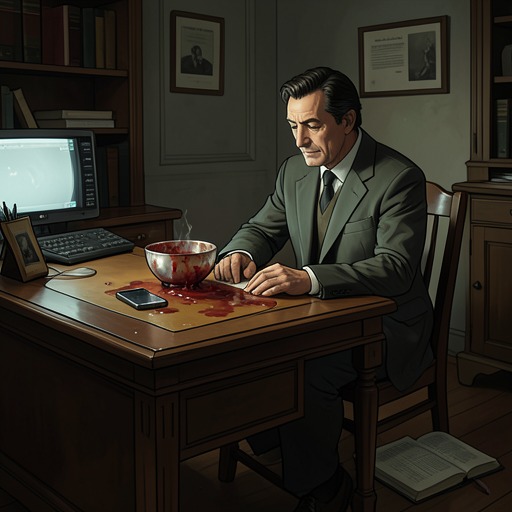
The illustrator’s forty days of vomiting and anonymous phone calls
Blind Willow, Sleeping WomanThe illustrator’s forty days of vomiting and anonymous phone calls is an episode of bodily distress and unexplained harassment whose two symptoms begin and end almost in unison. From June 4 through July 14, he vomits repeatedly while a stranger calls once a day, says his name, and hangs up. The doctors find no illness, the police see no actionable crime, and the caller’s identity remains unknown. The episode ends as abruptly as it began, leaving the illustrator with a changed body, a diary’s exact times, and one final unanswered question.
The episode begins
The illustrator tells the narrator about the ordeal during a visit in his apartment, after the two men have spent a day trading records. They collect jazz from the 1950s and early 1960s, though their tastes differ: the narrator favors lesser-known West Coast musicians, while his friend prefers later recordings by performers such as Coleman Hawkins and Lionel Hampton. Their exchanges of albums, beer, and conversation give way to whiskey and accounts of drunkenness, prompting the illustrator to describe his illness.
The first vomiting episode occurs at eight in the morning on June 4. The night before, he had drunk a great deal of whiskey and beer and slept with a friend’s wife, so the initial bout seems explicable. He empties his stomach into the toilet, flushes, and returns to his desk. He does not feel ill: his drawing goes well, and by noon he has a healthy appetite. The first anonymous call comes while he is brushing his teeth. A man says the illustrator’s name and hangs up. The symptoms that follow will make that otherwise ordinary interruption part of a longer, disquieting pattern.
Symptoms and failed explanations
The illustrator says he vomited every day for forty consecutive days, insisting that he was not sick and that the vomiting was not caused by drinking. The narrator suggests that the caller might have been the husband or boyfriend of one of the women the illustrator slept with. The illustrator rejects this: he knows those men’s voices, and this voice was unfamiliar and had a nasty ring to it.
From June 5 through July 14, the calls arrive once each day, at unpredictable hours. The caller repeats the same brief procedure: he says the illustrator’s name, then hangs up. The illustrator could have stopped answering, but the telephone also brings work and calls from women. Meanwhile, nausea continues without a day’s break. He vomits most of what he eats, grows hungry, eats again, and often loses that meal too. He estimates that he kept down about one meal in three—enough, he thinks, to stay alive, though not enough to make the cycle less punishing.
He goes to a sizable neighborhood hospital. The staff take X-rays and test his urine, and examine him for cancer, which they consider a real possibility. They find nothing wrong and describe him as the picture of health. Their prescription is medicine for what they call chronic stomach fatigue or perhaps stress, alongside familiar advice to go to bed early, rise early, drink less, and avoid being bothered by small things. He disputes the diagnosis: he has an appetite and a clear mind, and none of the usual stomach-fatigue symptoms that, in his view, would precede nausea. His account therefore sets the measurable absence of a medical finding against the persistence of an unexplained physical experience.
Calls, institutions, and isolation
The illustrator looks for help beyond the first hospital, but neither the symptoms nor the calls receive a satisfactory response. Psychiatrists at a university hospital tell him that vomiting has no known connection to schizophrenia and refuse to assess him because his symptoms are not unmistakable. They say that commuters on the Yamanote Line include many people with comparable symptoms, while the hospital lacks the facilities to treat every such case. Their practical direction is to take the vomiting to an internist and the calls to the police.
The police, he says, are similarly unwilling to pursue the matter. He understands crank calls and stolen bicycles as kinds of complaint they do not have the resources to investigate routinely. When he reports that the caller says only his name, they ask what else was said, tell him to fill out a form, and invite him to return if anything worse happens. His question—how the caller knows where he is—does not persuade them to take the case seriously. By the twentieth day, he concludes that doctors, police, and other people will not help, and that he will have to handle the ordeal himself.
He spends two nights in a hotel and later stays with friends, trying to discover whether changing location will make a difference. It does not: the calls continue to find him, and they come when he is alone in someone else’s house. The combination makes him imagine an invisible presence watching his movements and timing both the telephone calls and the vomiting. He recognizes that such thoughts might be a sign of schizophrenia, but also notes that psychiatrists have rejected a connection between schizophrenia and vomiting. The account preserves the fear without resolving whether the caller has access to the illustrator’s locations or whether the repeated coincidences have another explanation.
Endurance and the final call
Rather than keep moving, the illustrator decides that flight would amount to admitting defeat in a war of wills. He frames the contest as a question of whether the caller will run out of steam or he will die, and applies the same stubbornness to his body: since vomiting happens whether he drinks or not, he starts drinking again, including beer at breakfast and whiskey after sundown. He treats the illness as a form of dieting, says he can still work and carry out daily chores, and uses money from his savings to have a suit and two pairs of trousers made for his thinner body. He likes the way he looks in the tailor’s mirror and eventually regards the vomiting as manageable, given that examinations have ruled out cancer and he believes he is keeping enough food down.
The diary he has kept fixes the two endings to July 14. At 9:30 that morning, he vomits toast, tomato salad, and milk. At 10:25 that night, while listening to Erroll Garner’s Concert by the Sea and drinking Seagram’s VO, he receives the last call. Both disturbances stop after that day. He returns to 140 pounds, while the new suit and trousers remain in his closet as souvenirs of the altered body the episode briefly produced.
The final call almost follows the established script: the man says the illustrator’s name. This time, however, he adds, “Do you know who I am?” Neither man speaks for ten or fifteen seconds before the caller hangs up. The silence does not identify him or explain the forty days; it is the only departure from the repeated call and the episode’s final, unresolved exchange.
Narrative significance
The episode is structured around a parallel the characters cannot explain. The vomiting and calls proceed together, each recurring daily and each stopping on July 14, but the illustrator explicitly says he sees no connection between them. Medical testing supplies no cause for the bodily symptoms, while the calls offer too little information for the police to pursue. The coincidence is therefore not converted into a solution: its exact dates and the narrator’s questions clarify the pattern without disclosing its source.
The diary makes the ending unusually precise—the last vomiting at 9:30 in the morning, the final call at 10:25 that night—while the caller’s identity remains unavailable. His last question briefly suggests recognition or a concealed relationship, but the pause that follows yields no confirmation. The suit and trousers preserve a tangible trace of the ordeal, whereas the phone calls leave no comparable evidence. What ends is the pattern, not the uncertainty that made it frightening.