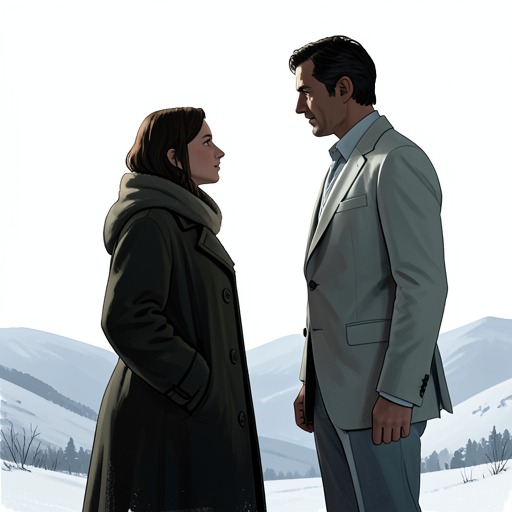
The journey to the South Pole
Blind Willow, Sleeping WomanThe journey to the South Pole is a turning point in the Ice Man and his wife’s marriage: a vacation proposed to relieve domestic boredom becomes an apparent passage into permanent isolation. The Ice Man’s wife hopes for novelty and a honeymoon at last; instead, the trip draws her husband into a place where he seems newly at home, while she is cut off from language, movement, and the future she had imagined. Their arrival ends not in discovery but in a long winter that reshapes both the marriage and the meaning of home.
Causes and Plans
After the couple fail to have a baby, the Ice Man’s wife has little to occupy her days. She keeps house in the mornings, then spends the rest of her time alone, reading or listening to music. Her mother and sister remain estranged over her marriage to an Ice Man, and she has no friends or neighbors to visit. Solitude itself is not intolerable to her; what wears her down is the sameness of every day, until she begins to feel like a shadow repeating the motions of a routine.
She proposes a trip to break that pattern, making clear that she is not unhappy with her husband or their relationship. She wants to see unfamiliar places, have new experiences, and take the honeymoon they never had. They have savings, and he has vacation time from his warehouse job, so a leisurely journey seems possible. The Ice Man initially questions whether her wish means she is dissatisfied with their life together, but agrees to go wherever she wants if it will make her happy.
She chooses the South Pole partly because she expects it to interest him, and partly because she has long wanted to see it herself. She imagines standing in a hooded parka beneath the aurora and playing with penguins. Her picture of the destination is therefore both an appeal to her husband’s icy nature and a personal fantasy of wonder: a faraway landscape that might make their ordinary life feel new.
The Decision Becomes Irreversible
The Ice Man’s response to the destination is unusually intense. He studies her without blinking, pauses, and then agrees, asking whether she is sure. His wife can only nod; she feels that his icicle-like stare has frozen her thoughts. In the days that follow, his manner changes. His gaze grows sharper, his breath whiter, and frost spreads over his fingers. He becomes quieter and more stubborn, and stops eating. The proposed holiday seems to awaken something in him that the original request had not anticipated.
Five days before departure, his wife tries to change the plan. She suggests Spain or somewhere in Europe instead, imagining wine, paella, and a bullfight. The Ice Man refuses: Spain is too hot and dusty, and its food too spicy. More concretely, he has already bought tickets to the South Pole, along with a fur coat and fur-lined boots for her. The practical expense closes the door she is trying to reopen. She fears that something terrible will happen, but cannot make herself cancel the trip.
Her fear takes the form of a recurring dream in which she falls into a deep hole, is never found, and freezes inside the ice, conscious but unable to move. As she becomes part of the past, everyone watches her recede. She wakes beside the sleeping Ice Man and weeps; he holds her and tells her that the dream comes from the past, not the future, and that dreams should not control her. His comfort is tender, but it cannot dispel her uncertainty. The trip proceeds despite her dread, with the dream casting the journey as a movement toward a future already sealed away.
Arrival at the South Pole
The plane offers no relief or exhilaration. Its pilots and stewardesses say little, cloud obscures the view, and ice eventually coats the windows. The Ice Man reads quietly throughout the flight. His wife experiences their travel not as the beginning of an adventure but as the completion of a decision already made: they are simply carrying out what they set out to do.
When they step off the ramp, the Ice Man’s body trembles for an instant. His expression barely changes, so the others do not notice, but his wife sees the jolt pass through him. He looks at the sky, then at his hands, exhales, and smiles at her. His reaction marks the arrival as more than the end of a journey: the place has struck him with an intensity he does not explain. He asks whether this is where she wanted to come, leaving her wish at the center of the scene even as his response suggests that the destination has become his own.
The South Pole is nothing like the spectacle she imagined. There is one small, featureless town and one equally featureless hotel; no aurora appears, and there are no penguins. She asks passersby about the birds, but they cannot understand her. She sketches a penguin on paper, only to receive the same silent shake of the head. Beyond the town lies ice without trees, flowers, rivers, or ponds, a frozen expanse that gives her no sign of the lively, memorable landscape she had hoped to find.
Two Different Experiences of Winter
The Ice Man, by contrast, moves tirelessly through the town. His white breath, frosty fingers, and distant gaze seem to belong to the landscape. He learns the local language quickly and spends hours speaking with its inhabitants in hard, icy tones. His wife cannot understand their conversations. At first, she feels betrayed and abandoned as her husband is drawn into a world from which she is excluded.
Her isolation deepens into a loss of orientation. Little by little, she loses the strength even to feel upset; she no longer knows her direction, the time, or her sense of who she is. She cannot say when this numbness begins or ends. Though her husband remains considerate and speaks kindly to her, she becomes certain that the man beside her is no longer the Ice Man she met at the ski resort. The change is difficult to name precisely: his affection persists, but he now seems bound to a place and a life beyond her understanding.
The locals like him, while they cannot understand her words. She stays in the hotel, looking out at gray skies that will not clear for months and struggling with the complicated grammar of the South Pole language, which she knows she will never master. Language learning offers a possible route toward contact, but the gap remains. The more fluently her husband joins the community, the more completely she is left outside it.
The Long Winter and Its Consequences
After the plane that brought them leaves, no others land. The runway disappears beneath a hard sheet of ice, which her wife’s perspective likens to her own heart. The physical isolation is no longer merely a feature of the destination: it becomes the condition of their stay. The Ice Man announces that winter has come, that it will be long, and that neither planes nor ships will arrive. All they can do is wait for spring.
Three months after arriving, his wife realizes she is pregnant. The couple had previously failed to have a baby, perhaps because of a genetic difference between humans and Ice Men. Now she imagines the child as a tiny Ice Man, with its father’s icicle eyes and frost-covered fingers; she feels that her womb has frozen, a thin sheet of ice mixed with the amniotic fluid. Pregnancy, which might have promised a new beginning, instead intensifies her sense that the South Pole has taken hold of their future. She believes their little family will never leave and that the weight of the eternal past will not let them go.
The journey thus reverses the purpose with which it began. The wife had sought distance from repetition, novelty beyond the home, and a shared experience that might refresh their marriage. She finds a destination without the aurora or penguins she expected, an unpassable winter, and a husband who is loving yet altered by his belonging there. The final image holds these conditions together: he kisses her tears, which freeze on her cheeks, then peels them away and puts them on his tongue. His love is real to her, but his frozen words are carried farther into the past by the wind. The trip has taken them to the place she chose for both of them, but left her unable to imagine a way back.