The narrator searches at night after Izumi disappears
Blind Willow, Sleeping WomanThe narrator’s night search after Izumi disappears turns an ordinary attempt to find her into a journey through uncertainty, in which moonlight and distant music unsettle his sense of self as well as his grasp of where she has gone. He follows what he takes to be the path she might have chosen, but the search ends at an empty summit and brings him back to the apartment alone, unable to resolve her disappearance.
The disappearance
He wakes in the middle of the night and finds Izumi gone. It is twelve thirty. After switching on the lamp, he looks through the bedroom and the rest of the apartment, then opens the front door and calls into the yard. Two bent Salem cigarette butts and an empty pack lie in the ashtray; outside, the moon illuminates a pair of vinyl lounge chairs. The quiet is so complete that his own voice sounds unnatural to him. A sea breeze stirs the pampas grass, but there is no answer.
He pours half a glass of wine to calm himself and remembers another moonlit night: the night the cat disappeared up a pine tree. He had stared into the branches, thinking he saw the cat’s eyes, only to recognize them as an illusion. That earlier disappearance does not explain Izumi’s absence, but the recollection draws the two nights together. Moonlight has already been associated with something vanishing and with the mind’s uncertainty about what it sees.
Following the music
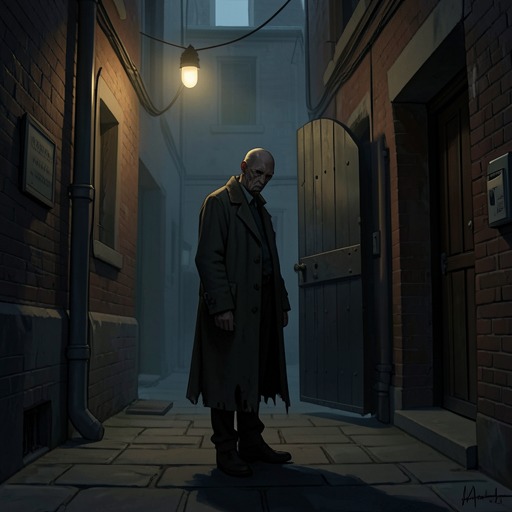
The narrator assumes Izumi has gone for a walk because she could not sleep. He puts on a thick sweater and jeans, pockets the coins on the table, and heads toward the harbor, convinced there is nowhere else she would go. The road is empty; the houses are dark, and moonlight makes the ground look silver, like the bottom of the sea. His shoes crunch loudly on the gravel, turning the walk into an experience of heightened, almost staged silence.
Halfway to the harbor, he hears faint, unamplified music. He first wonders if it is an auditory illusion, then listens until he is sure it is being played live. He cannot identify the instrument: it might be a bouzouki, like the instrument associated with Anthony Quinn in Zorba the Greek. At a crossroads, the sound seems to come from the village above the hill where he and Izumi exercise each day. He imagines Izumi hearing it at the same place and thinks she would have followed it.
He turns uphill. The path is bordered not by trees but by knee-high thorn bushes beneath the cliffs. As the music grows louder, he imagines a festive banquet in the village. He recalls that earlier that day they had seen a lively wedding procession at the harbor, and concludes that the music must be coming from its banquet. The inference gives his search a destination, but it remains an inference: he has not seen Izumi, the wedding party, or the musicians.
A crisis of identity
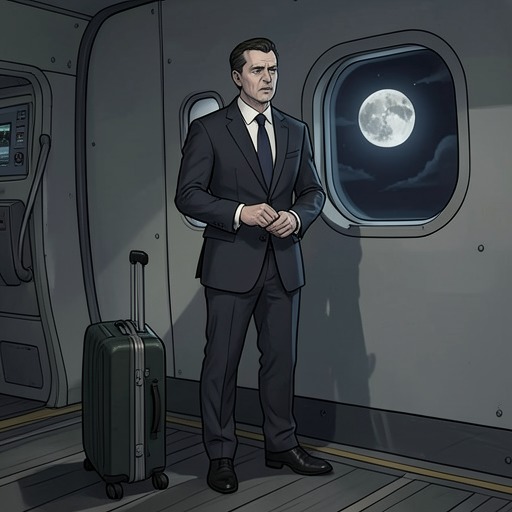
As he climbs, the narrator feels himself disappearing. The moonlight and music seem to draw him into the same kind of estrangement he remembers from an airplane flight over Egypt. He experiences his body not as securely his own, but as a plaster stand-in: his face and hand seem чужды to him, and his heart pounds as if a temporary life has been forced into a puppet. The search therefore becomes more than a physical attempt to locate Izumi. Her absence exposes how precarious his sense of being himself has become.
At one point he looks for his watch and realizes he is not wearing one. He no longer cares what time it is. The moon appears to him as a cold, worn rock, and he imagines its light as a force that plays tricks on people and makes cats—and now Izumi—disappear. He wonders whether the process began on the long-ago night the cat vanished. The connection remains his speculation, not an explanation of either disappearance.
He asks himself whether to go on or turn back, and how he could live alone on the island without Izumi, whom he regards as the fragile, provisional self’s only support. He continues uphill because he has come so far and wants to see whether any trace of the music remains. The effort is propelled by uncertainty: he is pursuing a sound and a possibility, not a confirmed sighting.
The empty summit and return
Within five minutes he reaches the summit. From there he can see the sea, the harbor, and the sleeping town below, with scattered streetlights along the coastal road. The far side of the mountain lies in darkness. There is no sign that a lively celebration has taken place there, despite the music he heard and the wedding procession he had seen earlier. The summit provides no clue to Izumi’s whereabouts and does not confirm his explanation of the sound.
He returns to the apartment and drinks a glass of brandy, but cannot sleep. He remains under the moon’s influence until the eastern sky grows light. As morning approaches, his thoughts turn to cats starving in a locked apartment and to an imagined vision of them devouring his body and consciousness. The search has yielded neither Izumi nor an account of what happened to her; instead, it ends in solitude and in an image of the self being consumed.
Narrative significance
The scene advances Izumi’s disappearance through a search that repeatedly substitutes interpretation for evidence. The narrator connects her absence to the cat’s earlier vanishing, treats music as a possible guide, and identifies it with a wedding banquet he never finds. Each explanation offers a temporary direction, then leaves the essential fact unchanged: Izumi is missing. The empty summit makes that gap visible, withholding the confirmation that the narrator has climbed toward.
The search’s changing sensory focus—first the unnatural sound of his voice, then the gravel underfoot, then music in the darkness—also shapes its emotional force. The narrator moves from familiar domestic space to an open road, a crossroads, and a barren summit, while his confidence gives way to estrangement from his own body. He returns to the same apartment without the person he sought, and the moonlit night has transformed a practical search into an encounter with absence, unstable identity, and the limits of what he can know.