The piano tuner’s sister’s breast cancer
Blind Willow, Sleeping WomanThe piano tuner’s sister’s breast cancer is the crisis that turns a long-delayed wish for reconciliation into a meeting between the siblings. Facing an operation to remove her right breast, she contacts her brother and tells him what she had kept from him; he responds by holding her as she cries. The cancer has not spread, and her recovery gives them time to rebuild their relationship through visits, family life, and a closeness that had been missing.
Diagnosis and the long silence
The sister tells her brother that she is going into the hospital the following day. She will undergo surgery for breast cancer, and the doctors plan to remove her right breast. They cannot know whether the operation will prevent the cancer from spreading until they have removed it. The uncertainty makes the conversation more than an announcement of illness: it places the siblings’ chance to speak honestly alongside the possibility of a grave outcome.
She explains that she had wondered for a long time whether she should contact him. In the end she decided against it, but she had wanted to see him very much and felt there were things she needed to apologize for. She had hoped that, if they met, it would be under happier circumstances, when she could feel more optimistic. She also says she did not want him to see her like this. The diagnosis has brought the very meeting she had postponed, under circumstances neither sibling would have chosen.
The meeting before surgery
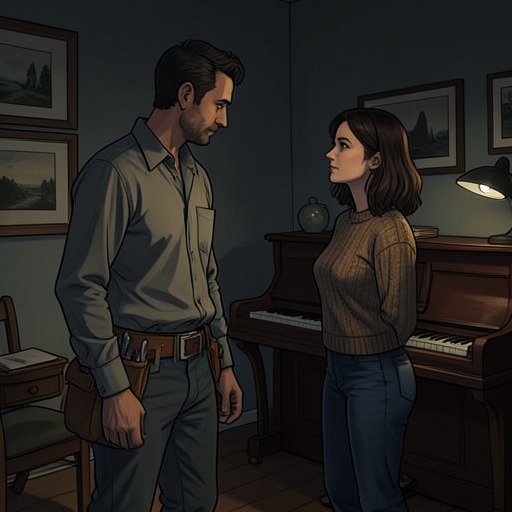
When she tells him that the operation will remove her breast, her brother cannot speak for a while. His attention falls on familiar objects in the room—the clock, an ornament, the calendar, the stereo remote—without his being able to take in the distance between them. The ordinary room offers no ready words for the news or for what it may mean.
He answers her explanation of the long silence with understanding, then puts both arms around her and draws her close. He can feel her breasts against his chest; she rests her face on his shoulder and cries. They remain that way for a long time. The embrace is a physical answer where speech has failed, and it brings into the open the affection that the years of distance had left unexpressed.
She asks what made him think of her and call. He cannot explain it clearly, describing only a series of coincidences. She accepts that he cannot put it into words and says she is glad it happened. He touches her right earlobe, rubs the mole there, and kisses it. The meeting ends not with a complete account of their past but with a gesture of tenderness and her acknowledgment that his call mattered.
Surgery and recovery
The operation removes her right breast, but the cancer has not spread. She receives mild chemotherapy, and her hair does not fall out; she is described as completely fine afterward. The outcome resolves the immediate fear that the cancer may have advanced, though the operation itself remains a significant bodily loss. Her recovery makes possible the continued relationship that their meeting has reopened.
Reconciliation in family life
The brother visits her in the hospital almost every day. After she returns home, he visits her family often, grows close to his nephew and niece, and begins teaching his niece piano. He also comes to know his brother-in-law better. He still finds him self-important and somewhat crude, but recognizes that he works hard and is good to his sister. The brother-in-law, in turn, finally understands that the brother’s being gay is not contagious and will not harm his children—a small but significant change in their family relationship.
The brother describes making up with his sister as feeling able to move forward in life and live as he is supposed to. He believes he had always hoped they would reconcile and embrace once more, but that something had to happen before he could face that hope. Her illness and the urgency of the night before surgery make the reunion possible; the recovery that follows lets reconciliation take a durable form in visits, teaching, and renewed kinship. The episode therefore turns illness into neither a simple cure nor a symbolic substitute for family repair: it is a real medical danger, and also the circumstance that prompts the siblings to act on a bond they had left unattended.