The waitress’s wish granted on her twentieth birthday
Blind Willow, Sleeping WomanThe waitress’s wish granted on her twentieth birthday is a quietly uncanny encounter in which a routine dinner delivery becomes an irreversible choice. On a stormy evening, a polite, carefully dressed old man tells a young waitress that he can grant one wish as a birthday present. She makes her choice; he says it has been granted. The story withholds the wish itself, so its force lies less in a revealed outcome than in the question the episode leaves open: what can a person truly wish for, and can the wish make that person into someone else?
The delivery to room 604
The encounter begins as a practical interruption to a slow restaurant shift. Rain keeps customers away, reservations are canceled, and the manager—who has not missed a day of work in more than ten years—suddenly becomes so ill that he has to be taken to hospital. Before leaving, he gives the waitress a precise instruction: at eight o’clock, take dinner to room 604, ring once, say that the dinner is there, and leave it. He emphasizes the exact time, “On the dot.”
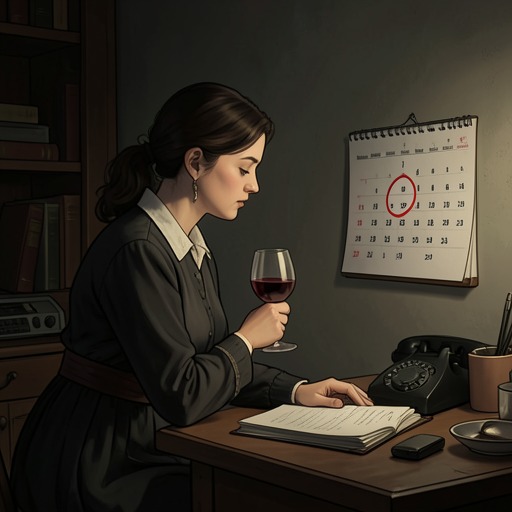
At eight, she pushes the service cart into the elevator with the owner’s usual meal: loosened red wine, coffee in a thermal pot, chicken with steamed vegetables, and rolls and butter. The cooked chicken’s heavy aroma mingles with the smell of rain; drops on the elevator floor suggest that someone with a wet umbrella has recently been there. These ordinary traces make the upstairs journey feel already occupied by another presence, though the story does not explain them. At the door marked 604, she checks the number, rings, and waits. After about twenty seconds, a short, thin old man opens it.
His appearance is exceptionally neat: dark suit, pressed clothes, smoothed white hair, and a brownish-yellow tie resembling withered leaves. Deep lines crease his forehead. Rather than simply receiving the meal, he asks the waitress to give him five minutes. His formal politeness and her awareness that he is her employer shape the exchange: she hesitates, then agrees, judging that he does not seem likely to harm her. The dinner delivery has become a private conversation, but not an openly threatening one.
The birthday and the offer
The old man asks how old she is. When she answers that she is twenty, he presses for precision: twenty as of when? She explains that she has just turned twenty and that the day of the encounter is her birthday. The repetition matters. He confirms that this is her twentieth birthday, treating the fact as something that makes the evening, and his response to it, unusually significant.
He calls the birthday special and proposes a commemorative present. The waitress initially refuses, pointing out that she has only brought the meal as instructed. The old man clarifies that he does not mean a tangible gift with a price tag. Instead, he offers to make a wish come true—anything she wishes for, if she has such a wish. He stresses the limit: he can grant only one, and she cannot change her mind afterward and take it back. The gift is therefore also a constraint. Before she can receive it, she must decide what she wants without the comfort of trying again.
The waitress later explains that the day had seemed to be passing without anything special: no one had wished her happy birthday, and she had been carrying tortellini with anchovy sauce to customers’ tables. Against that uncelebrated, workaday evening, the offer gives the birthday a sudden and consequential shape. She says that she made a wish. The narrative does not disclose what she asks for, preserving the choice as a deliberate gap rather than turning the episode into a simple account of a wish and its fulfillment.
The granting and its unresolved result
After she makes her wish, the old man performs a small, peculiar gesture. He fixes his gaze on a point in the air, opens his arms, rises slightly from his chair, and brings his palms together with a dry smack. He sits again, runs his fingertips along the furrows of his brow, and smiles gently. Then he tells her that the wish has been granted. The waitress is surprised that it has happened already; he answers that it was no trouble and tells her she may return to work, offering to put the cart in the hall.
The scene provides no visible proof of supernatural change and no explanation of the old man’s power. Its decisive action is the declaration itself: a wish is made, the giver says it is fulfilled, and the waitress leaves with the knowledge that her one choice cannot be withdrawn. The calmness of the exchange contrasts with the extraordinary terms of the offer. There is no spectacle beyond the old man’s gesture, and no immediate account of what has altered in the world.
In a later conversation, the waitress does answer whether the wish came true, but only with qualification: yes and no. She still has a great deal of life ahead of her and has not yet seen how matters will turn out to the end. The wish, then, is not presented as a neatly completed transaction whose result can be judged at once. Its fulfillment remains entangled with a future that the character herself has not lived through.
Secrecy, choice, and the story’s frame
The later conversation also makes the wish’s secrecy part of the episode’s meaning. The waitress reminds her listener that the recipient is not supposed to tell anyone what she wished for. The listener accepts this limit, asking instead whether the wish came true and whether she ever regretted not choosing something else. The distinction is important: the story lets the audience know that a wish was made and that its outcome resists a simple yes or no, while withholding its content and the grounds for a final judgment.
The waitress’s response turns the encounter from a curiosity about magic into a meditation on choice and identity. She tells the listener that people remain themselves regardless of what they wish for or how far they go. The old man’s promise sounds limitless—anything at all—yet the later reflection places a limit on what such a promise can mean. A wish may alter circumstances or shape a life, but the story does not suggest that it can erase the self who wished. The offered gift therefore contains a tension between boundless possibility and personal continuity.
The frame carries that tension into the ending. When the listener asks whether the waitress wishes for anything now, she looks directly at him and answers that he has already made his wish. The old man’s warning returns in the darkness: there can be only one, and it cannot be taken back. The closing echo does not explain the listener’s wish or identify it with the waitress’s, but it makes the birthday encounter newly relevant to the person hearing its story. The event concludes not with the secret exposed, but with the burden of choosing passed on to another listener—and, through the unresolved frame, to the reader.