The wind as an intimate, understanding presence
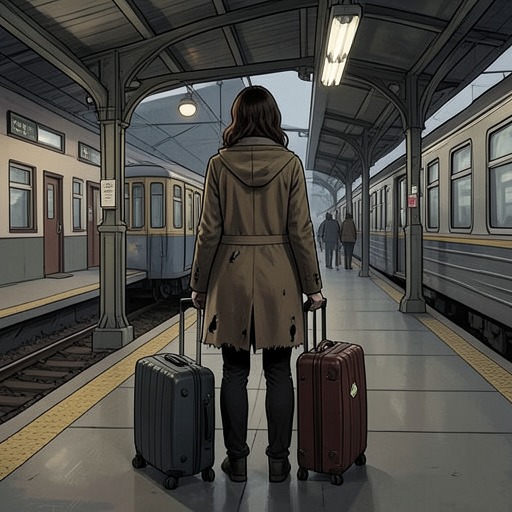
Blind Willow, Sleeping WomanThe wind as an intimate, understanding presence is a recurring idea in Junpei and Kirie’s story, where wind seems to possess purpose and knowledge rather than serving as mere background. Kirie describes it as a companion that understands her, and Junpei’s response to that bond reveals both his jealousy and the depth of feeling he eventually accepts. The image links her work at great heights with her reflections on the kidney-shaped stone and helps give shape to an emotion Junpei struggles to name.
An idea first spoken in confidence
Kirie introduces the idea while Junpei is drowsy and they are discussing the story he is trying to write. He has said that his plots move only when he is sitting at his desk and forming sentences, and that talking with her is beginning to help the rest of the story take shape. She says that the world’s events have reasons, even when people do not notice them in the course of ordinary life. At certain moments, she suggests, people are made to notice what has been present all along.
The wind is her clearest example. It envelops and rocks a person with a purpose, she says, and knows what is inside that person. Stones, too, know people. Her account joins natural forces that appear separate from human intention to a kind of intimate understanding: the wind and stone do not merely surround people but seem to know them through and through. Because Junpei is falling asleep, he cannot answer. Her words reach him indirectly, as something absorbed into his consciousness rather than debated between them.
Kirie’s work and the wind
The idea returns in a radio interview Junpei hears in a taxi. Asked about her profession, Kirie says she feels called to work high above the ground and cannot imagine doing anything else. She draws a distinction between work chosen out of love and work taken as a matter of convenience. The broadcast also describes the practical shape of her life: she arranges sponsors for performances, has performed at a cathedral in Germany, and hopes to attempt higher buildings, while earning a living through a window-cleaning company. She will not work for a circus; her interest is in high-rise buildings.
Kirie describes the transformation demanded by those heights. To survive there, she says, she has to change as a person. Once she is aloft, the wind becomes her sole companion: it envelops and rocks her, she understands it as it understands her, and they accept one another. Fear disappears when she reaches full concentration. She calls that shared state a warm void, and says it is the moment she loves most. Her account makes the wind not simply a danger to overcome but an intimate presence within the work she has chosen.
Junpei’s jealousy and separation
Listening to the interview, Junpei realizes that nothing can come between Kirie and the wind. He looks up at tall buildings and passing clouds after leaving the taxi, and feels a violent rush of jealousy. The feeling has no ordinary rival: he wonders whether he is jealous of the wind itself, an impossible competitor that is nevertheless closer to Kirie in the moment she values most.
Kirie does not contact Junpei for several months, and his attempts to reach her fail. When summer arrives, he gives up hope of seeing her again. Their relationship ends without a quarrel, in the quiet manner of his earlier relationships. Yet the wind’s place in her life remains vivid to him. As he writes at his desk, he imagines her alone high above others, without a lifeline, in the concentrated state she described. The contrast between his solitary work and her solitude in the heights gives the remembered words continuing force.
Meaning in Junpei’s reflection
During the following six months, Junpei writes many short stories and repeatedly recalls Kirie’s account of being alone with the wind. He recognizes that what he feels for her has a clear outline and real weight, although he does not know what to call it. He believes it cannot be exchanged for anything else, and that it will remain even if he never sees her again; her absence, he thinks, will continue to be felt deep within him.
At the end of the year, Junpei counts Kirie as the second of the women who have had real meaning in his life. The numerical countdown matters less to him than the recognition behind it: what matters is deciding in one’s heart to accept another person completely. The wind’s significance therefore extends beyond Kirie’s profession. It gives Junpei an image for a bond he cannot possess or control, but can finally acknowledge as singular and lasting.