Tony Takitani and His Father Shozaburo Takitani’s Father-Son Relationship
Blind Willow, Sleeping WomanTony Takitani and his father, Shozaburo Takitani, are bound by loss and a shared habit of living alone, but neither is equipped to turn that bond into open emotional intimacy. Their relationship is not simple estrangement: the two are closer than their separate routines might suggest. Yet, as the story puts it, Shozaburo is not suited to being a father, and Tony is not suited to being a son.
Loss and the Beginning of Their Family
Shozaburo’s wife died three days after giving birth to Tony. Faced with her death, he could not understand what he was supposed to feel or what the loss meant. He absorbed it as an accomplished fact, while imagining a flat, disk-like object lodged in his chest and preventing him from thinking more deeply. For a week he thought of nothing at all; in that stunned interval he even forgot the baby in the hospital.
A major at the military base tried to draw Shozaburo back toward his responsibilities. They drank together almost every day, and the major urged him to pull himself together and raise the boy properly. Shozaburo answered with silence and nods. Though he recognized that the major meant to help, the instruction itself did not reach him as a feeling or a plan.
The major offered to become the child’s godfather and give him a name. Only then did Shozaburo realize he had forgotten to name the baby. The major proposed his own first name, Tony. Shozaburo accepted it, writing “Tony Takitani” on a piece of paper and studying it for several days. He reasoned that an American-style name might prove useful while the American occupation of Japan continued. That decision gave his son a name that would later expose him to other people’s resentment and misunderstanding, even as it recorded the circumstances of his father’s attempt to begin again after bereavement.
A Household of Separate Solitudes
The name did not make Tony feel at home among other children. Schoolmates teased him as a half-breed, while adults sometimes responded to his name with puzzlement, distaste, or anger. These encounters helped close him off from the world. He never made real friends, but did not experience this as a painful deprivation: solitude seemed to him a premise of living, not a condition he needed to escape.
Shozaburo was often away traveling with his band. A housekeeper looked after Tony when he was small, but by his final years of elementary school he could manage on his own. He cooked, locked the house at night, and slept alone, finding this arrangement more comfortable than having someone fuss over him. After losing his wife, Shozaburo never remarried. He had girlfriends, but did not bring them home. Father and son thus developed parallel forms of self-sufficiency: Tony’s childhood solitude and Shozaburo’s life after his wife’s death became familiar routines rather than occasions for reaching toward one another.
Their emotional distance was real, but the narrative resists equating it with indifference. They were not as far apart as their lifestyles might lead someone to assume. Neither, however, took the initiative to open his heart, and neither felt an urgent need to do so. The relationship rests on a quiet likeness: both men are accustomed to taking care of themselves, and that likeness offers recognition without teaching either one how to communicate.
Art, Separation, and a Visit to the Bandstand
Tony’s drawing gave him a concentrated world of his own. He spent hours alone in his room making precise pictures of machines, sharpening his pencil point and rendering bicycles, radios, and engines down to minute details. The work led naturally from high school to art college and a career as an illustrator. At the point when he entered college, father and son began living separately without either of them proposing the change. Their separation was not presented as a rupture; it followed the independent paths each had already taken.
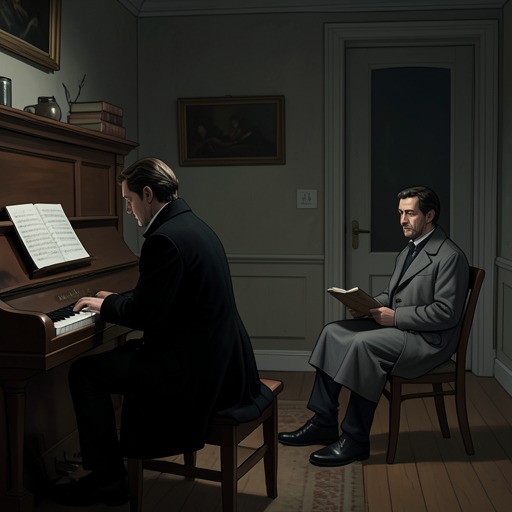
A later visit to hear Shozaburo perform offered Tony a rare encounter with his father’s work as an adult. Tony went with his wife to a Ginza nightclub, the first time since childhood that he had heard his father play in person. Shozaburo performed the same songs Tony remembered from the old days and maintained a smooth, elegant, sweet style: professional music capable of putting the audience in a good mood, though Tony did not consider it art. He drank considerably more than usual as he listened.
The performance also unsettled him. As he kept listening, the music seemed to fill him like a narrow pipe slowly clogging with sludge, until breathing and sitting still grew difficult. He sensed a minute but crucial difference between the music he heard in the club and the music he remembered from childhood. He wanted to go to the stage and ask his father what had changed, but could not explain even to himself what he meant. He did not approach him. Instead, he listened through the end of the set, drank whiskey and water, and applauded with his wife before going home.
The scene makes their difficulty of communication audible. Tony can recognize a difference in his father’s playing, but cannot turn that recognition into a question Shozaburo could answer. The past returns not as a shared conversation but as a comparison inside Tony: the remembered music and the present performance are almost alike, yet the gap between them feels decisive.
Death, Inheritance, and What Remains
Two years after Tony’s wife died, Shozaburo died of liver cancer. His illness caused little suffering and his hospital stay was short; he died almost as if falling asleep. The father who had once been unable to process his own wife’s death thus left his son with another loss, but the story does not describe a final reconciliation or a newly intimate exchange between them.
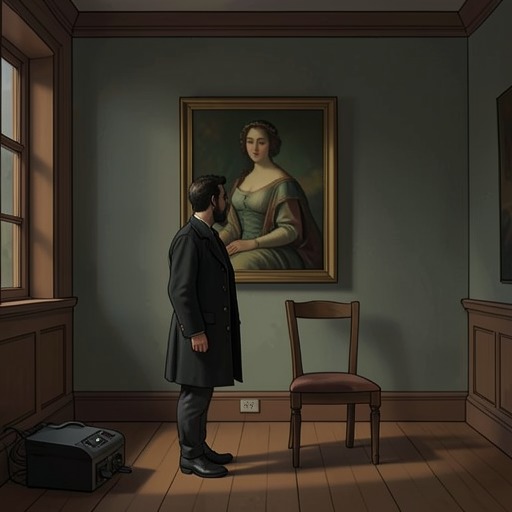
Shozaburo left little property beyond some cash, stock certificates, his instrument, and a huge collection of old jazz records. Tony kept the records boxed by the moving company and stacked in the empty room. Their moldy smell forced him to open the windows from time to time, but he otherwise avoided the room. After a year, the collection’s continued presence began to trouble him: merely thinking of the boxes made it hard to breathe, and sometimes he woke at night and could not return to sleep. His memories of the past had grown indistinct, but they still carried weight.
Tony eventually asked a used-record dealer to make an offer. The collection included valuable, long out-of-print discs, and the payment was high enough to buy a small car. The money meant nothing to him. The transaction therefore reads less as a financial gain than as a practical response to an inheritance that had become oppressive. The records had preserved Shozaburo’s musical life in material form, but their presence also kept the past in the house as a weight Tony could not simply ignore.
The Shape of the Bond
The father-son relationship is defined by what passes between generations without becoming explicit speech. Shozaburo’s choice of Tony’s name, his solitary household, and his work as a band musician all shape the conditions of his son’s upbringing. Tony, in turn, encounters his father through childhood memories of music and later through the jazz records left behind. Yet neither man turns these connections into a direct account of what he feels for the other.
The nightclub performance is the clearest instance of their unspoken connection and its limits: Tony recognizes his father’s music, notices how it differs from memory, and wants to ask about that difference, but remains silent. After Shozaburo’s death, the records make the inheritance concrete, while the effort to sell them shows that possession alone cannot restore intimacy. Their bond is therefore neither an uncomplicated closeness nor a clean break. It is a relationship of parallel solitude, sustained by shared history and material traces, in which understanding arrives in flashes but does not become conversation.