Tony Takitani’s wife’s death in a car accident
Blind Willow, Sleeping WomanTony Takitani’s wife’s death in a car accident turns her attempt to restrain her compulsive clothing purchases into an abrupt, irreversible loss. After returning a coat and dress to a boutique, she is struck by a truck at an intersection; Tony is left to confront her enormous wardrobe and the absence that gradually outlasts even his memories of its contents.
The Return and the Collision
Tony’s wife loves and respects her husband, and recognizes the force of his practical objection: she has only one body and does not need so many clothes. After a week spent trying to stay away from clothing stores, she contacts one of her favorite boutiques to ask whether she can return a coat and dress bought ten days earlier and never worn. The boutique agrees, in part because she is one of its best customers.
She puts the garments in her blue Renault Cinque and drives to fashionable Aoyama. After returning them for credit, she hurries back to the car without looking at other shops and drives straight home. At first, the return seems to bring a feeling of lightness. Waiting at a red light, however, she cannot stop recalling the clothes’ colors, cut, and texture. Her forehead breaks into a sweat; she grips the steering wheel, takes a deep breath, and closes her eyes. When she opens them, the light has turned green, and she instinctively accelerates.
A large truck attempting to cross the intersection on a yellow light slams into the side of the Renault at full speed. She dies without feeling the impact. The accident follows her brief effort to resist her longing for the clothes, but the account does not assign her death a moral cause: the truck’s collision, rather than a deliberate choice or a reckoning, ends her life.
Tony and the Clothes Left Behind
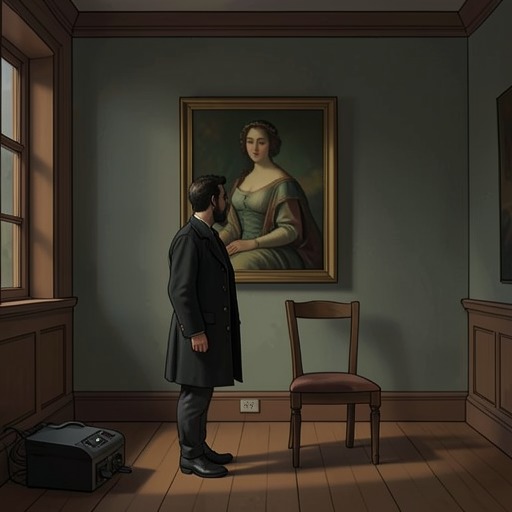
The death leaves Tony with a room full of size-seven dresses and 112 pairs of shoes, a material remainder too extensive for him to know how to manage. He sells at least the hats and accessories to a dealer for the first price offered and burns the stockings and undergarments in the garden incinerator. The dresses and shoes remain where they are. After the funeral, Tony shuts himself in the enormous walk-in closet and spends the day staring at clothes that fill every available space.
Ten days later, he advertises for a female assistant, specifying dress size seven, a height of about 161 centimeters, and shoe size 22 centimeters. The unusually high salary brings thirteen applicants to his Minami-Aoyama studio-office. He rejects five who appear to be lying about their dress size and chooses, from the remaining eight, the woman whose build most closely resembles his wife’s. He proposes that she wear his wife’s clothes as a kind of work uniform, explaining that he needs time to adjust to his wife’s absence. The proposal is an attempt to manage his grief through the wardrobe, but it also makes the clothing—and the dead woman’s place in Tony’s daily life—impossible to treat as ordinary possessions.
Eventually Tony has a used-clothing dealer take every garment away. The dealer pays less than one-twentieth of what Tony had spent, but the price no longer matters: he wants the clothes gone to somewhere he will never see them again. He leaves the emptied room bare for a long time, returning occasionally to sit on the floor and stare at the walls and the shadows left by what is no longer there.
Aftermath and the Persistence of Absence
As months pass, Tony loses the ability to recall the clothes’ colors and smells, and the emotions he once associated with them retreat from memory. His recollections shift and fade until each seems only the shadow of another. He sometimes can barely remember his wife’s face; what remains most tangible is the sense of absence. Yet the memory of the assistant crying among the dresses persists, including her unremarkable face and worn patent-leather shoes. Tony does not want to recall the scene, but it returns even after he has forgotten the woman’s name.
The accident thus continues beyond its immediate aftermath in the changing character of remembrance. The wardrobe first makes the loss physically overwhelming; once it is removed, the room’s emptiness becomes another form of evidence. Neither the clothes nor the attempt to reproduce their presence can restore Tony’s wife. What remains is not a stable image of her but the feeling of what has disappeared.