World War II
Blind Willow, Sleeping WomanWorld War II appears less as a single battlefield narrative than as a force entering private lives through distance, imprisonment, loss, and memory. Its central personal account follows Shozaburo Takitani, a Japanese jazz trombonist who spent the war in Shanghai, survived imprisonment after it ended, and returned to a Japan where his family had vanished. A later conversation on Kauai links another family’s bereavement to wartime death, while the narrator places the 1960s in the longer shadow of historical upheaval.
War at a Distance
Before the war, Shozaburo left Tokyo for Shanghai, where he built a life around playing trombone. During the conflict—from Japan’s invasion of China through the attack on Pearl Harbor and the atomic bombings—he continued performing in Shanghai nightclubs. The war, as he experienced it then, seemed to be happening elsewhere: he had little interest in history and concentrated on music and the daily conditions of his life.
His position was made possible in part by connections with influential figures, including Japanese Army officers and Chinese millionaires who profited from the war. These acquaintances looked after him, and his life in Shanghai remained comparatively comfortable. The contrast between that ease and what followed makes his apparent distance from the conflict temporary rather than secure.
Imprisonment and Return
After the war ended, Shozaburo’s associations drew the attention of the Chinese Army, and he was imprisoned for a long time. Other Japanese prisoners were taken from their cells and executed without trial. Shozaburo believed he might share their fate, but accepted the possibility of death without panic, thinking that he had lived as he wished and had little reason to complain. He passed the hours watching clouds through the small window and recalling the women he had known.
Ultimately, he was one of only two Japanese prisoners to leave the prison alive and return home; the other survivor, a high-ranking officer, had nearly lost his mind. On the repatriation boat, Shozaburo watched Shanghai recede and reflected that he would never understand life. His survival was a reversal, but not a restoration of what the war had taken.
He reached Japan in the spring of 1946, nine months after the war ended, emaciated and without possessions. His parents had died when their home was destroyed in the Great Tokyo Air Raid of March 1945, and his brother had disappeared on the Burmese front. Shozaburo was now alone. He felt an absence, but did not experience a dramatic outpouring of grief; solitude seemed to him an eventual condition of life. At thirty, he felt that he had aged several years at once, then turned toward the practical task of living on.
Aftermath and Historical Memory
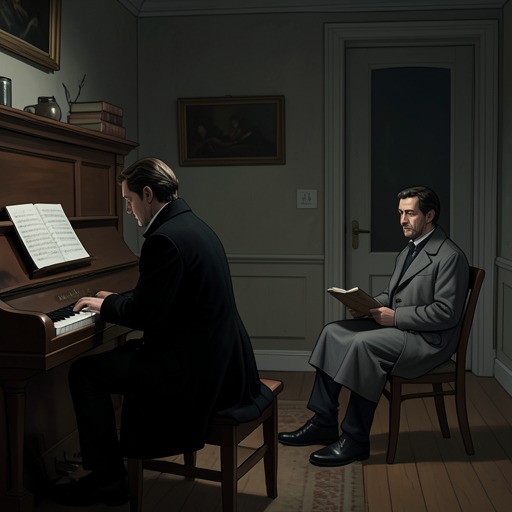
Shozaburo returned to the only work he knew, assembling a small jazz band to play at American military bases. A jazz-loving American army major helped him obtain records and scarce food, and the two played music together. This new livelihood shows how the aftermath of war reorganizes ordinary life: survival leads not to a return to the past, but to a different network of work, friendship, and material support.
The book also connects wartime loss to memory passed between generations. On Kauai, Officer Sakata tells Sachi that his brother died in Belgium in 1944 while serving with the 442nd Regimental Combat Team, a Japanese American unit sent to rescue a surrounded Texas battalion. His brother’s death changed their mother so profoundly that Sakata knew her only after that change. His account gives Sachi a family history of bereavement to hear alongside her own grief, and frames death as part of nature rather than as the property of any political cause or side.
The War’s Place in the Book
The war also forms a historical backdrop to the narrator’s account of growing up in the 1960s. Born in 1949, he entered college in 1967 and reached twenty amid the student movement, describing the decade as energetic, immediate, and unusually easy to grasp. He names his interpretation of that era “A Pre-History of Late-Stage Capitalism,” suggesting a transition from a world in which cause and effect seemed direct to one burdened by convoluted choices and hidden complications.
In another recollection, the narrator describes his circle of young men as absorbed in sex, rock music, films, political movements, and literature, barely noticing a devoted school couple nearby. The war is not the direct subject of that youthful scene; rather, the contrasting passages place individual experience within changing historical eras. Across these accounts, public history becomes legible through what remains in private life: an absent family, a mother altered by loss, a survivor’s uncomprehending return, and a generation trying to name the age it inherited.