the seventh man
Blind Willow, Sleeping WomanThe seventh man is an unnamed, middle-aged speaker whose childhood survival of a giant wave leaves him with lifelong trauma after his friend K is swept away. For decades he avoids the sea, his hometown, and the possibility of sharing a life with someone, while nightmares repeatedly return him to the loss. His eventual return to the beach, prompted by K’s watercolors, brings the story to a quiet but consequential ending: the nightmares stop, and he begins to imagine a life no longer governed by fear.
Identity and Introduction
The seventh man speaks last in a small group gathered at night. The clock has passed ten; wind moves around the house as the listeners wait for him to continue. He appears to be in his midfifties: tall and thin, with a mustache, short hair marked by stiff white patches, and a short, deep-looking scar beside his right eye. He wears a blue shirt beneath a gray tweed coat and repeatedly brings a hand to his collar. No one present knows his name or occupation. His face seems to have carried its difficulty finding words for so long that the expression has become part of him.
He begins by saying that a huge wave nearly swept him away when he was ten, one September afternoon. The wave, he explains, took from him what mattered most and sent it beyond reach; recovering from the experience cost him years that could never be replaced. He presents the wave as the particular form his fear took, not as a danger that must appear in the same form for everyone. The framing establishes a distinction between surviving an event physically and recovering from what it leaves behind.
Childhood, K, and the Wave
As a boy, the seventh man had been strong and athletic, and he often protected K, who was frail, pale, and affected by a speech impediment. K struggled with most school subjects, but his talent in art was unmistakable. His seascapes won prizes, and the seventh man remembers sitting beside him at the shore, watching him transform blank paper into lively shapes and colors with swift, precise brushstrokes. The boys’ friendship was bound not only to protection but to the shared time spent looking at the same coast.
The disaster arrives during a severe typhoon. The family prepares for evacuation: storm doors are nailed shut, provisions are cooked, water is stored, and important possessions are packed. To the adults the storm is a recurring threat; to the children it initially seems like an exciting spectacle. After the wind briefly stops, the seventh man’s father identifies the pause as the eye of the storm and warns that the wind will return. The boy is allowed outside on the condition that he stay close and come back at the first sign of wind.
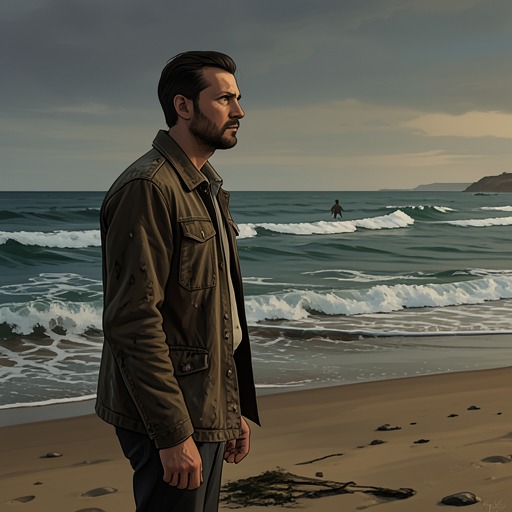
At the beach, the seventh man realizes that a wave is coming and knows he should run to K, who is absorbed in something on the sand. Fear overwhelms that intention: he runs alone toward the breakwater, then turns and shouts for K to escape. By then the wave is too close. It rises behind K, blocks the sky, and sweeps him away. The seventh man survives by ducking behind the breakwater; spray wets his clothes, but he is otherwise untouched. When he looks back, the shore is empty, with no trace of K or the dog.
He stays on the dike because he knows that large waves can arrive in twos or threes. A second wave follows, and he remains rooted to the seawall. The account makes his survival inseparable from his memory of running away from K before trying to warn him: the boy knew what he ought to do, yet fear sent him in the opposite direction. The loss is therefore both the sudden absence of his friend and an enduring confrontation with his own response.
Avoidance and the Long Aftermath
By the end of that year, the boy begs his parents to let him leave the town. He cannot bear to live within sight of the beach, and the nightmares will not stop. His parents arrange for him to live with his father’s family in a mountain village near Komoro, in Nagano Prefecture. He moves there in January, finishes elementary school in Nagano, and remains through junior and senior high school. He never returns home even for holidays, though his parents visit from time to time.
He stays in Nagano as an adult, graduates from an engineering college in the city, and works for a local precision-toolmaker. He describes an outwardly ordinary existence: he has a few friends with whom he climbs mountains, but is not sociable. The nightmares ease after he leaves his hometown, yet never disappear. They return in identical detail whenever he is close to forgetting, waking him screaming with his sheets soaked in sweat.
The fear shapes his relationships and daily choices. He believes this is probably why he never married: he could not bear to wake a sleeping partner with his screams. Although he falls in love with several women, he never spends a night with any of them, feeling that the terror in his bones cannot be shared. For more than forty years he avoids his hometown and that beach, and also stays away from other shores, swimming pools, deep rivers, and lakes. He avoids boats and will not travel abroad by plane. These precautions do not remove the image of drowning; the imagined threat remains with him despite his attempts to organize life around avoiding it.
Return, K’s Paintings, and Recovery
The change begins after his father dies of cancer and his brother sells the old house. While sorting the storage shed, his brother finds a cardboard carton of the seventh man’s childhood belongings and sends it to Nagano. Inside is a bundle of paintings K had made for him. At first the pictures renew the old terror: he fears that looking at them will make K’s spirit spring back to life, wraps them up again, and intends to throw them away. He cannot bring himself to do so. After several days, he opens the bundle and forces himself to look closely.
The watercolors depict familiar landscapes—the sea, sandy beach, pine woods, and town. Their vividness and skill bring back not only the loss but the boyhood world the friends once shared. As the seventh man studies them, he recognizes K’s way of seeing in his own memories: the boy who had walked beside K had looked at the world with the same lively, unclouded vision. The paintings thus reconnect him to a past that had been reduced to the moment of disaster, and to a part of himself that existed before fear took over.
Last spring, he finally revisits the beach. Sitting on the sand, he finds that the darkness within him has vanished. He walks into the surf without taking off his shoes or rolling up his cuffs, letting the waves wash over his ankles. The waves that once marked the site of his loss now touch him without provoking the old terror. He looks at the sky and remembers searching for the eye of the typhoon; then forty years collapse into a mingling of old and new time. He falls into the water and lies unable to stand, but is no longer afraid.
He reports that the terrible nightmares have stopped and that he is trying to begin life again, although he doubts he has much time left. He does not claim that the lost years can be restored. Instead, he is grateful to have reached a form of salvation before the end of his life, rather than remaining forever afraid and screaming in the dark.
Narrative Role and Meaning
The seventh man’s telling turns a private recollection into a warning addressed to the group listening to him. He rejects the familiar assurance that fear itself is the only thing to fear. Fear, he says, comes in many forms and can overwhelm a person; the greater danger is turning one’s back on it and closing one’s eyes. In his case, that refusal to face fear meant surrendering something precious to the wave. His conclusion does not erase his childhood failure or K’s death; it gives the experience a meaning grounded in the difference between enduring fear and allowing it to rule a life.
The structure of his story follows the delayed return of memory. The wave is first named as a devastating event, then recounted in the child’s divided moment of flight and warning, and later revisited through dreams, decades of avoidance, and K’s paintings. The paintings provide a route back to the beach that is not simply a repetition of the disaster: they restore K as an artist and companion, and restore the seventh man’s capacity to see the past as more than terror. His recovery remains limited and late, but the final change is concrete: he can enter the surf, the nightmares cease, and he can speak to others about the fear he once could not share.