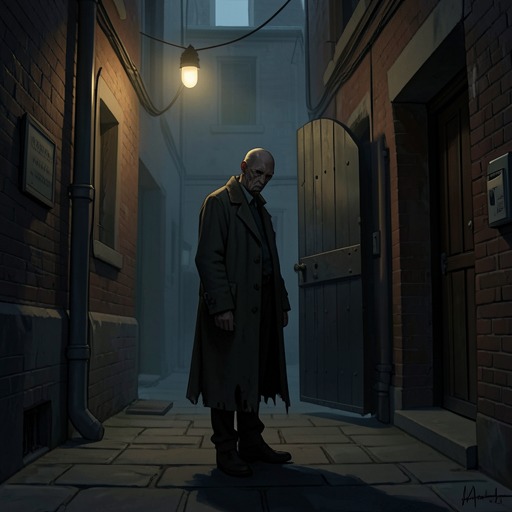
Child cat climbs pine tree and disappears
Blind Willow, Sleeping WomanThe childhood cat’s disappearance becomes a defining image of loss without an explanation: after watching the animal scramble into the top of a pine tree, the narrator never sees it again. Years later, he recalls the episode to Izumi, distinguishing his child-self’s conviction that the cat could not come down from her practical suggestion that it simply left while he was not watching.
The Cat and the Pine Tree
The narrator places the episode when he was in second or perhaps third grade. His family lived in a company house with a large garden, where an ancient pine tree rose so high that its top was difficult to see. One day he sat on the back porch reading while the family’s tortoiseshell cat played by itself in the garden.
The cat’s play gradually took on a frightening quality. It leapt about as though worked up over something the boy could not see, its fur standing on end. It raced repeatedly around the pine tree, then stopped abruptly and climbed toward the highest branches. From the porch, the boy could barely make out its small face near the top.
The cat remained tense among the branches, looking outward and ignoring the boy when he called. As evening darkened into night, he waited for it to climb down. It did not return, and the family never saw it again. The cat’s name also disappears from the narrator’s memory: when Izumi asks what it was called, he says he has forgotten.
Two Explanations for the Disappearance
Years later, the narrator tells the story to Izumi a few days after they have read an article about cats. She listens, asks what happened, and then offers an ordinary explanation: cats sometimes disappear, particularly when in heat; they become overexcited, lose their way home, and may climb down and wander off when nobody is watching. In her account, the cat’s disappearance requires no mystery.
The narrator accepts that explanation as possible, but recalls that as a child he was convinced the cat had decided to live in the tree. To him, there had to be a reason it could not come down. Every day he sat on the porch and looked up, hoping to glimpse the cat between the branches. The repeated vigil preserves the childhood belief even as the adult narrator can entertain Izumi’s alternative.
A Memory That Opens onto Absence
The story moves from a vivid, closely observed scene to an absence that cannot be resolved. The cat’s agitated movement is plain to the watching child, but what it sees remains inaccessible; its final destination is likewise unknown. The missing name deepens that gap: the narrator can recall the tree, the cat’s face, and his waiting, but not the word by which he called it.
After hearing the story, Izumi appears to lose interest, lights her second Salem, and asks the narrator whether he ever thinks about his child. The question shifts the conversation from a vanished childhood pet to parenthood, without explaining the connection. The cat’s disappearance thus remains both an episode in the narrator’s past and an unresolved image through which the conversation approaches another absence.