Cyclical hearing loss
Blind Willow, Sleeping WomanCyclical hearing loss is the cousin’s fluctuating hearing impairment, which began after a baseball struck him soon after he entered elementary school. His right ear is damaged, but the condition does not always prevent him from living an ordinary life: he attends a regular school, sits in the front row with his left ear toward the teacher, and keeps up academically. The impairment’s defining feature is its periodic worsening. At its most severe, hearing fails in both ears, forcing him to miss school, while the doctors who examine him can offer neither an explanation nor a treatment that changes the pattern.
Origin and Everyday Adaptation
The injury is described plainly, as one event in a childhood that led to a lasting but variable condition. The cousin’s right ear does not hear well; his left ear ordinarily compensates. In class he takes a seat at the front, on the right, positioning his better ear toward the teacher. This practical accommodation allows him to attend a regular school and lead what the narrator calls an entirely normal life most of the time. His hearing difficulty is therefore neither constant total deafness nor an impairment that makes ordinary participation impossible.
The distinction between his usual state and the episodes of acute loss matters. His hearing moves through periods in which he can hear fairly well and periods in which he cannot, a rhythm compared to the tides. Perhaps twice a year, the change becomes so pronounced that he can barely hear anything out of either ear. At those times, the silence in the injured ear seems to deepen until it overwhelms even the hearing on the left. Ordinary routines then fall away, and he has to take time off from school. The account gives no regular timetable beyond that approximate recurrence; its emphasis is on a condition whose severity shifts unpredictably.
Medical Uncertainty and the Clinic
The family seeks medical attention, but the condition remains unresolved. The doctors have not encountered a case like his and are stumped; they have nothing they can do. During the trip to the hospital, the cousin asks whether the treatments will hurt this time. The narrator cannot reassure him because he has not heard the details. The question conveys the repeated prospect of treatment without suggesting that an effective remedy has been found.
At the hospital, repetition itself becomes part of the cousin’s experience. He observes that it is the same everywhere: the same questions and the same tests. His flat tone and gaze lowered to his hands make the routine sound wearying, even though he does not say that the episodes frighten him. The book distinguishes between continued medical attention and medical understanding: examinations go on, but the doctors’ inability to classify or treat the unusual condition remains.
How the Episodes Feel
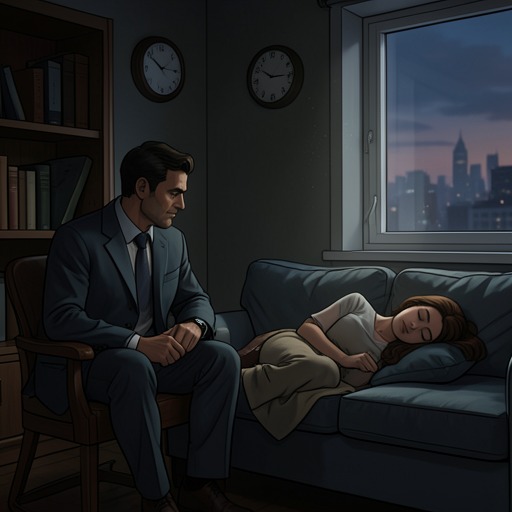
When the narrator asks what happens during a period of total hearing loss, the cousin explains that the change is not immediately apparent to him. Hearing disappears suddenly, but some time passes before he realizes what has happened; by then, he cannot hear a thing. He compares the sensation to being at the bottom of the sea with earplugs in. The image makes the experience more than a measurement of auditory capacity: the silence seems to envelop him, and he stresses that hearing loss is only one part of what it is like.
Asked whether it bothers him, he gives a short, definite shake of his head. He does not know why it fails to trouble him greatly, though he acknowledges that it is inconvenient. That response does not cancel the concrete disruption of missing school or enduring repeated tests. Instead, it preserves a difference between the cousin’s own account of his feelings and the narrator’s impulse to imagine what he cannot fully understand.
Family Distance and the Act of Listening
The cousin’s hearing loss shapes the conversation between him and the narrator, but their difficulty speaking is not attributed to the impairment alone. The narrator is twenty-five and has not seen his cousin for five years; the cousin, now fourteen, has grown from nine during that interval. The years have created a translucent barrier between them. The narrator wants to be kind and help him relax on the way to the hospital, yet repeatedly cannot find the right words. Each hesitation is met by the cousin’s slightly confused look and the subtle turn of his left ear toward the speaker.
Their exchanges show how listening becomes a practical and relational act. The narrator carefully repeats that a watch is cheap but keeps good time, looking directly at his cousin. The cousin, in turn, talks about the expensive watch he once owned, which was inaccurate and which he lost a year after receiving it for junior high; his family will not buy him another. He asks the narrator what time it is, and the narrator answers precisely. These small exchanges place the hearing condition within ordinary conversation, alongside the cousin’s wish to keep track of time and his difficulty doing so without a watch.
After they have laughed together over a conversation about a film, the cousin speaks as if unburdening himself and asks the narrator to look inside his ears, clarifying that he means only what can be seen from the outside. The request brings the impairment into direct view, but does not turn the narrator into a doctor or offer a diagnosis. It is a modest gesture of trust between relatives whose closeness has been interrupted by years apart. The cousin’s left ear tilts toward the narrator; the narrator, who has struggled to speak, is asked instead to look.
Narrative Significance
The account holds ordinary adaptation, recurring disruption, and unanswered medical questions together without reducing the cousin to a diagnosis. His impairment has tangible consequences: he arranges his place in class around his stronger ear, sometimes has to leave school, and returns to examinations that feel repetitive. At the same time, his own description is measured. He calls the episodes inconvenient and cannot say why they do not bother him more, while the narrator admits that he cannot picture the sensation of being underwater in silence.
That gap between bodily experience and another person’s imagination is part of the subject’s significance. The impairment prompts care and attention, yet it does not dissolve the broader reserve between the cousins. The narrative’s precise details—the changed seat, the tilted ear, the recurring tests, the approximate twice-yearly episodes—make the condition legible in daily life while leaving its underlying cause and its full subjective meaning uncertain. Its defining pattern is not a single crisis followed by recovery, but a return: periods of workable hearing interrupted by deeper silences that neither family nor medicine can fully explain.