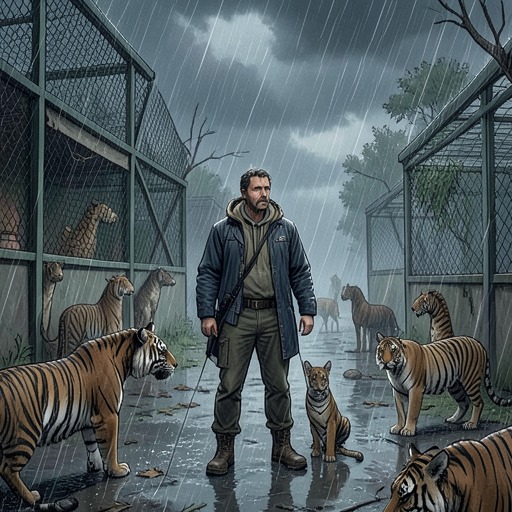
Going to the zoo during a typhoon
Blind Willow, Sleeping WomanGoing to the zoo during a typhoon is the narrator’s friend’s decade-long ritual of leaving home as a storm approaches to watch the animals. Sometimes he finds only locked gates; when the zoo is open, he visits the cages with beer in his pockets, attentive to how the animals behave in conditions that send most people indoors.
The Habit and Its Setting
The friend lives about a fifteen-minute walk from the zoo and has been making the trip whenever there is a typhoon for ten years. While other people shut their windows, stock up on mineral water, and check their radios and flashlights, he puts on a Vietnam-era army-surplus poncho, takes a couple of cans of beer, and sets off. The contrast is not presented as a practical response to the weather: the visit itself is what he insists on doing.
The outing depends on whether the zoo admits visitors. If it is closed because of the weather, its gates are locked, and the friend cannot see the animals. He sits on a stone squirrel statue beside the entrance, drinks his beer while it is still lukewarm, and then walks home. Even this failed visit has a familiar shape: the journey, the wait outside, and the return.
Inside the Zoo
When he arrives in time to enter, he pays the admission fee, lights a cigarette dampened by the rain, and looks at the animals one by one. Their responses vary. Many have withdrawn to their shelters; some stare at the rain without reacting, while others move energetically in the strong winds. A sudden change in barometric pressure frightens some animals and makes others vicious. The friend’s attention is directed toward these differences, not toward escaping the storm.
He has a set order for his beers. The first is drunk outside the Bengal tiger cage, because the tigers react most violently to storms. The second is taken to the gorilla enclosure. The gorillas are usually undisturbed: they watch him calmly as he sits on the concrete floor and drinks. Their composure contrasts with both the tigers’ agitation and the weather outside, making the gorillas’ quiet regard the ritual’s most striking encounter.
The Friend’s Explanation
The friend describes the experience as comparable to being trapped in an elevator with strangers. The comparison gives the zoo visit a social dimension: he is not simply watching animals from a safe distance, but placing himself among beings confined together by circumstances none of them controls. The animals cannot leave their enclosures, and he has chosen to be there; that difference remains, even as the storm briefly makes their shared enclosure feel like the point of the visit.
Outside these typhoon outings, the friend leads an ordinary, orderly life. He works managing foreign investments for an export company, lives alone in a neat apartment, and has a new girlfriend every six months, always for precisely that length of time. He owns Balzac’s collected works and a black suit, tie, and shoes that the narrator borrows for funerals. The zoo ritual stands apart from these recognizable routines: it is his unusual way of spending time in a place where the weather changes everyone’s behavior, while his own pattern persists.
Repetition and Meaning
The visit is built from repetition rather than a single decisive episode. The friend returns whenever a typhoon comes; each time, the zoo may be inaccessible, or it may offer another circuit of observation. The locked-gate version and the successful visit both belong to the same habit, and the distinction between them is not whether he reaches the animals but whether he can carry out the familiar act of looking.
The ritual also makes the animals’ varied reactions legible against one another. The tigers’ agitation, the gorillas’ composure, and the different responses of the other animals turn the storm into a test of behavior without making the friend an interpreter of it. He watches, drinks, and leaves. The account’s quiet ending at the gorilla cage preserves that reserve: the gorillas seem almost to pity him, but this is the narrator’s impression, not an explanation of the friend’s motives. What the story establishes is the persistence of his choice—to keep going to the zoo when a typhoon arrives, and to find company there among strangers who face the same weather.