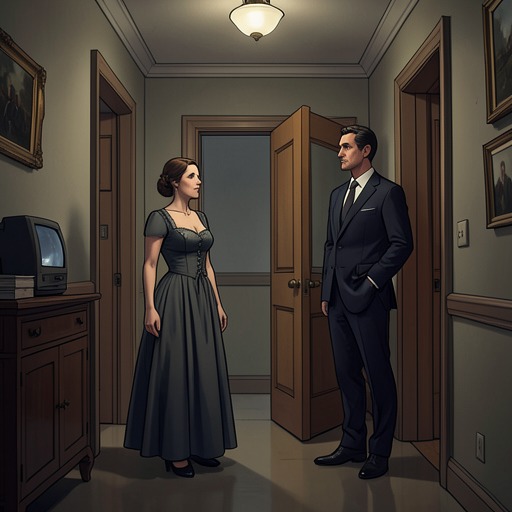
Hikosato's final reunion with her high school lover
Blind Willow, Sleeping WomanThe last reunion between Yoshiko Fujisawa and her former high-school boyfriend transforms a long-held promise into a farewell rather than a new beginning. When Yoshiko contacts him after more than a decade apart, he is single, newly self-employed, and under pressure from a failing business. She invites him to her home and reminds him of the promise she made during their youth: after she married, she would sleep with him. He goes to see her, but they do not have sex. Their restrained closeness acknowledges what they once shared while confirming that the future they might have had together has passed.
Background and the long separation
The two had dated for four years. After graduating, Yoshiko’s boyfriend joined a trading company and worked there for five years, including a period overseas. Two years after graduation, his mother told him that Yoshiko had married. He did not ask whom she had married. His first thought was whether Yoshiko had remained a virgin until marriage; sadness followed, growing stronger the next day as he recognized that a significant part of his youth had ended. He had loved her and continued to hope that they might someday marry, but decided he could accept her marriage if she was happy. His concern for her remained, because he believed she had a fragile side.
By the time Yoshiko called, he was twenty-eight and had been single since leaving the trading company to start a small imported-furniture business. He had borrowed money from his father, convinced the market was about to expand, but the venture faltered: orders arrived late, goods remained unsold, warehouse fees accumulated, and loans still had to be repaid. He describes this as the hardest period of his life, one that had worn him down and shaken his confidence. Yoshiko’s call, one evening around eight, arrived in the middle of that strain. He recognized her voice immediately, and hearing it brought back their shared past and made him feel better.
The promise that brings them together
They spoke at length, with an openness he had not expected. When the conversation reached a deep silence, he wanted to end the call by thanking Yoshiko for contacting him. Instead, she invited him to her home: her husband was away on a business trip, and she was alone. After a further silence, she reminded him that she had not forgotten the promise she had made.
The promise concerned sex after Yoshiko’s marriage. He had never treated her youthful statement as a binding agreement; he thought it had been an impulsive remark made in confusion. He now understood that she had meant it seriously. The invitation placed him between a powerful desire and an equally clear sense of danger. He had often imagined being with her after their breakup, but believed acting on that desire could be destructive and incompatible with who he was. Even so, he agreed to go. The prospect felt to him like a rare, almost fairy-tale encounter: his beautiful former girlfriend, with whom he had spent his youth, was inviting him to her home nearby and invoking a promise made long ago.
The visit and the choice not to have sex
He went to Yoshiko’s home, privately hoping as he knocked that she might not be there. She was there, and he found her as beautiful as he remembered. They had drinks, talked, and listened to old records. The meeting brought the old intimacy close, but did not simply restore their former relationship.
They held each other, but did not have sex or undress. Instead, they touched as they had in the past, and remained together that way for a long time. He understood this restraint as the best choice, and believed Yoshiko reached the same conclusion. Their physical closeness became a way of recognizing what they were meant to understand about their present circumstances. In his account, the possibility of a life in which they had continued together belonged to an earlier time; that possibility had already closed, and could not be reopened by fulfilling the old promise.
Farewell and aftermath
He stayed for about an hour. Any longer, he felt, might have overwhelmed him. At the door Yoshiko stood with her arms folded, seeming about to say something but not speaking. He understood the silence as part of their final farewell. After leaving, he felt hollow and disoriented: sounds seemed strange, the world looked distorted, and he wondered whether his life had been pointless. He wanted to turn back and return to Yoshiko, but knew he could not.
That night he paid for sex for the first time in his life, and believed it would probably be the last. The account does not present this as a resolution of his feelings. Rather, the action follows the emotional emptiness of leaving and remains separate from the connection he had just experienced with Yoshiko. Later, he recalls their meeting through the line from a childhood fairy tale, “And when it was all over, the king and his retainers burst out laughing.” The strange, comic ending becomes a reflexive accompaniment to his memory of an event that was deeply sad. The narrator concludes that there is no moral or lesson to extract from what happened, and says he could not laugh when the story was told to him and still cannot.
Narrative significance
The reunion is shaped by the contrast between a promise made in youth and the changed lives of the people who made it. Yoshiko has married; her former boyfriend has built a separate life and is attempting to establish a business, even as it falters. Their old desire remains present, but neither treats desire as sufficient reason to erase the time and choices between them. Their restraint makes the farewell definitive: intimacy allows them to recognize the bond, while also marking that its former possibilities are gone.
The fairy-tale line gives the memory an unresolved tonal edge. Its laughter does not undo the sadness; instead, it captures how an event can feel at once emotionally serious and strangely absurd when recalled. The story’s emphasis is not on a lesson learned or a relationship renewed, but on the difficult recognition that a cherished past cannot be made present again simply by honoring an old promise.